Realtors, Here's Everything Google Shared About Optimizing for AI Search...

The most quoted document in SEO this month is Google's new "Optimizing your website for generative AI features on Google Search." It is being passed around LinkedIn as gospel. 

It also contains, in plain sight, an admission that Google thinks the entire real estate industry has been producing the wrong kind of content for fifteen years.

The guide defines "commodity content" (the type AI search will not reward) with one specific example: "7 Tips for First-Time Homebuyers." It defines "non-commodity content" with another: "Why We Waived the Inspection & Saved Money: A Look Inside the Sewer Line." 

Both examples are real estate. Of every vertical Google could have picked to illustrate the difference between the content AI rewards and the content it ignores, they picked ours. 

Twice.

Sit with that for a second. 

The largest search company in the world has now told real estate, in writing, that the dominant content pattern of the last decade no longer works. Google's mythbusting section will get a lot of attention this month. The fact that they picked our industry as the cautionary tale won't.

I think the cautionary tale is more important than the mythbusting. And I think most of the mythbusting, taken at face value, will get real estate brands cited less in 2026, not more.

What Google Said About AI Search (GEO, AEO…)

The guide makes three moves. It tells you the rules haven't changed: optimising for AI search is still SEO. It gives you five things to stop doing:

Then it tells you the one thing that does matter, which is creating unique, expert-led, non-commodity content.

Two of those five myths are right. Three of them are right only if Google is the only AI model that matters to you. And the non-commodity-content principle is the most important thing in the guide by a wide margin, except that the way it's being read in real estate is going to produce more commodity content, not less.

I want to take the guide seriously, because the parts that are right are very right. I also want to be specific about where it stops being useful for realtors, team leads and brokerages, which is roughly the moment Google's interests stop overlapping with yours.

"It's Just SEO" Is a Budget Argument, Not a Technical One

Google's framing is that "AEO" and "GEO" are not new disciplines… They're SEO under different names. 

This is the line being amplified loudest, and it has a structural cost that most brokerages haven't priced.

Inside a brokerage, the line item is the argument. When the marketing director walks into the budget meeting and says "AI search is the same thing as SEO," the next thing that happens is the SEO retainer absorbs the work. 

The agency keeps the same headcount, runs the same monthly content production, and now also handles citation tracking across five different AI platforms, agent profile optimisation inside Zillow's AI mode, ChatGPT app surfacing for Realtor.com, Perplexity index hygiene, and the entirely separate measurement problem of figuring out which of those is driving inbound business. Same money. Three times the surface area.

The skill set has diverged whether the title has or not. The traditional real estate SEO toolkit is keyword research, MLS feed hygiene, on-page optimisation, schema, local citations, and link building. The work of getting cited in AI search adds passage-level content engineering, entity disambiguation across third-party platforms, brand presence work on sites you don't own (Reddit, Wikipedia, local press, third-party guides), and the ongoing surveillance of how four or five different retrieval systems are interpreting your brand.

There is overlap with classic SEO. There is also vast new surface area that has never appeared on a brokerage SEO scope of work.

This matters because of how brokerage marketing budgets move. A team leader who allocates $4,000 a month for SEO is not going to triple it because Google said the work was the same. They will hand the existing retainer the new work, watch the existing rankings slip because the agency is now stretched across five platforms, fire the agency, and conclude that AI search "doesn't work." Meanwhile the team across town who treated AI search as a separate line, hired a separate specialist, and ran a different playbook will be on the citation list for every buyer query in their market.

This is not theoretical. In FlyDragon's 2026 ‘State of AI Search’ benchmark of 12,400 AI responses across 192 metros, 91% of US agents are effectively invisible in the AI search engines their buyers now use. Buyer-side searches starting in an AI engine rather than a traditional one have hit 61.3%. The agents who started AI search work in early 2025 hold 5.7× the citation share of agents who started the same work twelve months later, despite the latter group spending more.

My read on those numbers: the gap between the cited agents and the invisible ones is not about who is doing better SEO. It is about who treated AI search as a separate problem early enough to build a separate operating budget around it. The "it's just SEO" framing is not a clarification. It is the move that keeps the work uncompensated, which is great for Google and lousy for the agents and brokerages funding it. 

I think by Q4 2026 there is a hard split between brokerages with a line-item AI search budget and brokerages without one, and the gap will be visible in lead cost.

Google Wrote a Manual for Google, Not for ChatGPT, Perplexity, or Grok

Here is what makes the "still SEO" framing especially misleading in real estate specifically: Google's guide describes an AI model that has the lowest AI Overview trigger rate of any major US industry.

According to the 2026 Luxury Real Estate AI Discovery Report from Stepps and 5WPR, real estate triggers Google AI Overviews 0.14% of the time. Health triggers them at 13%. Finance at 4.2%. Retail at 2.1%. Real estate, the largest single asset class in the American economy, sits at one-thirtieth of retail. 

Whatever Google's AI Overviews are doing for other industries, they are not yet doing for ours at a meaningful scale.

Which is the first reason this document should not be read as advice for ChatGPT, Perplexity, Grok, or Claude. It is conveniently aimed at Google. The other large language models — the ones your buyers are increasingly typing into before they ever open Google — retrieve from entirely different substrates, with entirely different incentives, and Google's guide does not speak for any of them.

Here is what the retrieval map looks for different LLMs:

ChatGPT uses Bing as its primary search partner, supplemented by direct content deals with publishers. When a buyer asks ChatGPT for an agent in your market, the system is sending rewritten sub-queries to Bing's index and pulling from OpenAI's contracted publisher set. 

Optimising for Google does very little for you here. Optimizing for Bing (the engine the SEO industry has ignored for fifteen years, including me) matters again, suddenly, for a different reason than it ever mattered before.

Perplexity uses a blend of Bing, third-party Google data, and a proprietary index it now exposes as a developer API. 

The substrate is partly Google-adjacent and partly its own crawler stack. Citations on Perplexity routinely surface content that does not rank in either Google or Bing's top 10, because Perplexity's reranking treats source diversity as a feature.

Grok retrieves from two distinct layers: a real-time web search with no public dependency on Google's index, and a live feed of public X posts. 

For real estate, the X layer is the part most agencies are not thinking about — agents publicly active on X with named transactions and identifiable thread history have a substrate advantage on Grok that no amount of website SEO will replicate.

Claude uses Brave Search as its primary live retrieval layer. Brave's index is independent of both Google and Bing, with its own crawler and its own ranking signals. Content that ranks well in Google can be invisible to Brave, and therefore invisible to Claude.

Five LLMs. Four different retrieval substrates. 

Optimising for Google's index is optimising for exactly one of them, in the vertical where Google's AI surface fires least often.

Stanford's 2026 research captured the directional shift directly: in July 2025, 76% of AI-cited URLs ranked in the organic top 10. By February 2026, only 38% did. The rest came from positions 11–100 and beyond. 

AI is finding authoritative content from across the web, not just the top of Google's index — and "the web" here means four different indexes operated by four different companies with four different definitions of authoritative.

A guide that describes one of those indexes, written by the operator of that index, telling you that index is the same thing as the other four, is not neutral guidance. It is product positioning. 

Read it as that.

Chunking Is Wrong As a Slogan. It's Right As a Format.

Google's most-quoted line in the mythbusting section is that you don't need to chunk content. The implication, repeated approvingly across SEO LinkedIn this month, is that you should write naturally for humans and trust the systems to figure out the rest.

The technical reality is different, and it matters more in real estate than in almost any other vertical. 

RAG (Retrieval Augmented Generation) systems do not retrieve pages. They retrieve passages. A passage is a chunk of text. A few sentences, a paragraph, a section that the retrieval system scores against the user's search.

The chunking happens regardless of whether you optimised for it. The question is whether your content survives the chunking process with meaning intact, or whether it shatters into incoherent fragments that lose retrieval comparisons to your competitor's tighter content.

Bing has been publishing the opposite of Google's position on this for months. 

In their May 2026 update on the evolving role of the index, Bing's team stated plainly that "chunking and transformations must preserve meaning and claims used in the answer." The unit of value, they said, is shifting from documents to groundable information — discrete, supportable facts with clear provenance.

The form factor where this matters most in real estate is the neighborhood guide. The neighborhood guide is the workhorse asset of every brokerage content marketing program in the country. 

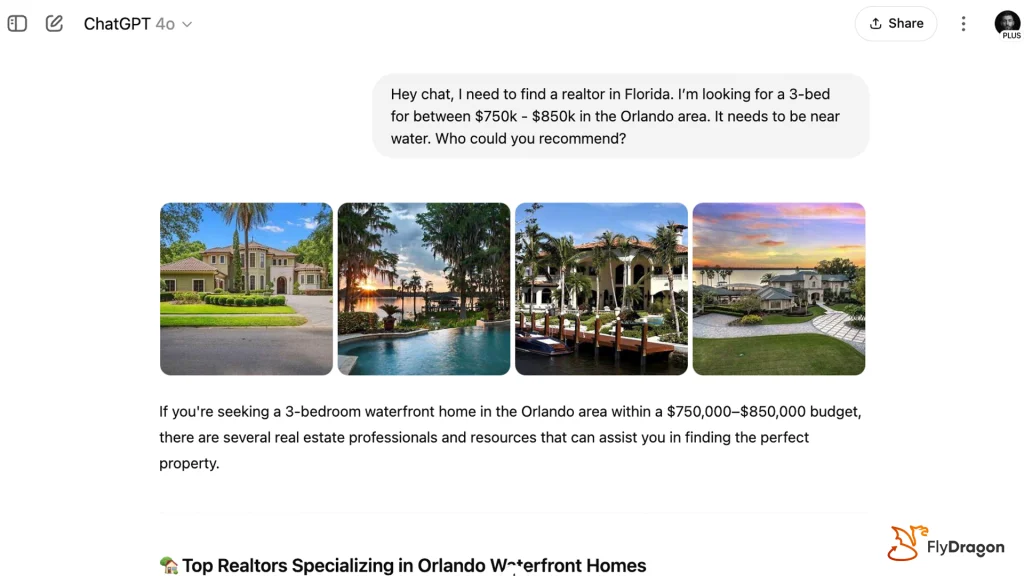
It’s also where most real estate content fails passage-level retrieval, because the standard format is a single page that tries to cover ten neighborhoods with three sentences each, then loops the same generic structure for the next city. When a buyer asks ChatGPT "Is Mueller a good neighborhood for families with kids and a dog?" The retrieval system pulls passages, scores them on semantic matches, and selects the passage that most tightly answers the specific question. 

A page covering ten neighborhoods at the same density loses every time to a page covering Mueller specifically.

Google is right that you shouldn't break content into 50-word answer blocks. That advice was always dumb, and it produces content humans don't want to read. But the deeper principle — that passages are the unit of retrieval, and that one tight, self-contained passage beats three loose ones every time — is the most important format change in real estate content since the move to mobile. 

Calling it "chunking" makes it sound like a tactic. 

Calling it passage-level structure makes it sound like what it is: a basic constraint of how the systems work.

"Don't Rewrite for AI" Is the Lie That Will Cost Agents the Most

Google says you don't need to write differently for AI. AI systems, the guide claims, understand synonyms and general meaning. Just write naturally and trust the system.

I disagree with this for one specific reason in real estate, and I'd put real money on it: most agent content fails AI retrieval not because of word choice, but because of entity ambiguity.

Read a hundred agent blogs at random. Count how many times you see the phrase "great schools" without a named school district. "The luxury market" without a defined price floor. "This neighborhood" without a named neighborhood. "We've helped many buyers" without a named transaction, ZIP code, or year. 

The content is technically natural language. It is also, from a retrieval system's perspective, almost entirely ungrounded (and identical).

AI retrieval is entity-anchored. The query is parsed into entities. The candidate passages are scored on entity match. A blog post that says "I help families find homes in great school districts in the Austin area" has roughly three retrievable entities: families, Austin, school districts. 

A blog post that says "Last month I closed a $785,000 four-bedroom in Mueller for a family relocating from San Jose, where the buyer specifically needed walking distance to Maplewood Elementary" has fifteen. 

When the retrieval system is choosing which passage to surface for "Mueller homes near good elementary schools," the second post wins by a margin that isn't even close.

This is what Google's "don't rewrite for AI" framing obscures. 

You don't need to write in a special AI dialect. You absolutely do need to write with named entities, specific transactions, and dollar amounts woven into prose at a density that most real estate content has never approached. 

Three principles I would tell every internal writer or editor at any brokerage are:

Google's guide will not tell you any of this, because the guide's authors are not building real estate agent websites for a living. 

The retrieval math is the retrieval math regardless.

The One Thing Google Got Right, and Where Real Estate Is Misreading It

Non-commodity content is the most important sentence in the guide. AI systems are trained on the open web. Content that just restates what's on the open web does not survive synthesis. The systems are not stupid; they will pick the source that adds something the other ten sources can't.

Where the real estate industry is misreading this — including most of the AI SEO advice currently being sold to agents — is in thinking "non-commodity" means "long" or "comprehensive" or "with original photos." 

It doesn't. 

A 4,000-word "Ultimate Guide to Buying a Home in Austin" with original drone photography is commodity content if everything it says could have been written by anyone with an MLS feed and a search engine. Length is not non-commodity. Imagery is not non-commodity. Even original data is only sometimes non-commodity, depending on whether the data is publicly derivable.

Non-commodity for an agent means content that could not have been produced by anyone who hasn't done the transaction. Three tests I use to score whether a piece of agent content earns the non-commodity label:

Google's own contrast example — "Why We Waived the Inspection & Saved Money: A Look Inside the Sewer Line" — passes all three. It is grounded in a specific transaction. It is dense with named entities (sewer line, inspection, dollar saved). 

It cannot be replicated from public data because the decision logic only exists inside the head of the person who made it.

Most agent content marketing programs running today do not produce content that passes a single one of those tests, much less all three. The work to fix that is much harder than the work most brokerages are commissioning their content agencies to do, which is why the brokerages getting cited are the brokerages who pivoted their editorial brief in early 2025, not the ones still ordering "10 things to know about the Austin market in May."

So What Does a Real Estate Brand Do Now

I don't want to end on a checklist, because the work is not a checklist. The work is a reframing.

Treat AI search as five interfaces, not one. Build a separate operating budget for it, with a separate scope from your existing SEO retainer. 

Use Google's own "non-commodity content" definition as a hiring filter for whoever writes your blog, not a tagline for your homepage. Stop spending on content production into a substrate that doesn't retrieve, because the retrieval substrate — entities, structure, brand presence across third-party sites — is doing the work the content is taking credit for.

The hardest part of this is the part Google's guide cannot help you with at all. The retrieval systems are now plural. The optimization surface is now plural. The opinions about what works are now plural. The era of one document, one platform, one set of best practices is over for real estate, and the brokerages who keep operating as if it isn't are funding the gap their competitors will exploit.

Google's guide is one opinion. It is the opinion of the company with the most to lose from a multi-platform world. 

Read it. Take what is useful. Apply it where it applies.

The buyer asking ChatGPT about your market this week doesn't know Google wrote a guide. They want a name. Either yours is in the answer or someone else's is. The next twelve months decide which.
How much does a real estate website cost? (I mean, really cost)

The pricing range for a real estate agent website in 2026 is wider than most realtors realize. 

Costs vary from $100/month up to $2,000/month leaves a lot to the imagination. And it’s never truly clear the benefit you’d get from investing in a website.I've consulted with agents at every tier over the past decade, and the pattern holds no matter how much they paid: the price of the site doesn't predict whether anyone finds it.

In my opinion real estate website costs are the wrong conversation to be having. 

The better question is: where the money goes inside that cost. Most agents invert the ratio that matters — they spend 80% on the build and 0–20% on the content that makes AI search models cite them. 

The top 10% of agent sites I audit have that ratio flipped. They cost less upfront and rank more.

Average prices of real estate website design

The market has roughly four tiers of pricing.

Template-based DIY tools (Placester, AgentFire, Squarespace with a Showcase IDX plugin, Wix) run $100 to $300 a month and get you a site that looks clean and does nothing else. 

All-in-one platforms (BoldTrail, BoomTown, CINC, Chime, Real Geeks) run $449 to $1,800 a month and bundle a site, a CRM, PPC tools, and lead capture into one monthly fee. 

Custom WordPress builds on Oxygen with plugins, Bricks, or Elementor run $8,000 to $10,000 up front with website hosting and maintenance on top (you own the site). Enterprise custom builds for top-producer teams run $40,000+ and include bespoke lead routing, iHomefinder or IDX Broker integration, and custom automation work.

Website development sounds fancy and impressive on paper.

But despite how great some of these websites look, 95% of them drive no traffic. I did the research in January 2026. Less than 5% of any real estate website was generating 100 or more visits.

No platform rep will tell you this. 

Three of those four tiers are designed for a market AI search models have already started to ignore. The IDX-heavy, listing-page-driven, forced-registration sites don't rank in ChatGPT, Perplexity, Claude, or Google AI Overviews. 

In fact, they barely rank in traditional search engines. But isn’t that what you’re paying for? Inbound leads?

Mistake 1: Paying monthly forever for a site you don't own

The all-in-one platform pitch is seductive. One monthly fee, everything included, nothing to manage. Inside a year you've spent $12,000 to $22,000 and you don’t have an asset, you have a liability.

As soon as you stop paying and the site disappears. Every URL, every page, every backlink you've built into it — gone. I’ve seen this at least 100 times in the last 5 years in the real estate industry. It’s a terrible way that most website providers trap agents.

The lead database stays with the platform in most cases if you move brokerages. You're renting, and the landlord holds the keys.

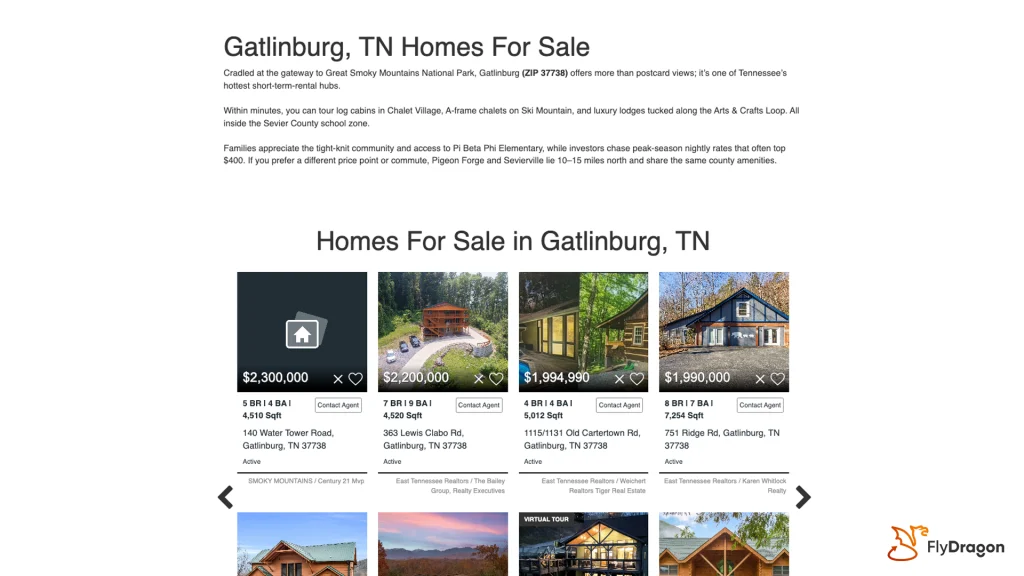
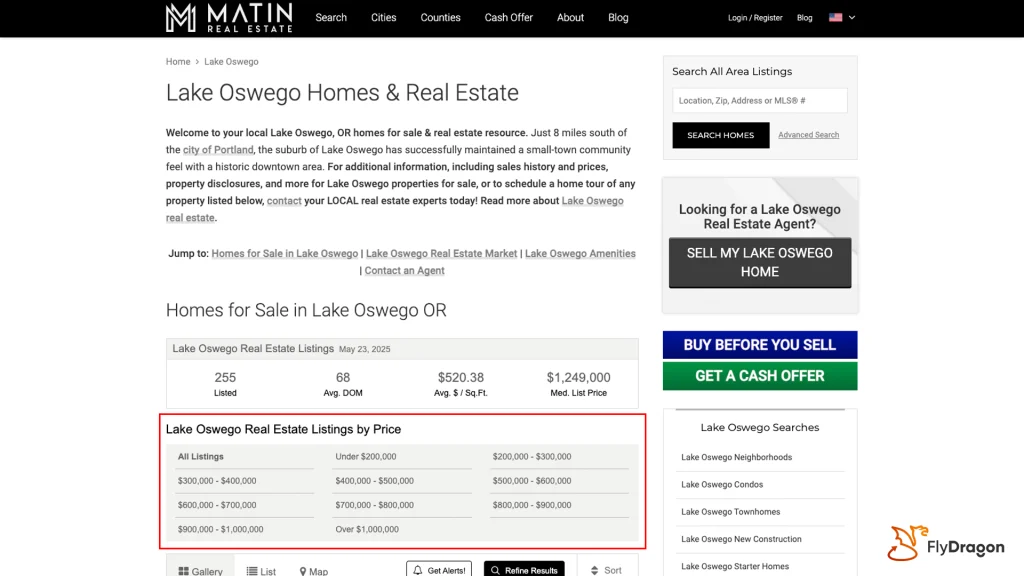
The deeper problem for AI search specifically: these platforms produce near-identical sites across thousands of agents. Same templates, same page structures, same thin neighborhood pages, same forced-registration gates on listing content. 

inboundREM's 2026 review of kvCORE said it directly — "SEO is non-existent. There is no organic means for Google to find your site." The quote comes from a review that broadly recommends the platform, which makes the admission sharper. Models like ChatGPT and Perplexity cite sources based on topical authority, entity recognition, and content uniqueness. 

A site that looks like 20,000 other sites has none of those.

My bet by the end of 2026: the all-in-one platform market loses 15–25% of its customer base to WordPress-based or headless CMS (content management system) alternatives, and the brokerages selling these platforms start pivoting to "hybrid" offerings where the site component is modular.

But no real estate website provider will ever be the best AI SEO agency. They will simply sell an ‘add-on’ which AI search isn’t so, keep that in mind.

Mistake 2: Spending 80% on design and development, 0% on content

This is the most common mistake I see, and it's the most expensive one in the long run. An agent pays a premium for a WordPress build with a designer, a logo, brand guidelines, and a styled IDX integration. 

The site launches looking beautiful and sits there ranking for nothing, because the agent never budgeted for content. No neighborhood guides. No market reports. No buyer-side or seller-side resources. No expertise pages. Nothing AI search can cite.

Design doesn't rank. Structure ranks. Content ranks. Entity signals rank. 

A professional website with 12 pages of thin content is worth less, in AI search terms, than an ugly site with 80 pages of specific, named, sourced, opinionated content that belongs to the agent who wrote it.

Imagine that for a second. A site that someone spent less than $1,000 on is converting more listings from AI search than yours which had a total cost of $10,000 to build.

Rule of thumb from the audits I run: if an agent has $10,000 to invest, I’d spend $2,000 on the website build and hosting. $5,000 on content. $3,000 on press releases and link building.

Why?

The agents who do this end up with sites AI search cites. This, in turn, gives you income. That is the point of a website in real estate: to convert.

Mistake 3: Paying the website cost and hoping for SEO wins

I've lost count of how many agents have forwarded me proposals from SEO agencies promising rankings in 90 days for $1,500 to $5,000 a month. 

The playbooks in those proposals are almost always identical. 

Keyword-optimized pages for 10 neighborhood targets. A monthly blog post. Generic link-building outreach. Google Business Profile optimization. 

It's the 2019 SEO playbook, and it hasn't ranked a real estate agent site in competitive markets for about three years.

AI search rewards different signals. 

The 2019 playbook optimizes for none of these. The agencies still selling it either haven't updated their product or are betting most of their clients won't notice. And most real estate website providers are still using this playbook.

How do I know this works? Well, take a look at Chris Speicher’s traffic. This is after working with us for the last 12 months.

What much should a real estate agent invest in a website?

My professional opinion is that you don’t need a gorgeous website if it doesn’t convert for you.

If you’re considering between:

  1. Investing $10,000 into a website that looks great and
  2. Investing $10,000 into generating listings from a website that works

You go with option b.

You should invest no more than $2,000 into a real estate website. Unless you need a custom CMS, with huge hosting capacity, in a market that demands ‘luxury’ then spend your money on something that will give you a return on investment: AI search.

Your biggest website cost should be content. We’ve helped realtors secure upward of $30k in GCI from AI search in a matter of weeks thanks to the content we’ve published. 

It works.

How to choose between real estate website providers 

An agency is worth the premium if they've ranked real estate agent sites in competitive AI search queries. 

A freelancer is the better call for 80% of agents — lower overhead, direct access, same quality if you pick the right one. A DIY template is the right call for new agents with a small budget — use Placester, AgentFire, or Real Geeks and spend the real money on content and your sphere of influence.

Before you sign a $25,000 proposal, ask the agency to name the last three times one of their client sites appeared in a ChatGPT response, a Perplexity citation, or a Google AI Overview. 

One question agents don't ask enough: how long until the site ranks? 

And, to be honest, these website providers shouldn’t have an answer. Because they aren’t an AI SEO company. It’s like me asking Walmart ‘when will I lose weight?’ just because they’ve sold me healthy food.

The smoke and mirror element of real estate websites is this: they look great, they’re built for traffic but they’re not made to generate the traffic or build an online presence.

You could wait 3 years, spend thousands of dollars on the best looking website in your market, and you’d still get no listings.

Be smart in 2026.

Invest in a website if it makes sense but, without any hesitation, you should be investing in an asset that generates come list me phone calls.

Become the agent AI recommends as #1 and you’ll never have to worry about website design or builds ever again.

My prediction: will AI replace real estate agents in 2026? 

In January 2026, a Delta Media survey covered by Inman found that 97% of brokerage leaders report their agents actively using AI. 

A few weeks later, Ascendix put the daily-use figure at 87% across brokerages and agents. Set those numbers next to Gartner's forecast that 40% of enterprise applications will include task-specific AI agents by end of 2026 — up from under 5% at the start of 2025 — and you have the outline of a transformation that's already happened without most real estate agents realizing it.

My read is that the adoption curve is running ahead of the capability curve. 

The AI that agents have integrated into their weekly workflow is still mostly the 2024 generation — generative models that draft and summarize. 

The 2026 generation is different. AI is already causing mass disruption to every industry.

So we have to ask what makes real estate any different?

Where we are now with AI in the real estate industry

The tools agents are running day-to-day aren't impressive on their own and, if you’ve used any AI tools, you’ll know that’s true.

Each one shaves time off a specific weekly task, but none of them change what an agent fundamentally does. 

Jason Ivens at KW Westfield in Orem, Utah runs 300 agents and told Keller Williams that his top 101 closed more deals and hit $183,000 median income after he pushed AI adoption two years ago. 

That's a good headline until you read it carefully.

300 agents, only 101 hitting the top bracket, which means the bottom two-thirds either aren't using the tools at all or aren't using them well, and they're losing ground inside their own office to the agents sitting two desks away.

The AI-curious agents — the ones who tell their broker they're "experimenting" with ChatGPT for listing descriptions — lose market share month over month to the AI-native agents in the same office, who've built the AI tools into their pipeline. 

The AI doesn't make the AI-native agents smarter or more skilled. It gives them back time. Ten extra hours a week compounded over 12 months is roughly 20% more client-facing capacity, and in a zero-sum market where every listing goes somewhere, that's where the transactions migrate. 

By the time the AI-curious agents realise they're being outcompeted by their own colleagues, the gap is too wide to close without a full workflow rebuild most of them aren't going to do.

The part that gets missed in the "97% of brokerages are using AI" headlines is a simple distinction: using AI and benefiting from AI are doing very different jobs in these stats. 

Most agents have the tools switched on and are barely touching them. A handful have built them into their workflow and are taking market share from the rest. McKinsey's estimate that AI could generate $110 to $180 billion in annual value for the US real estate sector is real, and I think it's probably low, but that value is heavily concentrated in the top 20% of agents who've figured out how to compound AI gains across a book of business. 

The middle 60% get marginal gains, mostly in admin and content. The bottom 20% are handing their leads to the top 20% through slower follow-ups and weaker positioning. Call it a redistribution event. The transactions are getting closed either way. 

Fewer agents are closing them.

The future of real estate and AI by the end of 2026

IDC expects AI copilots embedded in roughly 80% of workplace applications by the end of this year, and PwC's Emerging Trends in Real Estate 2026 draws a line between today's generative AI and what they call agentic AI.

KW Command relaunched in February 2026 with direct API integrations to Gemini, RemyAI, and Rejig.ai, which means a KW agent's CRM now talks to three different reasoning models depending on the task, and that capability is sitting in the platform whether the agent knows how to use it or not.

My bet on what end-of-2026 delivers in real estate specifically: a workflow where inbound leads get qualified, scored, nurtured, and scheduled into showings without an agent touching the top of the funnel. 

The agent gets involved at the showing and stays involved through the offer. 

Everything before, between, and after — including post-close nurture and sphere-of-influence drip — gets absorbed by the stack. I'd put that at 70% probability by December 2026 for teams at Compass, eXp, Real, and Keller Williams, because they have the platform infrastructure and the budget to deploy it. 

For independent agents without a tech-forward brokerage behind them, I'd put the probability closer to 40%, and dropping fast as the cost gap between a platform agent's stack and an independent's stack widens.

The tools that will matter most by December are those coming from the major models: Anthropic and OpenAI. Claude Cowork, as an example, can handle 80% of real estate admin tasks without much (or any) human interaction.

The model capability is already there. And it’s advancing incredibly quickly. Quicker than Sam Altman predicted. Quicker than any major AI player could’ve foreseen.

What the models won't be able to do by the end of 2026 — and probably not by the end of 2028 either — is sit across from a seller who's just been told their property is 15% overpriced and hold that conversation. 

Walk a first-time buyer through their second round of inspection findings. 

Read a room. 

Tell someone what they don't want to hear. 

The agreeable-by-default problem in current LLMs is baked in through alignment training. It's a feature, and the frontier labs have no incentive to change it (ask anyone who's tried to get ChatGPT to push back on a decision they've already made). 

Negotiation and judgment survive. Everything else doesn't.

Where we've been and what we got wrong

In August 2024, when the NAR settlement took effect, John Campbell at Stephens predicted a 50% agent attrition rate within two years, and the entire industry braced for it. 

It didn't happen. 

NAR's own mid-2025 numbers projected membership falling to 1.2 million by end of 2026 — down from a 1.6 million peak, a 25% drop — which is real, but slower than the doom forecasts.

Average buyer-side commissions, which were supposed to collapse under settlement pressure, actually held: Clever Real Estate's February 2026 data has them at 2.82%, higher than the 2.55% they averaged in early 2025, right after the settlement took effect. 

The lawsuit didn't deliver what the plaintiffs wanted, and most of the analysts covering the space have spent the last 18 months explaining why.

I was one of the people saying AI wasn't coming for agents in any serious way this year. I read the tools right and the deployment curve wrong. Even AI SEO has been adopted far more aggressively than we could've ever anticipated.

What I thought was a 2027 problem is already here for most real estate agents.

The reason the settlement failed to move commissions is clients kept asking for human representation and sellers kept paying for it, and regulation doesn't override what buyers and sellers are willing to do in a market. 

What moves markets is infrastructure. The commission settlement was a legal framework agents could resist by keeping their workflow unchanged, which is what happened. 

AI is an infrastructure change the agents themselves are driving by upgrading their own workflow, which is why it's going to move the number the settlement couldn't.

So will realtors get replaced by AI?

If your job is the tasks — listing copy, follow-up emails, MLS admin, CMA prep, scheduled calls, drip campaigns, sphere-of-influence nurture — you're already being replaced, and the only reason you still have a job is that your broker hasn't fully deployed the stack and your clients haven't noticed the difference. 

Both of those gaps close within the next 12 months. Max. 

The software is cheaper, more consistent, and by December 2026 it'll be orchestrating the whole task pipeline without a human pressing go between steps. You're not competing with other agents anymore. 

You're competing with a workflow that doesn't need to eat or sleep.

If your job is the decisions:

End-of-2026 AI won't touch you.

End-of-2028 AI probably won't either but that could change. The alignment problem means models will keep agreeing with whoever's typing into them, and the judgment tier requires the opposite: someone willing to tell a seller their expectations are wrong, or tell a buyer their dream house is overpriced by six figures.

The problem is most agents don't know which category they're in. 

They think they're decision-tier because they've been doing this for 12 years and closed $8M in 2024. But if they audit their week, 90% of the hours were task-layer work. 

The $8M closed on top of the tasks. Strip the task layer out and the closings stay. The software runs the pipeline. 

The agent sees the offer on the screen where their CRM used to send it.

The best agents at the task layer are the first ones to go.

By December 2026, I think NAR hits its 1.2 million projection, which is 400,000 fewer agents than the peak. Most of them will blame the market. Some will blame commission compression. 

A few will blame AI. 

Almost none of them will connect it back to the choice they made six years ago, when they defined their career as a series of tasks instead of a series of decisions.

How To Use Claude Cowork As An AI Follow-Up Agent For Real Estate Leads

Some real estate agents are sitting on a database worth six figures in commission income and doing nothing with it.

A case study from The Shift AI tracked a Tampa Bay brokerage that was losing an estimated $1 million per year in gross commission income because their average lead response time was 2.5 hours and 40% of leads were never contacted within 24 hours. 

When they deployed an AI agent, response time dropped to under one minute. Pipeline conversion improved 27% in 60 days. One in five AI-qualified leads booked showings.

And that’s a team with resources. Most solo agents have it worse.

NAR’s 2025 Home Buyers and Sellers Generational Trends Report found that 78% of buyers work with the first agent who responds. 

Not the best agent. Not the one with the best reviews. The first one. That stat has held steady for five years running.

So speed isn’t a competitive advantage anymore. It’s the baseline. And most agents are failing it.

I’m going to walk you through how to set up an AI follow-up agent for real estate leads using Claude Cowork, Anthropic’s desktop AI tool that launched in January 2026. 

You’ll need about an hour to set this up.

What Is Claude Cowork?

You’ve probably used Claude in a browser before. You type a question, it gives you an answer. That’s chat mode. Cowork is different.

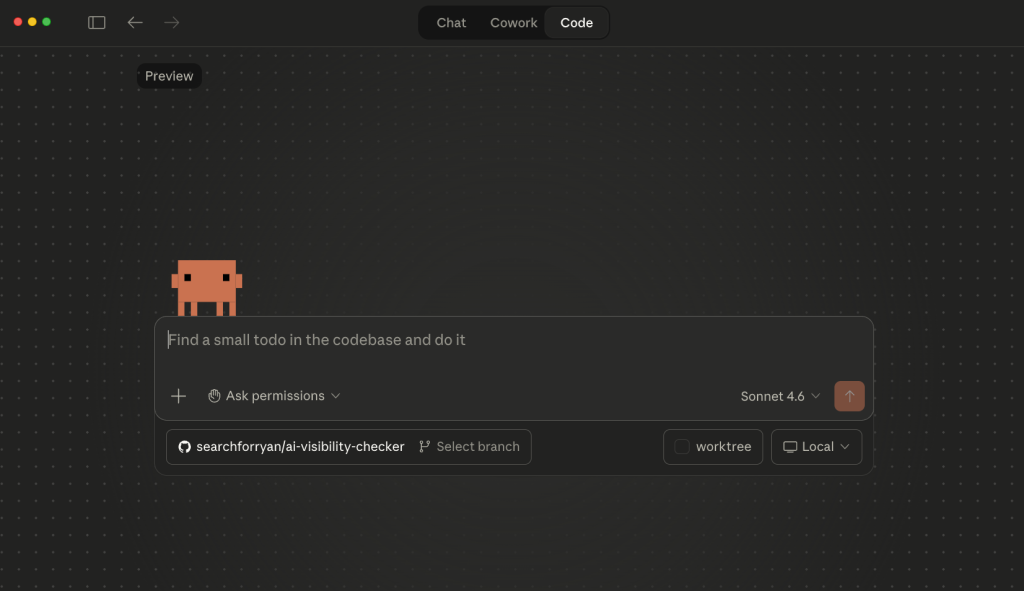
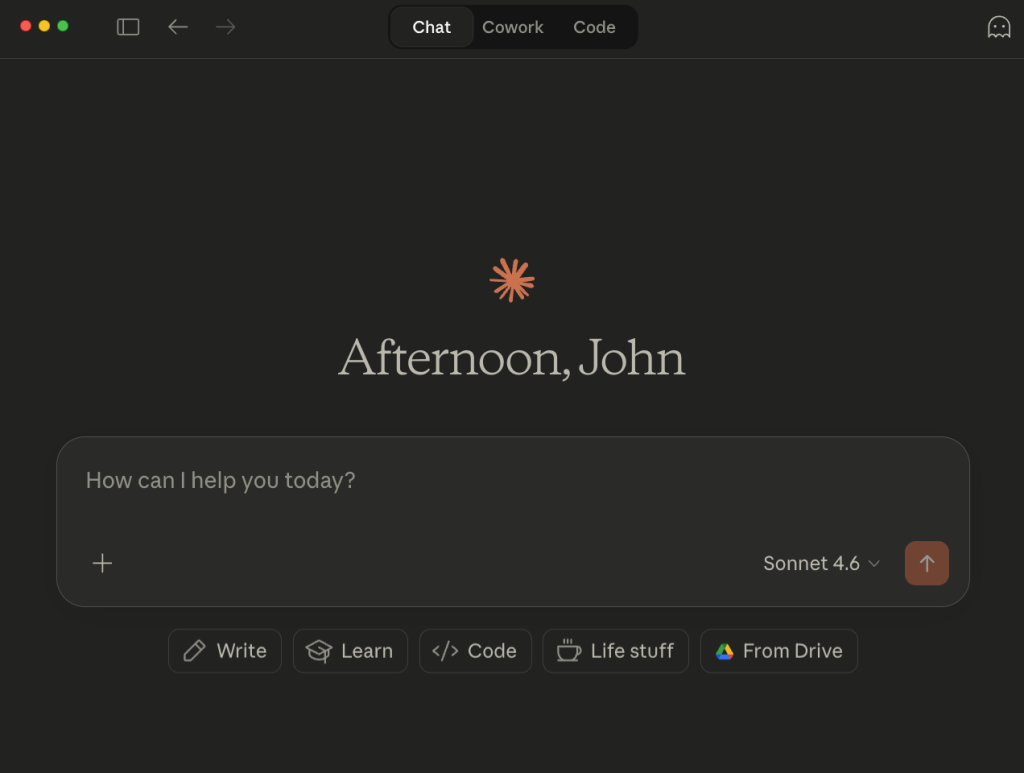
Cowork runs inside the Claude desktop app (macOS or Windows, no mobile). When you open the app, you’ll see two tabs at the top: “Chat” and “Cowork.”

Click Cowork and you’re in a completely different interface. Instead of conversations, you’re creating tasks

You describe what you want done in plain English, and Claude breaks it into subtasks, executes them autonomously, and checks in with you at key decision points before doing anything irreversible.

Cowork can read, edit, and create files directly on your computer. It can open your browser and navigate to Gmail, Google Drive, or your CRM. It runs inside an isolated virtual machine (so it can’t accidentally wreck your system), but it has direct access to any folders you give it permission to touch.

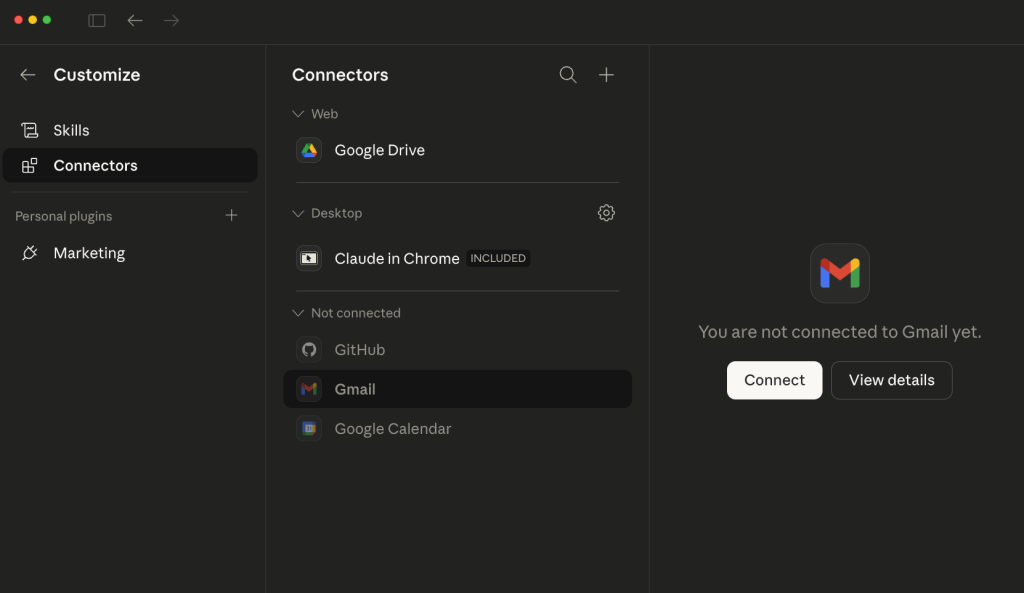
Anthropic added MCP connectors in February 2026 for Gmail, Google Calendar, Google Drive, Slack, and others. 

These let Cowork search your inbox, read email threads, draft follow-ups, and update documents without you having to copy-paste anything between tabs. 

You authenticate once through OAuth (same process as connecting any app to your Google account), and Cowork can interact with those services on your behalf.

You need a paid plan. The Claude Max 5x plan is $100/month and gives you around 225 messages per 5-hour window. Max 20x is $200/month with around 900 messages. For a solo agent running follow-up workflows a few times a week, $100/month is more than enough. If you’re on a team processing 50+ leads per week, go with the $200 tier.

One thing to know upfront: Cowork uses significantly more tokens than regular chat because of how much computation it does behind the scenes. So you’ll burn through your message allowance faster than you would just asking Claude questions in a browser. 

Plan your usage around your lead processing schedule.

How to set up a lead follow-up workflow in Cowork, step by step

Download the Claude desktop app if you don’t have it. Sign up for the Max plan. Open the app and click “Cowork” at the top of the screen.

Before you create your first task, do two things:

First, set up your global instructions. 

Go to Settings, then Cowork, then Global Instructions. 

Type something like: “I’m a real estate agent in [your city]. When drafting emails, use a casual, first-name tone. Never use corporate language. Keep emails under 100 words. Always reference the lead’s original inquiry date and what they were looking for.” 

These instructions apply to every Cowork task you create, so you don’t have to repeat yourself each time.

Second, create a folder structure on your computer. Something like:

In the Templates folder, create a text file with your base follow-up template. 

Here’s one that works:

“Hey [First Name], this is [Your Name] with [Brokerage]. You reached out about [buying/selling] back in [Month]. I realized I dropped the ball on following up with you, and I didn’t want you to think I forgot. Are you still thinking about [buying/selling], or has anything changed? Either way, no pressure. Just wanted to reach out.”

That last part matters. “I dropped the ball” takes ownership of the gap instead of putting it on the lead. 

People respond to honesty about the lapse more than they respond to a polished sales email pretending the gap didn’t happen.

Now create your first task. Click the “+” icon in Cowork to give it access to your Lead Follow-Up folder. Then type your instructions. 

Be specific. The more specific your prompt, the better the output. Here’s what I’d use:

"I have a CSV of leads in my Incoming Leads folder. For each lead, I want you to:

  1. Read their first name, email, original inquiry date, and what they were interested in (buying or selling, and the area if listed).
  2. Draft a personalized follow-up email using the template in my Templates folder. Reference the specific month they reached out and what they were looking for. If their inquiry was about buying, ask if their timeline has changed. If it was about selling, ask if they’ve had a recent home valuation.
  3. Keep each email under 80 words.
  4. Save each draft as a separate text file in my Drafts folder, named [FirstName]-[LastName]-followup.txt."

Cowork will read the CSV, identify the columns, match each lead to your template, personalize every message, and output individual draft files. You review them (takes 10 minutes for 50 leads), tweak anything that sounds off, and send them through Gmail.

If you’ve connected the Gmail MCP connector, you can go further and tell Cowork to create the drafts directly in your Gmail drafts folder instead of saving text files. 

But I’d recommend starting with text files first so you can review the output quality before letting it touch your email.

Scheduling recurring lead follow-up with Claude Cowork

The manual workflow above is useful for an initial blast through your database. But the real power is scheduled tasks, which is Cowork running the same workflow automatically on a cadence you set.

There are two ways to create a scheduled task. 

The easiest: type /schedule inside any Cowork task. A setup wizard launches and walks you through a few questions, usually with multiple-choice options, so you’re not guessing what to type. 

You’ll set the task name, describe what it does, pick your cadence (hourly, daily, weekly, weekdays, or manual), choose which folder it has access to, and confirm.

The second way: click “Scheduled” in the left sidebar of Cowork, then click “+ New task” in the upper right. This opens a modal where you fill in the same details.

For a real estate follow-up agent, here’s the schedule I’d set up:

  1. Export your CRM leads into a CSV every Monday morning. Most CRMs (Follow Up Boss, KvCORE, Sierra Interactive, BoldTrail) have an export feature. If yours doesn’t, copy-paste from your lead list into a Google Sheet and download as CSV. Drop the file into your Incoming Leads folder.
  2. Set a weekly scheduled task to run every Monday at 8 AM. The prompt:

“Check my Incoming Leads folder for any new CSV files added this week. For each new lead, draft a personalized first-touch follow-up email using the template in my Templates folder. Reference their inquiry date and interest. Save drafts to my Drafts folder. After processing, move the CSV to a ‘Processed’ subfolder so it doesn’t get re-read next week.”

  1. Set a second weekly task for Wednesday at 9 AM. This one handles the second touch for leads who haven’t responded:

“Check my Drafts folder for any files older than 3 days that haven’t been moved to the Sent folder. For each one, draft a second-touch email with a different angle: include a recent comparable sale in their area or a brief market update for their zip code. Save the second-touch draft as [Name]-followup-2.txt in the Drafts folder.”

One limitation you need to know: your computer must be on and the Claude desktop app must be open for scheduled tasks to run. 

If your laptop is closed at 8 AM on Monday, the task gets skipped and runs automatically when you open the app. So either keep a desktop machine running or time your schedules for when you know you’ll be at your computer.

It’s not ideal, but it’s the tradeoff for a $100/month tool vs. a $500/month purpose-built platform.

Reactivating your old real estate leads with Claude Cowork

This is where the real money is for most agents reading this, and the data backs it up.

The same Shift AI case study tracked a multi-state real estate team in Texas and Colorado that had accumulated over 18,000 inactive leads (dormant 120+ days). 

They ran an AI reactivation campaign. In 90 days, they re-engaged over 900 leads, moved 62 back into active pipeline, and closed 15 listings from contacts the team had completely written off. 

They doubled their contact touchpoints without adding a single person to the team.

An independent broker in Bergen County, New Jersey, from the same study, reduced admin workload by 40%, saved 3-4 hours per day, and increased listing acquisitions by 30% in the following quarter, all by having AI handle 100% of first-touch communications.

Research from BoldTrail shows that reactivating dormant contacts costs 5-10x less than acquiring new leads and converts at 3-4x higher rates. Dormant prospects typically convert at 8-12%.

Here’s how to do it with Cowork. 

Export everyone from your CRM who came in over the past 24 months and didn’t convert. Drop the CSV into your Incoming Leads folder. Give Cowork this prompt:

"Read through this lead list. For each person, draft a re-engagement email with the following rules:

Review the drafts. Send the ones that feel right. For the ones who reply with interest, go back to Cowork and have it draft a second-touch email with a different angle: a recent comparable sale in their area, a note about interest rate changes, or a question about their timeline.

Say you have 500 old leads. BoldTrail’s benchmarks suggest dormant prospects convert at 8-12%. 

Even at the low end, 8% of 500 is 40 re-engaged conversations. The Shift AI data shows roughly 1 in 5 of those will book a showing. That’s 8 showings from contacts you’d written off. Close a third into listings and you’ve got 2-3 new listings from a dead database and a $100/month tool.

Scale that up. The Shift AI study found that a brokerage with 50 agents and 35,000-60,000 dormant contacts could generate 1,400-2,400 additional transactions annually through segmented reactivation campaigns, translating to $2-6 million in commission revenue.

‘Do I need Claude Code or just Cowork?’

If you’re not a developer, you want Cowork. Full stop.

Claude Code is a separate tool that runs in your terminal (the black screen with the blinking cursor). It’s built for software engineers who want to build custom systems. It can do things Cowork can’t, like build a full conversational SMS agent that texts leads via Twilio, holds back-and-forth qualifying conversations, scores leads automatically, and books appointments into your calendar without you touching anything.

But it requires you to know (or hire someone who knows) how to write code, manage APIs, and deploy to a server.

That’s a different article and a different budget.

Cowork was built for people who want AI to do real work without writing a single line of code. For the highest-impact use case most agents need (drafting and scheduling personalized follow-up at scale), it handles it without any technical overhead.

Why this matters more in 2026 than it did last year

The Inman Real Estate Technology Survey from 2025 found that the average agent response time to a new lead is 917 minutes. That’s over 15 hours. And InsideSales research on 55 million sales activities found that 57.1% of first call attempts happen after more than a week.

After more than a week.

Meanwhile, NAR data shows 62% of real estate inquiries come in after business hours, between 6 and 9 PM and on weekends, exactly when you’re not at your desk.

The agents who set up a system like this now, even a basic one, end up in the same position as the agents who claimed their Google Business Profile before everyone else did. Or the ones who started building an email list in 2014 when it felt pointless.

$100/month and an hour of setup. That’s the gap between you and the agent in your market whose old leads are booking calls while they sleep.

I’ve watched this pattern play out in SEO for over a decade. The people who move early on shifts like this build advantages that compound.

The people who wait until it’s obvious end up paying 10x more for the same result (hello every agent who’s now paying $500/month for Zillow leads and calling them back the next day).

The Best AI Search Engines For Real Estate Leads (Ranked In Order)

Most real estate agents are using the wrong AI search engine to get found.

I went through the data. The market share, referral traffic, citation behaviour, conversion rates across ChatGPT, Google's AI Mode, Gemini, Perplexity, Grok, and Copilot. I wanted to know which ones are genuinely sending leads to agents right now, and which ones are future opportunities.

Here's how I'd rank each AI search engine for real estate leads — and why.

1. Google AI Mode

This should be your number one priority. And almost no realtor is treating it that way.

Google AI Mode has 100 million monthly active users in the US alone. It sits inside the search engine that still controls 92% of the market.

When a homeowner types 'best estate agent in [your city]' into Google, there's an increasing chance they're getting sent straight into AI Mode without knowing about it.

AI Mode has a 93% zero-click rate.

That sounds terrifying until you realise there's still opportunity here.

But if you're not being cited in that AI response, you don't exist. There's no page two to fall back on. There's no 'well, at least I'm ranking somewhere.' You're either in the answer or you're invisible.

iPullRank's referral data from 2025 showed that high-authority, community-driven sites dominate AI Mode citations. Reddit, YouTube, Wikipedia, Zillow — these are the platforms Google's AI trusts.

What does that show you?

Google's AI is looking for agents, teams, brokerages, and brands with authority signals across the web. Your Google Business Profile, your reviews, your local content, your backlink profile. The stuff you should've been building for the last decade.

If you've been doing AI SEO properly, AI Mode is your biggest advantage. If you haven't, it's about to become your biggest problem.

2. ChatGPT

ChatGPT holds somewhere between 64% and 81% of the AI chatbot market depending on which data set you're looking at (SimilarWeb puts it at 64.5% as of December 2025, Conductor's data from November 2025 says 87.4% of all AI referral traffic comes from ChatGPT).

The numbers are massive. 800 million weekly users. The third most visited website on the planet.

And for real estate agents, the referral traffic story is incredibly high intent. The agents we work with see the highest intent leads from ChatGPT compared with any other LLM search engine.

Exposure Ninja reported that AI search traffic converts at 14.2% compared to Google's 2.8%. Microsoft Clarity's study across 1,200 sites found LLM traffic converting at 3x the rate of traditional channels.

Based on the successes of our clients (take Katelyn Warren for example) we can confidently say this is the case.

When someone asks ChatGPT to recommend an agent or compare neighbourhoods, it pulls from your existing web presence. Your site, your reviews, your mentions in local press, your YouTube transcripts.

The agents who focused on content distribution (i.e., different channels) are the folks winning in ChatGPT answers.

The real estate agents who get ahead of this now, while the space is still wide open, are the ones who'll own those citations as the rate climbs.

BrightEdge found that ChatGPT makes it easy to get mentioned — but only 2 in 10 mentions include a clickable link. So your brand shows up, but the user doesn't always have a direct path to your site. That's a limitation worth knowing about, not a reason to ignore the platform.

ChatGPT is the volume leader. The conversion data is strong. The real estate-specific citation rate is still low, which means there's a window right now for agents who move first.

3. Perplexity

Perplexity is small.

Around 22 million monthly users. Roughly 6.2% of the US market. It processed 780 million queries in May 2025 — big growth, but a fraction of ChatGPT.

So why is it third?

Because Perplexity users are researchers. The platform averages over 5 citations per answer (BrightEdge data). That's more than any other AI engine.

Every response comes with sources, links, and attribution. When someone uses Perplexity to ask 'who are the top-rated estate agents in Austin for luxury homes,' they get a sourced, linked answer — and they click through.

The conversion data backs this up. Seer Interactive's analysis found Perplexity converting at the second-highest rate of any AI platform. Microsoft Clarity's study showed Perplexity referrals converting sign-ups at 7x the rate of direct traffic.

Perplexity's user base skews professional. Students, analysts, decision-makers. The kind of people who read the sources, compare options, and make informed choices. That's exactly who you want finding your content when they're researching a move.

Only 1 in 5 Perplexity answers mention a brand at all (BrightEdge, May 2025). So while the traffic it does send is high quality, the total volume is small.

You're not going to build a pipeline off Perplexity alone. But as a supplement to your Google and ChatGPT visibility, it's punching above its weight.

4. Gemini

Gemini is the story of 2026. Google's AI assistant nearly quadrupled its market share — from 5.7% to 21.5% in twelve months (SimilarWeb, January 2026).

It has 400 million monthly active users globally. And its referral traffic to external websites grew 388% year-over-year from September to November 2025, dwarfing ChatGPT's 52% growth in the same period.

Those numbers look incredible on paper.

But for real estate leads, Gemini has a problem.

It's tightly integrated into Google's ecosystem — Android, Workspace, YouTube — which means most people encounter it inside products they're already using, not as a standalone search tool. The US market share is only about 3.4% (SimilarWeb), way below the global figure, because American users are still defaulting to ChatGPT for direct AI search.

We don't have strong data on Gemini-specific conversion rates for real estate. Seer Interactive's study showed Gemini converting at about 4x the rate of direct traffic for general sign-ups — decent, but behind Perplexity and Copilot. The real estate-specific data simply isn't there yet.

I'd watch Gemini closely. The trajectory is aggressive.

But right now, it's a visibility play, not a lead generation one. Make sure your content is structured for AI citation (clear headings, direct answers, schema markup) and Gemini will likely become more important over the next 12 months.

Just don't bet your pipeline on it today.

5. Grok

Grok went from zero to 3.4% global market share in a year (SimilarWeb, January 2026). That's impressive for a platform built by xAI and integrated into X (formerly Twitter). Around 29.6 million visits in July 2025 alone.

Grok's audience skews toward high-net-worth, entrepreneurial users on X.

And we've seen early signals of conversions coming from affluent buyers and sellers who use the platform as part of their research process. That's a small but valuable segment — the kind of clients most agents would love to attract.

The platform rewards real-time data, trending topics, and social-media-native content. If you're an agent who's already active on X and building a personal brand there, Grok's integration could surface your content to exactly the right audience.

The volume isn't there yet for most agents to prioritise it. But if you work in luxury or high-value markets, Grok is worth paying attention to. The affluent buyer profile and the platform's growth trajectory make it one to watch closely heading into the second half of 2026.

6. Copilot

Microsoft poured $13 billion into OpenAI. Copilot is baked into Windows, Office, Teams, Outlook, and Edge. It should be dominating.

It's not.

Copilot sits at roughly 1.1% global market share — and it's declining (SimilarWeb, January 2026). In the US it performs slightly better at around 14% in some data sets, but that's heavily skewed by enterprise usage within Microsoft 365, not consumer search behaviour.

The irony is that Copilot's conversion data is technically the best of any platform. Microsoft Clarity's study found Copilot referrals converting subscriptions at 17x the rate of direct traffic. But the volume is so low that the stat is almost meaningless for real estate. You might get one incredibly qualified lead per quarter from Copilot. Maybe.

The brand confusion doesn't help either. Microsoft has Copilot in Windows, Copilot in Edge, Copilot in Bing, Copilot in Teams — users don't know which one does what, and most of them aren't using any of them for property searches.

I'd put Copilot last. Not because the technology is bad, but because the user behaviour isn't there for real estate.

So which sends the best real estate leads?

Stop treating 'AI visibility' as a single strategy. Each platform has different citation behaviour, different audiences, and different conversion patterns.

If you had to pick one thing to focus on right now, it's making sure Google's AI Mode can find you and trust you. That means your Google Business Profile needs to be flawless. Your local content needs to answer specific questions about specific neighbourhoods. Your reviews need to be recent and consistent. Your site needs schema markup that tells AI exactly what you do and where you do it.

For ChatGPT visibility, the play is broader authority — being cited on industry publications, having YouTube content with solid transcripts, getting mentioned on Reddit and in local press. ChatGPT pulls from Bing's index, so your Bing Places profile matters more than you think.

Perplexity rewards depth. Long-form, well-sourced content with clear attribution. If you're publishing data-backed neighbourhood guides and market reports, Perplexity will find them.

And for the rest — Gemini, Grok, Copilot — keep an eye on them, but don't restructure your business around platforms that aren't sending consistent real estate traffic yet.

I've been in SEO long enough to know that the agents who move first on distribution shifts like this are the ones who build advantages that compound for years. The ones who wait for the 'definitive guide' to AI search in 2027 will be fighting over whatever scraps are left (I'm speaking from firsthand experience).

The data's here. The rankings are clear. The question is whether you'll act on them before your competitor in the next postcode does.

How Do Real Estate Agents Use Video To Rank In AI Search?

Watch on YouTube

'I don't have time to make videos.' Yes, you do.

'I don't know what to talk about.' Yes, you do.

'I'm not a video person.' Nobody is until they start.

The excuse factory runs 24/7 in real estate. And I get it. You're busy showing homes, managing clients, and trying not to drown in admin. Video feels like one more thing on an already overflowing plate.

But you're probably sitting on 10, 20, maybe 50 blog posts right now that could be turned into video scripts with AI in under 10 minutes (not an exaggeration).

From content you've already written but haven't distributed yet.

And the reason this matters more in 2026 than it ever has before is because YouTube is the #1 cited source in Google's AI Mode and ChatGPT.

This means, it's a traffic and lead driver.

P.S. If you need an AI SEO company to do this for you... well, book a call.

YouTube Is Now The #1 Cited Source In AI Search

BrightEdge tracked AI citations across ChatGPT, Perplexity, and Google's AI Overviews from May 2024 to September 2025. YouTube averages a 20% citation share across all AI platforms.

That makes it the single most cited video source. 200 times more than any competitor.

And this isn't just Google playing favourites with its own platform. ChatGPT and Perplexity have zero corporate reason to prioritise YouTube.

They do it anyway.

Because YouTube has the depth, the transcripts, and the structured content that AI models need to pull answers from for real estate searches.

Surfer's AI Citation Report backed this up — across 36 million AI Overviews and 46 million citations, YouTube sat at approximately 23% of all citations. Ahead of Wikipedia. Ahead of Reddit. Ahead of every government site, every news outlet, every niche blog.

Let that sink in for a second.

When a potential buyer types 'best neighbourhoods in [your city] for families' into ChatGPT, search engines aren't only pulling from website content, it's pulling from YouTube transcripts, too.

And if you don't have the right video content, you won't exist in ChatGPT's answers by the end of 2026.

It's that simple.

How Do You Turn Real Estate Blogs Into YouTube Videos With AI?

I'm not asking you to become a YouTuber. I'm not asking you to buy a ring light, learn Final Cut Pro, or start doing jump cuts.

(You're probably exhausted from dancing on Instagram already to sell a house... am I right?)

I'm asking you to take the blog posts you've already written — the neighbourhood guides, the market updates, the first-time buyer tips — and turn them into video scripts using AI.

Here's the workflow and prompt:

  1. Take a piece of content you've already written (or somebody else's highly ranking blog).
  2. Use the prompt we're giving you for free.
  3. The prompt will create the video title, description, key talking points, the length of time you need to record... everything.
  4. Use Claude Opus 4.6 or 4.5 (we don't recommend ChatGPT... it sucks lately).
  5. Your entire video transcript will be done in 3 minutes.
  6. Go record it.
  7. Post it and distribute.

That's it.

You've just created a piece of content that AI models can cite, Google can index, and potential clients can watch at 2 AM when they're lying in bed thinking about moving.

The blog post was the hard part.

You already did the research. You already organised the thoughts. The video is just you saying what you already wrote — but now it lives on the platform that AI trusts more than any other.

Do You Need To Go Viral For AI Search To Cite Your Video?

'Oh but I'll only get 200 views...'

This is probably the most common pushback I hear.

And it tells me that most agents are measuring video success the same way they measure Instagram success.

Views don't matter. Not in the way you think.

A neighbourhood guide with 200 views on YouTube isn't competing for virality. Your job is to attract high-intent buyers and sellers in your market.

That's it.

Nate Clark started his YouTube channel 30 days ago and has already secured a listing. His YouTube videos, on average, generate 15–45 views. He generated 300 views in 30 days.

What does that show you?

These are the warmest leads you'll ever get. By the time they contact you, they already feel like they know you.

Agents with small YouTube channels — under 500 subscribers, sometimes under 300 — report consistent inbound leads from their content. Not thousands of views. Just the right views.

Compare that to the leads you're buying from Zillow or whatever platform you're currently renting your pipeline from. Those people don't know you. They don't trust you. They gave their number to a form and now six agents are fighting over the same callback.

Will AI Clones Matter For Real Estate Video?

I knew this was coming.

The idea is seductive. You record a few minutes of yourself talking, feed it to some AI avatar tool, and suddenly 'you' are pumping out videos while the real you is at a showing.

Sounds efficient. Sounds smart.

It's also the fastest way to destroy the one thing that makes video work for you in the first place — trust.

The entire value of video for agents is that it's you

Your face, your voice, your knowledge of that specific street, that specific neighbourhood, that specific market. When someone watches a 6-minute video of you walking through your local area and explaining why families love it there, they're not just absorbing information. They're deciding whether they like you. Whether they'd trust you with the biggest financial decision of their life.

An AI clone can't do that.

It looks like you. It sounds close to you. But something's off. 

And people feel it… You’ve seen it, I know you have. The uncanny valley isn't just a tech problem.

It's a trust problem. And in an industry where trust is literally your product, that's not a risk worth taking.

Don't get me wrong, AI clones will improve. They already have. But the moment your audience finds out (and they will), you've lost something you can't get back.

There's another issue nobody talks about. If every agent starts using AI avatars to mass-produce video content, what happens? 

Saturation. Hundreds of identical-feeling videos flooding YouTube.

That's the opposite of a moat. That's a race to the bottom.

The agents who win on YouTube over the next few years won't be the ones who produced the most content. They'll be the ones who produced the most real content. The stuff that's imperfect, a little rough around the edges, but unmistakably human.

AI Gives You No Excuse To Not Make Video in Real Estate

Let's go back to where we started.

'I don't have time.' You don't have to write anything new. You're repurposing what already exists.

'I don't know what to talk about.' Your blog posts are a content library waiting to be spoken out loud.

'I'm not good on camera.' Nobody watching a local neighbourhood guide expects you to be a TV presenter. They expect you to know the area. That's it.

AI has made this process absurdly simple. Feed your blog into a model. Get a script back. Record it on your phone. Upload it to YouTube.

The agent who does this 20 times over the next six months will have 20 indexed, citable, searchable video assets working for them around the clock.

The agent who doesn't will keep wondering why their competitor shows up in AI answers and they don't.

This isn't about being a content creator. Trust me, I would never wish that on you. Video is going to be the only surviving moat left when AI models become so good, people won't know who to trust.

Even if you don't have the content, there are millions of blogs online you can repurpose. As long as you're adding your unique view and opinion, use whatever form of inspiration you want.

The gap between agents getting cited in AI using video, and agents who aren't is embarrassingly small.

The only question is whether you'll close it.

I've watched this pattern play out in SEO for over a decade. The people who act early on a shift like this build an advantage that compounds.

The people who wait until it's obvious end up fighting for scraps (hello Zillow owning Google for 2 decades or hello agents who didn't use Google My Business when it first launched).

Is There A Difference Between AI SEO & SEO for Real Estate Agents?

Yes, there's a difference between AI SEO and traditional SEO for real estate agents. 

The noise is in the nuance.

And it's the nuance that catches out most real estate teams. They end up paying for SEO and AI SEO separately. Which is both unsustainable and unnecessary.

I have 12 years in traditional SEO and 5 years in AI SEO (I'm likely the only person who has in real estate) and so, I'm uniquely qualified to tell you the differences.

These differences will save you money and bring you more listings so, it's worthwhile you read this if you're an agent who feels like you maybe are being mislead by agencies online.

The Key Differences Between AI SEO and SEO in Real Estate

TLDR: the biggest difference between AI SEO and traditional SEO in real estate is how you deliver content and links to each LLM.

Most LLMs (ChatGPT, Copilot, AI Mode) steal from traditional search engines. 

AI SEO cannot exist without normal webpages. However, AI search engines do not use pages that have no traffic, no structure, no intent and, no value.

How do we define no value in real estate? 

Simple. Look at any of your last 50 blogs that your CMS provider has given you and ask yourself these questions:

Ranking in AI models works in the same fashion as you assessing content manually. Traditional SEO could be easily manipulated whereas AI SEO is more heavily in favor of how your content speaks to a person specifically.

Optimizing for AI Search vs. Google

Here's where things should get technical. Search engine optimization (SEO) is anything but simple. Websites are complicated, algorithms are messy and CMS providers have done their absolute best to offer the least SEO-friendly platforms available (that's for another time, though).

But, despite that, I'll outline the comparative differences between the two disciplines. You'll notice how much overlap there is. And then, hopefully, you'll see where the nuances are.

Hyper-specific content about your market

Traditional search results were ranked on traffic and links. The algorithm changed the quality threshold based on the industry but, for real estate content, if you could get people to visit your site, and other websites to give you backlinks, you did pretty well.

With AI SEO, it's now about the specificity of your answers.

Your content should no longer be: how do I sell my home in Florida?

And instead become: how can I sell my 4-bedroom home, with a pool, in Florida for higher than the market average in the next 3-6 months?

This is natural conversation. This is how normal homebuyers and sellers query ChatGPT. 

How do you apply this to your content?

Like this.

Let's say you've written a blog called 'Moving To Florida: Everything You Need To Know'. It's a pretty common topic and something AI tools like to reference in real estate.

To make your content match up to the conversational intent of somebody's question, you'd need to break it down into chunks:

Etc, etc.

It's less about opinion, and more about depth. When someone asks AI that question, your content needs to be "chunked" (i.e., segmented) down in this fashion so it's easy to scan and easy to extract answers from.

Building brand citations across the web

A brand citation is where your brokerage, team name or personal name are mentioned on different websites. Citations are the key to AI SEO.

Your visibility in AI search engines will be controlled by:

A big problem with real estate professionals is they change teams or brokerages... a lot. 

And so, ChatGPT, for example, could find 3 different brokerages attached to your name. If at any point the AI-driven search is confused, it simply will not return your business.

You will miss out on leads, rankings and organic traffic (inbound, at that).

Traditional SEO relied on citations, too. But not to the same extent. AI SEO is 95% reliant, whereas traditional SEO was 50-60% reliant.

Creating key real estate profiles

Do you have a Zillow profile? How about a Fast Expert? Or Rate My Agent?

The chances are you either:

a) have the profiles but don't keep them updated

b) you don't have the profiles apart from Zillow

This is typical in real estate (unfortunately). Real estate SEO relies on trusted authority platforms. This means most LLM engines and Google go to the same sites over and over for information, because they trust them.

If ChatGPT expects to see you on 10 different real estate profiles, but you're on 1, what are the chances of you being the agent AI recommends?

I'll save you the trouble of thinking: the answer is zero.

AI results work in the same way as traditional SEO when it comes to what we call 'seed sites'. The play a huge role in real estate, whether it's for lead generation, reviews or brand building.

The nuance here is that ChatGPT, Perplexity, Grok etc., rely on the same 40 profiles. Whereas Google used to rely on hundreds.

Reviews and trust

Reviews are where the two disciplines balance out. Local SEO is heavily skewed on the reviews you get, how often you get them and where you get reviews.

Google's AI Mode uses Maps to find the agents people are looking for when they search for 'who's the best?'

Best is subjective but, most platforms treat 'best' based on:

And it extracts that from your reviews. You can't claim you're the best, you need your clients to do it for you. Which is why reviews make such a big difference in you appearing in AI-generated answers (or not).

Here's where you should get reviews in priority order:

  1. Google Business Profile
  2. Zillow
  3. Realtor
  4. Fast Expert
  5. Yelp
  6. RateMyAgent
  7. Angi
  8. Homelight
  9. Expertise
  10. Bestrated

And, as we said about citations, make sure every profile you make is consistent.

Traffic from different channels

This is the biggest difference in real estate SEO in 2026. It's where you get your traffic. 

Traditional SEO has gone from Google only to now being searched everywhere. The age old SEO strategy was based on driving traffic to your website from Google. And it worked well.

But, now, you need to consider:

Traffic needs to come from everywhere. AI scans every platform for mentions of who you are. Buyers and sellers are in subreddits asking for recommendations for agents to work with. Mortgage brokers are setting up Facebook groups to build local lead generation inquiries. 

Getting traffic from every platform makes you authoritative. It's essentially what digital marketing should have been but now, LLMs have made it a necessity rather than an afterthought for real estate agents.

What Are The Cost Differences?

AI SEO will cost you much less than a traditional SEO campaign.

Based on my experience of well over 100 SEO campaigns in the last 12 years, I can tell you the average retainer cost was north of $4,200 per month. This was to cover content writing, links, consultancy, technical SEO: the whole 9 yards.

That was for an SMB. Enterprise SEO campaigns used to range in the region of $10,000 - $20,000 per month.

For real estate agents specifically, you could find a local SEO campaign for $1,500 a month. But it would likely underperform.

In the age of AI-powered SEO, you can get results for $800 - $1,000 a month.

It depends on:

We have helped agents with no website history get to well over $2m in pipeline in 6 months. And others, we've helped achieved that in 90 days or less.

Which Will Give Me Quicker Results (More Listing Appointments)

AI SEO will give you much quicker results and inbound listing appointments.

A typical SEO campaign timeline could be anywhere from 6 - 12 months. There were/are ways you could speed it up, but it involved risk.

AI search can start working immediately. As in, within 24 hours in real estate. We've helped agents become the #1 results in ChatGPT and Google's AI Mode within a week of starting with us (and they're still there today).

Which Will Send Me Better Qualified Leads?

AI SEO will send you much better leads.

Why?

Because people interact with AI engines as if they were an assistant. It's personal. It's a conversation, rather than a search action.

What we find is that realtors who rank better in ChatGPT, typically get:

Traditional SEO can absolutely do this, too. But it's the length of time vs. the ROI (return on investment) that makes all the difference.

They don't compare.

That's coming from someone who has helped generate north of $100m from traditional SEO.

Which One Is Best for Realtors: AI SEO vs Traditional SEO

AI SEO is a much better choice for real estate agents in comparison with traditional SEO.

But, a lot of the deliverables and strategies (as I've outlined above) are largely the same. It's the frequency, the quality, the intent and the distribution that makes all the difference now.

It should no longer be a choice between a traditional SEO agency or an AI SEO agency: because ALL agencies should be catering for AI now.

If they're not, they're already years behind. And, they're likely not going to help you, if they can't help themselves.

FAQs

What is GEO (Generative Engine Optimization)?

GEO is the same as AEO (Answer Engine Optimization) and AISEO. It's a different name for the same practice. The most commonly used term is AI SEO.

Will traditional SEO still work for real estate agents?

Yes traditional SEO will still work for agents who have more budget and are willing to play the long game. This carries risk. Google is moving everything to AI Mode and so, traditional search, will change thanks to artificial intelligence.

Should I pay for real estate SEO and AI SEO?

No, you shouldn't pay for real estate SEO and AI SEO separately. You should choose an AI-first SEO agency to do your work because the deliverables are 90%. the same. It's not worth the additional expense to pay for both.

How Realtors Can Use ChatGPT Ads in 2026 (Will This Change The Industry?)

Watch this on YouTube

OpenAI announced they will be testing ads within ChatGPT on January 16th, 2026.

This comes as no surprise to most users.

After Sam Altman did a complete 180 on his stance on not using advertising as a business model, we can see it as a bad thing or, capitalize on the opportunity of a lifetime.

Realtors will have access to millions of homebuyers and sellers for a fraction of the cost they’d pay on Meta or Google PPC (Pay Per Click).

AI search already proved that traditional marketing channels could (and should) be different.

ChatGPT ads will be hyper-personalized, they’ll have higher intent signals than any other advertising platform and, the best part is, people already trust ChatGPT’s responses.

Let’s take a look at how ChatGPT ads could work for real estate agents in the very near future*.

How will ChatGPT ads work?

Based on OpenAI’s release article, ads will be shown natively at the bottom of a ChatGPT window.

(Source: OpenAI)

Initially, ChatGPT ads will be shown to free users and to Go tiers (a newly introduced subscription at $8 per month). 

95% of ChatGPT’s users are on the free tier. 

That’s 750 million users.

That’s most homeowners in your market. That’s most of the motivated sellers in your area, too.

Can real estate agents use ChatGPT ads for leads?

Yes, real estate agents can use ChatGPT ads to generate leads.

The advantage of early movers’ advantage cannot be stressed enough. Most realtors will ignore this announcement

Leaving the market open for agents who want:

  1. Cheaper paid traffic
  2. Higher-intent leads than any other platform
  3. The ability to lower CPL (cost per lead) by an estimated 30-40%

How do we know this will happen for real estate?

Well, answer this…

When you have 18 months of a ChatGPT user’s memories, chat windows and preferences, what do you think they’re going to do with this data?

This (as much as OpenAI says they won’t use it) will be the initial draw for advertisers.

For people looking to buy, sell or rent a home, ChatGPT ads will likely prove more useful than other platforms for that reason. If the ads are integrated correctly, most consumers won’t even notice they’re clicking ads.

Google has used ads for over a decade and people still don’t know when they’re clicking a sponsored result versus an organic. 

How will ChatGPT ads drive leads to an agents’ site?

Traffic will be sent directly from ChatGPT to the agent’s website. 

It’s that simple.

There won’t be any middle interface between a user’s conversation and your website.

This means you will need:

  1. A dedicated landing page for ChatGPT ad traffic
  2. The ability to track conversions on these pages
  3. The ability to receive form enquiries on your website

Those agents with difficult CMS platforms should consider how this works for them now. If your CMS platform doesn’t allow you to add forms freely, or create paid landing pages, you’re going to be restricted.

Which will be costing you listing appointments… 

The alternative is that ChatGPT ads will send people directly to your Map (using Google’s index) or to call you from within the chat window.

The less friction, the better. If OpenAI takes any inspiration from Google or Meta, they benefit from keeping users in their ecosystem (think Google Local Service Ads or Meta’s Lead Form).

This could mean less traffic overall to your website but… better qualified leads are great, no matter how you get them.

Right?

When will ChatGPT ads be available for real estate?

OpenAI is rolling out testing in the United States as of January 16th, 2026.

And with existing partnerships with portals like Zillow, there’s a high likelihood that we will start seeing ads imminently. With a full rollout likely to be within Q1 2026.

As soon as ChatGPT starts serving ads based on geography, home interests, demographics and personalised history, we will be entering a new ecosystem of advertisement.

If OpenAI is willing to do this, you can be sure Google will introduce ads into AI Mode. As will Copilot, Perplexity and Grok.

Where does this leave the real estate industry?

Real estate is the industry I see benefitting from this change in the ad ecosystem.

Individual agents, smaller teams and even larger brokerages find it hard to generate paid leads, consistently, through current channels.

With rising CPM (cost per mille) costs on Meta, and CPL (cost per lead) higher than ever before, this announcement from OpenAI is a much needed change.

Will this replace Zillow leads?

Will this mean Realtor.com will need to revisit its business model?

No, it won’t. 

This, as with most marketing channels, will be another route to customer acquisition, rather than a replacement.

Our advice would be to pay attention to how this pans out and jump at the opportunity as soon as it presents itself to you.

We’ll be watching and updating throughout the coming weeks and months.

If you want to stay updated, join the waitlist, and be the first to win in this new market.

*This article is FlyDragon’s opinion, not fact. ChatGPT ads have yet to roll out as of the 19th January 2026. We’re using official information from OpenAI to provide you this information.

How To Generate Real Estate Seller Leads In 2026 (You’ve Never Tried These)

For the last decade, the real estate industry has operated on a "pay-to-play" model. 

You paid the portals for access, you called the leads within 5 minutes, and you prayed for a conversion. 

It was a simple, albeit expensive, transaction.

Unfortunately, paying Zillow for seller leads leaves you with small margins, a co-dependent business model and, if you’re honest, it’s not why you got into real estate.

Sellers are using AI search to disqualify agents they don’t see as the right fit. Social media is becoming ruined by slop and every agent is using the exact same lead generation strategies as they were 5 years ago.

If you’re tired of being a realtor who spends their time chasing seller leads, rather than sellers coming to them, I’ll show you how to change that in 2026.

What percentage of home sellers are using AI search?

Recent data shows that 82% of Americans are now using AI tools (like ChatGPT, Gemini, and Perplexity) to gain housing market insights.

Let that sink in.

Four out of five sellers in your market are consulting an AI algorithm before they ever consult a human.

Why? Because the AI doesn't try to sell them something. And that’s what makes AI SEO so powerful.

It gives them unbiased data on customer acquisition costs, market trends, and neighborhood safety. It answers their specific, high-intent questions without demanding a phone number in exchange.

67% are using ChatGPT and 54% are using Gemini. That means sellers are having natural conversations with an AI assistant because they’re trusted.

AI is quickly becoming a companion for many people and so, sellers trust their information more than they trust their friends or family (that’s not a joke, I promise).

If you’re not capitalizing on AI search to generate seller leads, you’re losing GCI and you don’t even know it.

Are inbound seller leads motivated?

The average conversion rate for a "cold" outbound lead (cold calling, door knocking) or a "forced registration" lead (Zillow, Realtor.com) sits at a miserable 0.2% to 1%.

That means you have to outreach 100 people to find one person who might sell.

In contrast, inbound AI leads convert at over 15%.

Let’s say you get 500 visits to your website per month. That’s 75 inbound seller leads, every month.*

When a seller finds you through an AI Overview or any other LLM, they have already performed a zero-click search. They have consumed your data, verified your brand authority, and decided you are the expert.

If you use the right content strategy, by the time a seller is reaching out to you, you’ve already answered their questions (more on that later in the article).

*This doesn’t account for market downturns or seasonal swings. And most agents don’t invest in SEO to get 500 visits per month.

How real estate agents can get more seller leads in 2026

I’m tired of seeing the same lead generation tactics online in every real estate blog. The only brand we know who share battle-tested ways to get more seller leads is ListingLeads.com

So, we’re going to share with you how we’re helping agents generate more seller leads every month instead.

Make AI models recommend you

Real estate agents were never able to outrank property portals. And it’s why so many of you never invested in SEO.

That isn’t the case with AI search. Most AI search engines recommend agents, teams and brokerages because they understand intent better. A conversation is not a search. And so, property portals rarely make it as a recommendation.

To make an AI model recommend you as the ‘best agent to sell a home in…’, here’s what you need to know:

  1. You need to teach AI models who you are, where you work and what you sell.
  2. You need to specialize in something (price brackets, home types).
  3. You need to consistently reference that everywhere online.

It sounds like a lot of work (it is) but it’s the most powerful way to generate seller leads today.

Here are two tactics you can use today.

Firstly, you have NO authority so, go and piggyback on someone who does.

Think about:

You can use these websites to promote your brokerage, or your team, and AI assistants eat it up. Talk about popular listings you’ve sold, how many homes you’ve sold in the last 12 months, any awards you’ve won for being a great salesperson.

(If you want to see a full breakdown, download the full AI Masterclass PDF).

Sales-focused AI chatbots

Most real estate chatbots are useless. They are just annoying digital gatekeepers trying to force an email address out of a seller.

That doesn’t work anymore. 

Consumers are tired of clicking "Chat" only to be met with a glorified contact form saying, "Hi! Someone will be with you shortly."

To make a chatbot actually convert a seller, you need to stop thinking of it as a greeter and start training AI to provide value and qualify your sellers.

Here is what you need to do:

The standard for "value" has gone up.

A seller is on your site at 11 PM. They aren't looking for a generic "Free Home Valuation." They are stressed about specific problems.

They are asking: 

If your bot replies with "Please enter your email to chat," they bounce. You lost them.

If your bot replies with "Based on current Austin tax codes and your zone, here is the breakdown...", you win.

You establish trust by giving the answer away. You get the lead because you were the only one awake to help them.

Your sales chat should come to a natural conclusion (i.e., speak to the agent) or, you should follow up as soon as convenient to see if you can offer any more value.

Seller-intent landing pages

The "What is my home worth?" landing page is a vanity metric.

You cannot compete with Zillow on this. They have billions of data points, better engineers, and they own the consumer's attention on price. When an agent runs Facebook ads to a home valuation tool, they are usually just paying $15 a lead to generate a list of curious neighbors who aren't selling for three years.

So, stop burning cash on generic valuation traps.

To generate actual seller leads, you need to target trigger events in someone’s life.

People don't sell homes because they woke up and checked a Zestimate. They sell because of life transitions: Death, Divorce, Debt, Downsizing, or Relocation.

You need to build high-intent seller pages that capture them during the research phase of that transition.

Here are the three high-value assets you should build immediately:

Thousands of homeowners in your city are sitting on equity, terrified to sell because they have a 3% mortgage rate. They are debating renting it out vs. cashing out.

Build a breakdown of local rental yields vs. capital gains tax exposure.

"If you rent it for $2,500, you net $200/mo. If you sell, you net $150k tax-free. Here is the math."

The result? 

You capture the seller who is financially stuck.

Next, think about probate and inheritance.

When a parent dies, the children inherit a property they often don't want, filled with furniture they can't move, in a tax bracket they don't understand.

"Selling an Inherited Home in [City]: The Step-by-Step Guide." is the page you should create on your site. Deeply explain the "Step-up in Basis" tax rule (which Zillow won't tell them about) and they’ll start trusting you immediately.

These pages target long-tail searches. Which means there will be fewer of them happening. But, you’re competing for intent, not volume.

Use AI for predictive market growth

Most agents pick a farm area because they "like the houses" or it’s close to where they live.

If you are sending postcards to a neighborhood with a 2% turnover rate, you are setting money on fire. 

You are marketing to people who are statistically guaranteed not to move.

The top 1% of listing agents don't guess how to find sellers. They use AI to perform predictive prospecting. 

They know who is selling 6 months before the "For Sale" sign goes up by analyzing market signals that otherwise would’ve taken days of manual searching.

Take the "pre-listing" renovation spike, for example.

Homeowners rarely replace a roof or upgrade an HVAC system just for the fun of it. 

They do it to pass an upcoming inspection. By using AI tools to track local permit data, you can spot sudden clusters of exterior permits in specific subdivisions. It could signal a wave of deferred maintenance being fixed right before a wave of listings hits the market.

You can also use data to identify absentee owner fatigue.

Rental properties have a psychological lifespan. An out-of-state owner who bought in 2018 has seen massive appreciation, but now faces rising insurance costs and maintenance headaches. By filtering for out-of-state owners with high equity who have held the property for more than seven years, you aren't finding investors. 

You are finding tired landlords ready to cash out.

These are just two of the ways you can use AI to identify market trends. Tapping into a tool like Manus to do this research will dramatically speed up the process.

Once you identify these pockets, do not insult these homeowners with a recipe card.

Position yourself as the economist of that micro-market. When the homeowner finally decides to sell, they won't call a generalist; they will call the person who clearly knows more about their street than they do.

Should I buy seller leads?

The cost of buying seller leads is skyrocketing. In competitive markets, you are paying upwards of $60 to $200 per lead for contact info that has been sold to three other agents.

This is the "Zillow Tax” you all know and love.

You are renting an audience. The moment you stop paying, the pipeline dries up.

Investing in AI SEO is buying the building. It costs more upfront in time and effort. But once you rank in the AI Overviews, that traffic is free. It compounds.

Does outbound still work to generate seller leads?

Yes, outbound still works to find motivated sellers but if your business model relies on interrupting strangers to beg for attention, you are missing deals.

Privacy laws are tightening. Spam filters are aggressive. People under 40 do not answer unrecognized numbers.

Combine your outbound efforts with inbound marketing. This will, by default, make you easier to trust. Who is a seller more likely to trust:

Inbound, by proxy, improves the conversion rates of seller leads.

Agent takeaway

The window is closing.

Right now, most agents are ignoring AI SEO because it sounds hard. They are hoping things go back to "normal."

They won't.

You have a choice. You can keep fighting for scraps in the "paid lead" shark tank, watching your margins erode.

Or, you can build a discovery engine. You can create the assets—the data-rich articles, the local guides, the brand mentions—that train the AI to see you as the only logical choice.

Months 1-3 will suck. You will write content that no one reads. You will feel stupid.

Months 4-6 will be quiet.

But by Month 12? 

You will have a pipeline of sellers who call you, ask for you, and trust you before you even say hello.

Build the engine.

How Real Estate Agents Can Get Inbound Leads in 2026 (No More Cold Calling)

(Watch it on YouTube)

If you joined real estate to make a quick buck without any marketing skills, you’ve by now, realized your mistake.

Nearly every realtor uses cold outbound to generate leads.

On one hand, everyone wants to make money. On the other hand, absolutely no one wants to spend their Tuesday cold-calling a list of expired listings who have already been harassed by twelve other real estate agents before breakfast.

The dream for most agents is to generate enough inbound leads that they don't need to chase homeowners anymore.

There is a comforting lie circulating in the brokerage world right now. It goes like this: "It’s a numbers game. If you annoy enough people, one of them will eventually submit.”

But that is dangerously naive and it’s losing you deals.

We are operating in an era of AI. Where the consumer has access to more data than you do. They don't need you to find the house; they need you to verify the decision. If your business model relies on interrupting strangers to beg for attention, you are fighting a mathematical war you cannot win.

So, let’s talk about how to stop chasing ghosts and build a system where the phone rings for you.

How well do warm leads convert?

Well, let’s look at the data, because the discrepancy is actually offensive.

Industry data consistently shows that "cold" outbound leads (cold calling, door knocking, cold DMs) convert at roughly 1% to 3%. 

And that’s if you’re good. 

That means for every 100 people you harass, 99 of them hate you, and one might buy a condo in six months.

But warm inbound leads? They convert between 10% and 15%.

And for AI search... it's over 50%*.

That's 15 homeowners coming to you saying ‘I found you online, I’d love to talk about you listing my home’ potentially every month.

When a lead comes to you—because they read your newsletter, saw your YouTube video, or found your answer on Reddit—they have already "consumed" your expertise. It takes 12 content interactions before anybody makes a decision on which realtor to work with.

With inbound leads the trust barrier is gone. You aren't selling yourself anymore; you're just facilitating the transaction.

*based on data we have from working with 75+ agents across the country.

Differences between warm and cold prospects

The difference isn't just conversion rate; it's psychological framing.

A cold prospect views you as a commodity. To them, you are a "salesperson" trying to extract a commission. They are guarded, skeptical, and price-sensitive.They will grind you down on your commission percentage because they don't see your unique value. They just see a transaction fee.

A warm prospect views you as an authority.

They’ve already consumed your content or gotten free value from you.

To them, you are the "expert" who solved their problem before they even met you. They are open, cooperative, and value-insensitive.

They don't ask you to cut your commission because they believe you are the only one who can get the job done.

Cold prospects require persuasion. Warm prospects require onboarding and nurturing.

The best ways for agents to get inbound appointments in 2026

Most agents fail at inbound because they treat it like a lottery ticket. They post once and wait. To generate actual inbound appointments, you need to build growth engines—systems that leverage specific algorithmic behaviors to put your content in front of people at the right time and on the right platform.

AI SEO (ChatGPT, Grok, Gemini)

AI search is producing multi-million dollar deals for real estate agents all over the country. How do I know this? Most of them are our clients.

Users no longer need to conduct 20 different searches, across 10 different agent websites on Google. They have one continuous conversation with an AI assistant who prequalifies them for you.

AI SEO is about three things:

  1. A predictable content strategy.
  2. A repeatable way to generate authority.
  3. Systems to grow your reviews and trust online.

Right now, AI doesn't know who you are, and it won't recommend you. You need to train the AI models to recognize you as the authority. It’s easier than traditional SEO but still, it’s not as simple as putting yourself as the best agent in your market on a single blog post.

(That is actual SEO advice I’ve seen online from a real estate influencer.)

Your content needs to be specific and steeped in local knowledge. Alongside that, you need to, at every opportunity, validate your sales history, the size of your team, the areas you serve and the types of homes you sell.

I have a full AI masterclass you can download but at a top level, you need these page types:

40% of Gen Z prefers searching on AI over Google. Homebuyers now trust AI more than they trust a real estate agent. If that doesn’t scream out to you ‘okay, I should try getting leads from AI search’, I don’t know what till.

But… It takes time to build. Roughly 6 months of work to see real inbound appointments from AI. That’s because of nothing other than a) LLMs don’t trust you and b) the market has seasons (as you well know).

The thing is though, once you’re being recommended as the best agent in your area, your inbound leads compound. Unlike cold outreach which is consistently output driven.

Own a subreddit

Reddit is the new Google.

Google recently signed a $60M/year deal with Reddit to access their data API. This means Google is aggressively prioritizing Reddit threads in search results to satisfy "human" queries. If you search "Moving to [City]" right now, I guarantee a Reddit thread is in the top 3 results (along with Facebook which we’ll get onto next).

Reddit is also the #1 cited website in AI search so, it makes sense to be there because your leads are there.

Reddit has a Domain Authority of 90+. If you start a subreddit, and consistently post local threads that get engagement, you will have a platform that competes with (and beats) Zillow.

Why this works as a lead generation strategy for agents:

  1. Subreddits are user-driven so it’s a safe place to ask questions without being pitched to. Homeowners ask questions about their town or city regularly to learn from other people who live there.
  2. You can run Reddit ads directly in relevant subreddits (i.e., your location, your type of service or type of home).
  3. People regularly ask for recommendations of which agent is best and who they worked with in the past.

The biggest benefit is, as the moderator, you control the sidebar (the "About" section). Place links to your "Relocation Guide," your "Vendor List," and your "Calendly" right there.

Agents can build unlimited leads if they’re willing to put in the work

Do not post your listings. Post market updates, answer questions about schools, and ban other agents who spam. Your job is to continue to provide value to a community of people who will likely (at some stage) need a realtor.

Don’t believe me that this is a profitable source of leads?

Add "Reddit" to the end of any real estate search query. You will see millions of search results. 

The demand for "human" answers is at an all-time high.

It’ll take between 3–6 months to build community traction organically. But you need distribution. Share it amongst your email database, your old leads and cross-promote on other platforms.

Own a local Facebook group

This is the legacy version of the Subreddit strategy, but it captures the 40+ demographic that holds the most home equity.

And Facebook is now heavily being cited in AI overviews, AI mode and ChatGPT results.

Facebook’s algorithm has killed "Page" reach (now <2%). But "Group" reach is still prioritized because it keeps users on the app. By owning the Group, you own the notification bar of your members.

(You win twice with Facebook. Once when someone uses Facebook’s native search bar and secondly, when your group gets cited by AI models.)

Name the group "[City] Community Connect" or "[City] Parents & Schools." Never put "Real Estate" in the title; people join groups for utility, not to be sold to.

To capture leads (and prequalify bad fits for your group) sse the "Membership Questions" feature.

Spend 90% of your time responding to posts from your members. The other 10% you can DM them privately with a follow up with ‘additional resources’ which just happen to be blogs on your website.

Don’t shill listings. Offer only value and you’ll build trust.

In 3 months you could have 1,000 members if you seed it with local ads ($5/day).

The cost per lead is effectively zero once the group is self-sustaining.

The reverse organic method

I love organic content, but waiting for the algorithm to bless you is a fool’s errand. This method uses money to guarantee distribution of your best assets.

You use organic performance as a "signal" to determine what to put ad spend behind. You are buying certainty. You’re saying ‘here’s my best content, now put it in the right hands’.

It’s not paid advertising. There’s no direct response needed here. You’re building brand awareness with homeowners (in hopes they later become leads).

And because you’re not asking for a sale, the costs are inexpensive on Meta, YouTube and Reddit.

Post 5 Reels/Shorts a week. Don't overthink them. Just market updates or property tours.

Identify the one video that got 20% more watch time/shares than the others. That is your winner.

Go to Ads Manager. Run a "Video Views" campaign (ThruPlay) targeting your city + 15 miles. 

Put $50 behind it. You’ll start to regularly build brand advocacy, inbound leads and sales. All because you did the opposite of what you’re told to do: which is sell.

The best thing about this is you can start generating traffic today.

Long-form content

Short-form video is for awareness; long-form content is for conversion. No one sells a $1M house because of a 15-second dance.

Long-form (YouTube/Podcasts) creates para-social relationships. The viewer spends hours with you. By the time they call, they feel they know you. They trust you.

And agents across the country are making millions of dollars with less than 5,000 subscribers. This is not a numbers game. We personally work with an agent who did $60m worth of listings solely through YouTube in 2025.

I’d imagine 2026 would be even better for inbound leads on YouTube.

The topics you should cover in your YouTube videos to attract leads:

Every video description must have links to ways people can convert with you. Your website, your socials, your Calendly link… YouTube is a platform to get traffic. That traffic needs to go somewhere of value.

YouTube is the second largest search engine in the world. Real estate queries are high-intent.

But, again, this is a long game. The "Flywheel" takes time to spin. But if in 18 months you’ve booked $2m worth of listings from a single inbound channel, well, you’d be pretty happy.

How to get warm buyers as a real estate agent?

Buyers in 2026 are researching outcomes, not features. They aren't searching for a "3 bedroom house" (Zillow does that). They are searching for lifestyle assurance.

To catch them, you must move upstream.

Create content and resources that address the lifestyle friction before the transaction.

If you help them solve the logistical nightmare of moving or financing, you earn the right to help them buy the house. You need to be the consultant first, and the realtor second.

How to get inbound sellers appointments?

Sellers are a different animal. They don't care about lifestyle; they care about asset valuation and net proceeds.

Warm seller leads come from data authority and transparency.

Sellers want to know you are a shark. Show them your teeth through data.

How long will inbound leads take?

Siiiiigh. This is the part where every agent says ‘I don’t have time for that. I’d rather spend my dollars with Zillow’.

Well, how’s that working out for you? Less profit for you. Stricter conversion commitments. You don’t own a real estate business when Zillow is your only pipeline for leads.

It is a compound interest curve.

Months 1-3: You are creating content and building infrastructure. You will get zero leads. You will feel stupid. Most agents quit here.

Months 4-6: You will get a comment here, a DM there. The algorithm is learning who you are. You likely would’ve started to receive your first calls from AI search.

Months 6-12: Old videos start resurfacing. Your subreddit gains critical mass. Your Facebook group has 2,000 members. You’re generating thousands of visits from AI search every month.

This is where your business becomes a business and not a machine that solely relies on outbound lead generation to grow.

If you stop at Month 3, you wasted your time. Inbound is not a faucet you turn on; it is a garden you grow.

Will inbound leads work for a new agent?

Yes, but you have a deficit of "Proof," so you must substitute it with "Effort."

You don't have a track record of sales to show off? Fine. Show off your research.

"I toured 50 open houses this month, and here is what I learned about the current state of the market."

You can borrow authority by being the hardest working reporter in the field. A new agent actually has an advantage here: Time. You have the time to make the videos, moderate the subreddit, build a Facebook group and learn your community.

Takeaway for agents

The era of "interruption marketing" is dying. The privacy updates on iOS and the rise of AI Search are making it harder and harder to buy your way into someone's attention span.

You have a choice.

You can keep renting your audience from Zillow or paid ads.

Or, you can build your own Discovery Engine. You can build the assets—the videos, the articles, the communities—that will generate you leads in slow markets, in scarcity, in every possible downturn you can think of.

It is harder work. It takes longer.

But the leads actually pick up the phone.

Not everyone is going to make it through this pivot. Some agents will still be cold calling in 2030, wondering why no one answers.

But those of us who build the engines now? We won't have to chase anyone.

7 Best AI SEO Agencies for Real Estate Agents in 2026

Key takeaways

If you’re a real estate agent right now, your inbox is probably a mess of pitches.

“AI SEO for realtors.”

“LLM content at scale.”

“Rank #1 in ChatGPT.”

Half of them sound the same. The other half feels like someone bolted “AI” onto a generic SEO offer and hoped nobody would notice.

Meanwhile, buyers and sellers are changing how they search. 

They’re not typing “realtor near me” into Google anymore. They’re asking ChatGPT who the best listing agent is in their price range, or which agent actually knows a specific neighborhood. 

So the real question isn’t “Should I use AI?”

It’s: Which agency knows how to make AI and SEO work in real estate?

Which real estate agents need an AI SEO agency?

Not every agent needs an AI-powered SEO retainer right now. Some agents still just need a clean site, a basic blog, and a Google Business Profile that isn’t half-empty.

You’re more likely to benefit from an AI SEO agency if:

If you’re a brand-new agent with no site, your money is probably better spent on a solid website build and local basics first.

Once that foundation is there, AI SEO is how you stop playing only on Google’s terms and start showing up where homeowners are starting to find someone to sell their home.

What to look for in an AI SEO agency

Before we get into the list, it’s worth sanity-checking the criteria.

The principles of AI SEO are… SEO. So, it’s worth knowing if the agency you’re choosing to work with has the chops to deliver.

Keep those in the back of your mind as you skim. The right answer for a listing-heavy solo agent is very different from the right answer for a 40-agent brokerage trying to standardize across offices.

The 7 best AI SEO agencies for real estate agents in 2025

1. FlyDragon

Starting at: around $799/month with market exclusivity.

FlyDragon positions itself very clearly: they’re an AI visibility and AI SEO agency built specifically for real estate agents, with the explicit goal of making you the person large language models recommend when consumers ask about “the best agent in [market].”

Instead of treating AI like a bolt-on, their entire offer is built around the new search reality: people are asking long, messy questions in tools like ChatGPT and trusting a single answer. 

FlyDragon’s job is to make sure that AI answer includes you consistently. Their goal is to take lead generation from an outbound game, to an inbound strategy where prospects come to you.

Their team is stacked with people who’ve lived in real estate marketing for years: CEO Tim Harvey (ex-Curaytor COO), AI search specialist Ryan Darani, and a content/ops crew that’s been building high-intent funnels for a long time.

On the numbers side, FlyDragon publicly shares performance benchmarks like a 250% average increase in AI traffic in roughly 120 days, first AI-driven calls within about six weeks, and coverage across 50+ markets in the US and Canada. 

They combine entity-focused content, schema, and AI ranking tactics to get your brand cited in LLM answers, not just tucked away on page two of Google.

What we love

Pricing

If your main goal is “When someone asks an AI who the best agent in town is, I want it to say my name”, this is the one that’s built for exactly that problem.

Check out agency reviews for more info on FlyDragon's case studies and more!

2. Luxury Presence

Starting at: contact for pricing (platform plus services).

Luxury Presence is still, first and foremost, a premium real estate website and marketing platform. 

That’s the core product top producers buy: high-end design, IDX search, and a polished website for their brokerage. The newer AI pieces—AI SEO Specialist and AI Blog Specialist—sit on top of that foundation rather than replacing it

The AI tools are there to keep your site from going stale. 

The AI SEO Specialist makes ongoing tweaks to titles, meta descriptions, and headers based on live search patterns, while the AI Blog Specialist publishes local SEO posts for your market without you having to brief a writer every week. 

There’s no mention of human-in-the-loop QC, which worries us. If you’re solely relying on AI or LLMs to control your SEO, it’s destined to crash at some point.

What we love

Where AI fits (and where it doesn’t)

Pricing

3. SEO Discovery

Starting at: no pricing publicly available on their site.

SEO Discovery is a global SEO and digital marketing agency, not a real-estate-only boutique. 

They work across a lot of verticals, but they do have a dedicated real estate SEO practice and a separate AI SEO offering.

On the real estate side, they focus on the classic building blocks: technical audits, on-site SEO, local optimization, content strategy, link building, and sometimes PPC. 

AI comes in as a new addition. They use AI tools for keyword automation, content gap analysis, and real-time ranking optimizations.

We don’t see any mentions of successful real estate case studies where listing appointments are the direct result of their work. It feels like they’re using AI to speed up their workflow, rather than making sure agents rank #1.

What we love

Tradeoffs and fit

Pricing

If you’re running a larger operation—multi-market, multi-brand, or with several verticals beyond residential—and you want AI woven into a full search strategy rather than a standalone AI experiment, this might help.

But for local agents who want to dominate their area in ChatGPT and AI assistant, this might not be the choice.

4. SEO To Real Estate Investors

Starting at: contact for pricing.

SEO To Real Estate Investors is unapologetically niche: they are built for real estate investors, wholesalers, and investment-focused brands, not for a typical residential listing agent trying to build a farm in one suburb. 

Their entire pitch is “AI + GEO intelligence for motivated seller and investor search.

(Note: we’re not huge fans of the ‘GEO’ acronym. It’s confusing and actually, it doesn’t technically exist.)

They combine AI analytics, GEO intelligence, and predictive SEO to find the exact phrases sellers and investors use in specific cities and ZIP codes (“sell my house fast in Dallas”, “real estate investor near me”), then structure content and pages to dominate those searches.

So yes, they are very much an AI SEO shop—but with a strong tilt toward investor-style campaigns, not luxury listings or brand building for traditional agents.

What we love

Tradeoffs and fit

Pricing

If most of your revenue comes from investor deals or wholesaling, this is one of the few AI SEO partners that speaks your language out of the gate.

5. The Park Group

Starting at: contact for pricing.

The Park Group is an award-winning advertising, digital marketing, and web design agency based in Macon, Georgia. 

They’re not branded as an “AI SEO agency” first; they’re a full-service local marketing shop that has added AI-informed SEO and content into their mix as search evolves

For real estate clients, they lean into the basics: neighborhood pages, Q&A-style content around local search questions, Google Business Profile optimization, and on-page SEO that lines up with how people actually talk about schools, ZIP codes, and price ranges. 

What we love

Tradeoffs and fit

Pricing

6. Roar Digital

Starting at: custom pricing.

Roar Digital is a UK-based SEO and paid media agency with a specific service track for estate agents and property groups. 

Their core identity is still as a performance SEO agency—technical audits, local SEO, content strategy, and conversion-focused on-site work—but they’ve leaned hard into the reality that AI overviews and LLM answers now sit on top of traditional results.

Their estate-agent SEO pages talk explicitly about featuring your content in Gemini AI Overviews and ChatGPT-style answers by building “top-of-funnel frameworks” that address the questions AI systems prioritize.

The offer is a modern SEO program that is AI-aware, rather than a pure AI SEO lab.

What we love

Tradeoffs and fit

Pricing

7. Webhive Digital

Starting at: custom retainers.

Webhive Digital is a global digital marketing agency based in the UK.

For estate agents, they offer both a dedicated “SEO for estate agents” service and standalone AI SEO services.

Their estate-agent SEO pages focus on the fundamentals: technical SEO, content strategies, local visibility, and conversion-focused on-page work tailored to property searches.

Because they work globally, they’re used to handling cross-border search, which is handy if your market attracts overseas buyers.

What we love

Tradeoffs and fit

Pricing

Which AI SEO agency should you work with?

FlyDragon is the only AI SEO agency for real estate agents. There’s no alternatives in their service offering.

Their pricing is transparent, there are no lengthy retainers, and they have both a real estate and a true SEO pedigree.

They focus solely on generating listing appointments for agents in their local markets. That’s it.

And, based on their client feedback, you can see that what they’re doing in the AI space is working incredibly well.

The agents who move early on this won’t just get “more traffic.”

They’ll be the names AI says out loud when clients finally ask the question you’ve been hoping to hear:

“Who’s the best agent to talk to about selling my house here?”

How Real Estate Agents Should Protect Their Brand in LLMs and AI Search

The first time an agent sent me a screenshot of “what ChatGPT says about me,” I honestly thought it was a joke.

The model had her brokerage wrong. 

It listed a city she left three years ago. It invented a “Top Producer” award from a brand she’s never worked with. One paragraph even confused her with another agent who happened to share her name three states away.

“This is what my sellers are seeing?” she asked.

Yeah.

And that’s the part most agents in real estate haven’t caught up to yet: your “Google yourself” moment has now become a risk thanks to AI. 

The one where buyers and sellers ask an AI assistant a question and trust whatever shows up.

Those answers aren’t coming straight from your website. 

They’re coming from a stitched-together, probabilistic picture of you based on whatever the model has absorbed—good, bad, outdated, or malicious.

How Does AI Search Understand An Agent’s Brand?

Let’s clear one thing up quickly: AI search is not a magic mirror reflecting “the truth.”

Large language models and AI surfaces like Google’s AI Overviews do three things that matter a lot for your reputation:

  1. They compress thousands of sources into a few sentences.
  2. They fill gaps with their own best guesses.
  3. They prioritize patterns over nuance.

That means:

From the outside, it looks like “AI hallucination.” But it’s just the model doing what it’s designed to do: predict a plausible answer based on the patterns it sees.

Plausible is not the same as accurate.

And “plausible but wrong” is exactly how reputations get ruined.

Why Brand Defamation Is High In Competitive Markets

If you work a sleepy little market where everyone mostly plays nice, you’ll still have AI problems—just slower ones.

If you work a high-stakes, high-turnover market? 

You’re in a different game entirely.

You already know how petty this industry can get:

Now imagine that behavior extended into AI systems that:

You don’t need full-blown malicious attacks to have a problem. You just need indifference:

To a human, those are just data points. 

To a model scanning the web, they’re ingredients. 

And if you aren’t actively supplying stronger, clearer, more up-to-date ingredients, you’re letting this stuff season the story by default.

How Your Brand Becomes an “Entity” in AI Systems

Search engines and LLMs don’t see “you” the way a human does. They see:

That cluster becomes your entity in the model’s internal world.

When someone asks, “Tell me about Alex Johnson, a real estate agent in Denver,” the system roughly:

If there are multiple Alex Johnsons, or your info is scattered and inconsistent, things get fuzzy:

In classic search, a buyer might click two or three links and piece things together. In AI search, they often just read the answer and move on.

So the question isn’t, “Does ChatGPT know who I am?

It’s, “Is there a high-confidence, well-fed entity for me in these systems, or am I a blurry composite of five different people and five different eras of my career?”

Where Agents Get Their Brand Wrong With AI Search

Most brand damage in AI doesn’t start with a scandal. 

It starts with neglect.

I see this over and over when we audit an agent’s AI visibility:

In other words: the source material is a mess.

If that’s the case, why would we expect AI systems to get it right? 

The model isn’t “against” you. It’s just trying to tidy up your mess in the best way it knows how.

Then layer on a few predictable behaviors from the rest of the ecosystem:

Now you’ve got:

…and an AI system trying to turn that into a neat, one-paragraph answer.

You see the problem.

How Can Agents Monitor Their Brand Reputation in LLMs

Traditional online reputation management for agents focuses on:

That still matters.

But AI is more complex.

1. Models read the content of reviews, not just the stars.

A two-paragraph, specific four-star review about how you saved a deal in inspection is more valuable input than ten “Great agent! Highly recommend!!!” one-liners. The language becomes training data.

2. Models read everything around you.

They’ll happily digest:

If all you have are portal profiles and a few templated bios, the model doesn’t have much to work with. That’s how you end up described as “a real estate agent in [Market]” with nothing interesting attached.

3. Models don’t always rank you, they describe you.

A buyer might ask, “Who is [Agent Name]?” before they ever ask, “Who’s the best agent in [City]?” If the answer they get feels thin, outdated, or vaguely off, that’s a trust leak that no star rating can patch.

So yes, protect your reviews. But understand that reviews are now just one feed into a bigger, weirder, machine-mediated reputation system.

Tips For Agents To Protect Their Brand In AI Models

This is where the paranoia can kick in if you’re not careful. “So I’m just at the mercy of the robots and my competitors?” 

No.

You can’t control everything, but you can absolutely stack the deck in your favor.

Here’s how we think about it when we’re hardening an agent’s brand against AI weirdness.

1. Create a Canonical “Source of Truth” About You

Think of this as your official spec sheet for both humans and machines.

On your own site, have a page that:

Then back it up with structured data (your SEO team will talk your ear off about schema markup if you let them). 

That’s basically a machine-readable “about this person” card that helps search systems recognize and tie you together across the web.

2. Clean Up and Align Your Top Profiles

If you’re serious about AI reputation, you cannot have:

…floating around in your public profiles.

At minimum, make sure:

are all telling the same basic story about who you are and what you do.

You can absolutely have different angles (luxury focus on one, relocation on another), but the core facts—the ones a model is likely to copy—should match.

3. Seed the Web With High-Quality, On-Brand Content

You don’t need to become a full-time creator. 

But you do need more than “Active Listings” and “Contact Me” to feed the LLMs

Think:

Use AI to help with structure, drafts, and polishing, sure. 

Just make sure the final copy sounds like you and contains enough real detail that a model can distinguish you from every other “trusted local expert.”

4. Watch for “Off” Answers and Document Them

Every so often, take 10–15 minutes and behave like a curious seller:

Check a few surfaces:

If something is clearly wrong—outdated brokerage, invented awards, conflated identity—take screenshots and note the sources the system claims to use.

Then you’ve got options:

No, you won’t fix everything overnight. 

But the act of noticing is a huge step forward compared to pretending AI search doesn’t exist.

What About Malicious or Shady Behavior?

“What if another agent tries to game the system against me?”

Full disclosure: you’re not going to stop every bad actor on the internet. That’s not how any of this works.

But there are some very human patterns you can watch for:

AI systems are not smart enough to understand local politics. They just see links, mentions, and language.

Your job is to:

You’re playing the long game of being clearly, repeatedly yourself. Not the short game of winning one skirmish in a Facebook thread.

Building An Agent’s Reputation In ChatGPT and LLMs

The agents who come out of this era in a strong position won’t be the ones who panic every time some chatbot gets a detail wrong.

It’ll be the agent who spends the time to:

That’s the real risk here. Not that AI search hates you.

That you’ve left such a thin, noisy trail behind you that it has no choice but to make things up.

You don’t have to be perfect. You just have to be deliberate.

Because at this point, your brand doesn’t just live in your market’s head. It lives inside the models your clients are quietly asking about you at midnight.

And those models are going to answer—whether you’ve done the work to shape the story or not.

AI Content Is the New Spam: The Visibility Gap No One in Real Estate Is Talking About

When ChatGPT launched, every agent with a laptop suddenly became a content creator. Blog posts, market updates, “Top 10 Reasons to Move to X” pieces—AI could churn them out in seconds. Fast-forward to 2025, and most of that material is invisible.

It isn’t ranking, it isn’t being cited by large language models, and it isn’t generating leads.

The problem isn’t AI itself. It’s that agents are producing content with no identity attached.

The Great Content Collapse

For the last decade, SEO rewarded consistency and keywords. Now the signal has flipped. Google’s Search Generative Experience and AI Overviews no longer pull from anonymous articles—they pull from entities they recognize: people, teams, brokerages, and brands with a digital footprint that can be verified across the web.

That means the average AI-generated post, no matter how polished, looks like static. It carries no authorship, no location context, and no relational ties to the person who wrote it. To an algorithm, it’s just one more cloned paragraph floating in space.

Why Identity Beats Volume

When an AI model answers “Who’s the best agent in Scottsdale?” it isn’t guessing—it’s triangulating. It looks for consistent name-address-phone (NAP) data, structured schema, press mentions, reviews, and social profiles that confirm, yes, this person exists and has authority here.

If your name, brokerage, and specialties don’t appear together in those verified sources, you could publish 100 blogs a month and still never be surfaced. Visibility now flows through entity coherence, not content velocity.

How to Build a Recognizable Digital Identity

Think of your online presence like a verified passport. Every stamp reinforces who you are and where you operate. This is how you’ll make it machine-readable:

  1. Structured Data / Schema – Add RealEstateAgent JSON-LD to your site with your name, address, phone, areas served, aggregateRating, and review snippets. Use BreadcrumbList for clear site hierarchy and FAQPage on evergreen guides to capture answer boxes. If you publish listings, mark up key details (SingleFamilyResidence, Offer, price, address) to enable rich results. Validate with Google’s Rich Results Test and monitor in Search Console.
  2. SameAs Links – In your Organization/Person schema, include a sameAs array that points to the official versions of your profiles. Think GBP, Zillow, Realtor.com, Homes.com, LinkedIn, social profiles, your brokerage bio, and major press mentions. Ensure your usernames and naming formats match your site exactly and cross-link back to your domain from each profile. Mismatched identities will weaken machine trust.
  3. Consistent NAP Across Platforms – Standardize your name, address, and phone character-for-character across directories and bios (suite vs. #, “Road” vs. “Rd,” phone formatting). Start with GBP, Zillow, Realtor.com, Facebook, LinkedIn, and major data aggregators; then audit top local/citation sites. On GBP, pick the precise primary category, add service areas, hours, photos, and ongoing posts. Consistency here is the backbone of entity recognition.
  4. Citable Proof Points – Algorithms look for verifiable evidence: third-party articles, association directories, award lists, and review platforms. Pursue local media quotes, board/MLS features, and niche trade pubs; when possible, include concrete numbers (transactions, volume, days on market). Collect reviews that name neighborhoods and property types,
  5. Authorship & Updates – Publish under a real byline that maps to a dedicated author page with Person schema, headshot, credentials, and SameAs links. Add “last updated” dates on key pages and refresh quarterly so crawlers see ongoing expertise, not one-and-done posts. Fold in multimedia (short videos, charts) and link newer analyses to older guides to show continuity and depth from the same identifiable professional.

The Trap Marketing Companies Are (Unknowingly) Setting

Here’s where many real estate marketing companies are leading agents astray. They promise “AI-powered content packages” and flood client sites with potentially hundreds of SEO-optimized pages—but none of the five elements above are in place. No structured schema, no entity linking, no review signals, no authorship, no consistency.

They assume quantity equals visibility when, in reality, they’re diluting their domain with unverified content that algorithms actively ignore.

These companies aren’t optimizing for AI discovery—they’re just filling space. And, unfortunately for them, these agents are being sold a bad bill of goods that neither they nor their marketing provider realizes yet.

Quality ≠ Quantity (Anymore)

Agents chasing content volume are solving the wrong problem. The future of visibility belongs to professionals who show up as themselves in structured, verifiable ways.

AI won’t recommend you until it can verify you—and it can’t verify you until your digital identity is consistent everywhere it looks.

So yes, AI content is the new spam.

But for agents who pair AI-optimized content with transparent identity, it’s also the biggest opportunity since the first IDX feed hit the web. The winners won’t be those who publish the most words; they’ll be the ones the machines can actually recognize.

How To Write A Real Estate Agent Bio For AI Search & ChatGPT

Most agent bios read like résumés; LLMs read them like mush. 

The fix isn’t word count. It’s relationships your bio states plainly. The best real estate agent bios for AI search will name entities (you, your practice, your markets) and mirror those facts in valid structured data so search and AI systems can verify, quote, and route leads back to you.

Definition: A best‑in‑class real estate agent bio is a concise, entity‑rich profile that declares who you are (schema.org/Person), who you work for (RealEstateAgent as a local business), and where you operate, then echoes those claims in JSON‑LD that meets Google’s general structured‑data guidelines. 

AI favors verifiable entities over adjectives.

What This Means for Agents & Teams

Your bio isn’t just copy; it’s a data source. If you don’t state who/what/where explicitly (name, brokerage, market areas, credentials), models can’t confidently frame you as the answer. Structured data helps Google understand and reuse those facts beyond blue links. 

Treat your agent page as a ProfilePage: name + identity info (image, sameAs, url) marked up as Person/Organization so Search can associate your page with the right entity.

If a human can’t spot your name, role, brokerage, market, and proof in 10 seconds, a machine can’t either.

How LLMs & Knowledge Graphs Read Agent Bios

Think of your bio as a set of claims the machine needs to reuse in answers. LLMs and knowledge graphs don’t “feel” the prose; they resolve statements like:

Each statement is a triple (subject–predicate–object). 

Triples let systems answer concrete questions (“Who does Avery work for?” “Where does Avery operate?”) and cross-check your identity against LinkedIn, Zillow, or your brokerage page.

Without explicit relationships, your bio becomes a blob. “Avery is experienced and community-focused” is a sentiment; the machine can’t reuse it. “Avery → worksFor → Compass Austin” is a reusable fact.

Triples are the smallest unit of truth a machine can quote reliably in ChatGPT results.

The Entity Graph of a Strong Agent Bio Using Schema

A solid bio exposes two linked entities:

  1. You, the Person.
    This covers identity and qualifications—name, jobTitle, hasCredential (ABR, CRS, SRES), image, and credible sameAs links (LinkedIn, Zillow, Google Business Profile).

The Person node anchors who is being described and ties to your off-site profiles, so models know they’re looking at the same Avery.

  1. Your practice/office, the Business.

Model this as Organization typed RealEstateAgent. Put areaServed on this node (cities/counties; not every micro-neighborhood).

Buyers hire a person who operates through a business in a geography. Separating Person from Business keeps the graph clean and lets you change offices later without rewriting your identity.

Glue it together with worksFor.

That single edge—Person → worksFor → Organization(RealEstateAgent)—is what lets machines traverse from you to your brokerage/team.

Two practical nuances:

If a fact isn’t typed (Person/Organization) and linked (worksFor, areaServed), machines could skim past it.

How Agents Can Create Their Own Semantic Triples

Step 1 — Write human first.

I’m Avery Chen, a licensed real estate agent with Compass in Austin, TX. Since 2018, I’ve helped 100+ buyers, with a focus on new construction. I hold the ABR credential.”

Step 2 — Extract the triples hiding in that paragraph.

Step 3 — Mirror those facts in JSON-LD.

Two nodes (Person + RealEstateAgent), linked by worksFor. Put areaServed on the RealEstateAgent node. Add sameAs for reconciliation.

Common pitfalls with schema (and fixes):

Pitfall: One node that’s both a Person and a RealEstateAgent.

Fix: Keep Person (you) and RealEstateAgent (practice) separate; link with worksFor.

Pitfall: areaServed on the Person.

Fix: Put areaServed on the business (or a Service node) so geography stays tied to the practice.

Pitfall: No sameAs links.

Fix: Add 2–3 authoritative profiles to help the graph confirm identity.

If a fact will ever change (brokerage, headshot, credential), give it a single home in your markup and keep the @id stable. Stability beats perfection.

Agent Bio Templates That AI Will Cite

Strong opening example:

“I’m Avery Chen, a licensed real estate agent with Compass in Austin, TX, focused on new construction and relocations. Since 2018, I’ve guided 100+ purchases, leaning on lender coordination and neighborhood-by-neighborhood trade-offs. I hold the ABR credential and publish monthly notes on incentives and build timelines across Travis County.”

Why this works:

Write for people; encode for machines. If your first two sentences read like a laminated nameplate, you’re on the right track.

Templates (Pick Your Format)

Use these as human‑readable copy. You’ll encode the same facts in JSON‑LD below.

Solo Agent bio

“I’m Avery Chen, a licensed real estate agent focusing on Austin, TX and Travis County relocations. I work with the Compass Austin office and lead buyers through new construction and neighborhood‑by‑neighborhood trade‑offs. Since 2018, I’ve guided more than 100 purchases with a focus on inspection, schools, and commute math. I hold the ABR (Accredited Buyer’s Representative) credential and partner closely with lenders for rate scenario planning.

Recent work includes helping two remote‑work families move from the Bay Area to Circle C with 30‑day close times and on‑site walkthroughs via video. Clients say my updates are “calm and exact,” which is exactly how I like transactions to feel.

Outside of showings, I publish market notes on price per square foot trends and new‑build incentives. If you’re comparing neighborhoods like Mueller vs South Austin, I’ll map what changes block‑to‑block—then make sure the contract reflects those realities.”

Team Lead bio

“I’m Jordan Patel, team lead at Neighborhood North Group (brokered by Keller Williams). We handle North Dallas single‑family listings with a process built around prep, pricing, and pacing. Our four‑agent team averages 15–20 listings per quarter; we use pre‑inspection summaries and “day‑zero” social to compress days on market.

I’ve sold in Dallas since 2015, hold the CRS designation, and manage vendor relationships for staging and repairs. Because pricing discipline matters, we track comps weekly and set “walk‑away” thresholds before offers even hit your inbox.

Sellers hire us when they want a single point of contact who still brings a team’s bandwidth. We coordinate everything—photography, 3D tours, yard signage, showing protocol—and publish a three‑milestone timeline clients can check from their phone.”

Luxury/Investment Specialist

“I’m Sofia Ramos, specializing in Miami waterfront and short‑term rental investments. I work with The Shoreline Collective (brokered by Douglas Elliman) and help buyers analyze cash‑flow under realistic occupancy assumptions and local regulation. I hold the SRES and RSPS designations and collaborate with property managers before offer.

My recent deals include a Coconut Grove bayfront condo that needed HOA due‑diligence cleanup and an Edgewater unit optimized for a 30‑day minimum rental strategy. I publish underwriting checklists and cap‑rate walk‑throughs clients can reuse across buildings.

If you’re evaluating Brickell vs Edgewater, I’ll show how elevator counts, valet policies, and flood zones change both guest experience and NOI. Then we structure offer terms to fit finance timelines and building approvals.”

JSON‑LD Block (Copy/Paste and Customize)

Pattern: Two nodes—Person (agent) and Organization typed RealEstateAgent (practice/office). Link them with worksFor. Put areaServed on the RealEstateAgent node (or attach service areas via a Service node if your site models services separately). 

{

  "@context": "https://schema.org",

  "@graph": [

    {

      "@type": "Person",

      "@id": "https://yourdomain.com/agents/avery-chen#person",

      "name": "Avery Chen",

      "jobTitle": "Licensed real estate agent",

      "worksFor": { "@id": "https://yourdomain.com/agents/avery-chen#practice" },

      "hasCredential": [

        {

          "@type": "EducationalOccupationalCredential",

          "name": "ABR",

          "credentialCategory": "Certification"

        }

      ],

      "image": "https://yourdomain.com/images/avery.jpg",

      "sameAs": [

        "https://www.linkedin.com/in/avery-chen",

        "https://www.zillow.com/profile/avery-chen"

      ],

      "url": "https://yourdomain.com/agents/avery-chen"

    },

    {

      "@type": ["Organization", "RealEstateAgent"],

      "@id": "https://yourdomain.com/agents/avery-chen#practice",

      "name": "Compass — Austin",

      "areaServed": ["Austin, TX", "Travis County, TX"],

      "url": "https://yourdomain.com/offices/compass-austin"

    }

  ]

}

Why this works:

How‑To Create Your AI-Ready Agent Bio in 7 Steps

  1. Inventory facts (license, years active, brokerage/team, neighborhoods, credentials).
  2. Draft 150–220 words in plain English (no fluff), stating each fact once.
  3. Extract triples (worksFor, areaServed, hasCredential); list them in bullets.
  4. Encode JSON‑LD with Person and RealEstateAgent nodes; keep IDs stable.
  5. Add sameAs links to authoritative profiles (LinkedIn, Zillow, GBP).
  6. Publish on a canonical agent URL with a current headshot and clear name.
  7. Validate in a structured‑data tester; monitor in Search Console.

Keep areaServed at the business/service level; list cities/counties, not dozens of micro‑neighborhoods.

Using FAQ/How‑To markup to chase rich results. Google limits FAQ rich results to certain authoritative sites and has deprecated How‑To; use FAQ content for users, not SERP decoration.

Agent Bio FAQs

What makes a real estate bio “LLM‑ready”?

An LLM‑ready bio states verifiable facts (who you are, who you work for, where you operate) and mirrors them in JSON‑LD using Person and RealEstateAgent nodes, plus credible sameAs links. This helps Search associate your page with the right entity. 

Do I need REALTOR® or “real estate agent” in the bio?

Use REALTOR® only if you’re an NAR member, with the mark in caps and the ® symbol, and avoid using it generically as a job title or descriptor. Otherwise say “real estate agent” or your license title. 

Where should JSON‑LD go on an agent page?

Place a single JSON‑LD script in the HTML of your agent profile page that declares the Person node and the linked RealEstateAgent business node. Keep IDs/URLs stable and align with Google’s ProfilePage guidance. 

Should I still add FAQ schema to my bio page?

You can, but don’t expect rich results. Google limits FAQ rich results to specific authoritative sites; the content can still help users and may influence People Also Ask, but it usually won’t produce FAQ rich snippets for typical businesses. 

Do LLMs actually use this markup?

Search uses structured data to understand content and entities and may surface it in experiences beyond standard results; consistent entity markup also helps external knowledge tools reconcile your identity. 

How AI Search Has Changed The Homeowners Journey To Find Agents

Search didn’t die. I think it’s gotten better.

There’s the tab-hopping, “open six results and compare” version most of us grew up on. 

And there’s the new lane where you ask ChatGPT a messy, 100-word-long question and get a straight answer.

That difference in search is where agents can show up in the journey. It also changes what buyers and sellers expect when they finally reach out. Agents can expect to see higher, more qualified leads thanks to ChatGPT and AI search.

AI search crushes the research phase into something tighter and more decisive. It front-loads trust. If you’re used to playing the volume game—more blogs, more clicks, more forms—you’re going to feel whiplash. 

If you’ve been building a reputation you can prove, this is the best thing that’s happened to you in a decade.

What Traditional Search Looked Like For Real Estate

Agents built entire plans around this loop:

Keyword → page → click → compare → inquire.

It rewarded impressions and click-through rates. 

It made retargeting lists your security blanket. We tweaked headline tags, shaved milliseconds off load times, and celebrated when the new city guide nudged the bounce rate from 72% to 69%. 

It was work tuned to an attention economy where “open five tabs and graze” was normal.

Buyers and sellers got trained by that system. They’d read a “moving to X” guide, skim a list of “best neighborhoods,” pop over to an agent grid, and half-seriously submit a form to see who responded first. 

Lots of motion, not much memory. It kept pipelines busy, but it also filled them with people who weren’t ready or weren’t sure (which meant agents were chasing dead leads).

What AI Search Means For Real Estate Agents

When someone asks, “Can I close in 30 days with a VA loan on a 1990s ranch in Maple Ridge, and what tends to blow up inspection?” the model isn’t hunting for your clever title. It’s hunting for certainty. 

Names. Dates. Relationships. Receipts.

If you exist online like a person with a very specific lane—real markets, real designations, real cases—the answer engine can point at you without blushing. 

If you exist like a slogan (“top agent, great service, born to help”), it shrugs and moves on.

The machine’s risk is recommending the wrong human. So it prefers humans who are easy to verify.

The New Buyer/Seller Journey With AI Search

Before: You searched, you skimmed a listicle, you opened five agent profiles, you filled one form because you got tired.

After: You ask the exact thing you’re worried about. You get an answer with details that don’t feel generic—plus one or two names attached to similar situations. 

You make a micro-decision: “Call this person,” or, “Ask one follow-up.” 

You contact fewer agents, later in the process, with sharper intent.

I’ve watched this play out in real time. 

A seller doesn’t ask for “market updates.” They ask, “If we list in late October, how often do appraisals come in light around here, and what kills them?” 

A buyer doesn’t want a “neighborhood guide.” He wants, “Which pockets of Cedar Grove actually feed into Northview High next year, and what’s a realistic offer window if we have to be in by January?” 

The answer layer handles 80% of that and hands you the baton for the last 20%. You win not because you wrote the longest guide, but because you’re the most believable solution to that exact problem.

AI search is the new referral engine… just warmer, and faster.

When the call comes, they’re not looking for a pitch. They’re checking if you can start.

What This Means For Real Estate Agents

Expect fewer leads. Expect better ones.

People will reach out after they’ve done research inside ChatGPT. They’ll come with a specific question and a timeline. 

They’ll have zero patience for vague bios and “we love helping families” paragraphs.

This is where a lot of marketing gets exposed. 

If your online footprint can’t answer the simplest questions about you—who you are, who you work with, where you actually operate, what you’re good at, and what you’ve done lately—the model won’t risk recommending you. 

And if you do get the call, your first five minutes have to match the confidence of the answer they just read. “Let’s book a discovery for next week” feels like a stall. “Here’s the path, here’s what we’ll send, and here’s what we’ll decide by Friday” feels like a fit.

Entity reputation is all that matters in AI search. 

Your name tied to a real practice, in a real place, with real proof—beats keyword volume now. 

It’s not that content stops mattering; it’s that content without receipts stops moving the needle.

Which Agents Will Win and Lose?

Winners: Agents who picked a lane and can show work. The relocation person who can talk lender timelines without flipping a coin. 

The lake specialist who knows which inspectors actually get under the crawl space and which ones wave from the driveway. Teams whose name, brokerage, and offices show up the same way in every place that matters. 

Boringly consistent beats loudly prolific.

Losers: Everybody who built a maze of look-alike posts and doorway pages just to capture a phrase. Folks renting credibility—splashy site, thin proof. Anyone who thinks volume will outrun verification.

The internet used to reward “cover everything.” AI search rewards “own something and prove it.”

What Does 2026 Look Like?

Inside the next year or so, we’ll see more queries that end with a human name than with “10 pages you might like.” 

The answer layer will absorb the research grind, and you’ll show up not as a blogger but as a person the system trusts to finish the job.

You won’t out-write a model—you’ll out-verify it.

That doesn’t mean stop writing. It means write like someone who was there. Short, specific, dated, and tied to a place and a process. If you can’t attach a name, a number, or a “what happened next,” it’s probably filler.

Tighten the way you exist online. Make your bio read like a fact card: legal name, role, team/brokerage relationship, where you actually work, what you actually handle, what you’ve done lately.

If you claim “top 1%,” say where, when, and by whose math. If you say “closed 42 buyer sides since 2022,” make sure the rest of your footprint doesn’t undercut the number.

Publish proofs, not platitudes. One-pagers that show how you shave days off VA timelines. A short write-up of the inspection that didn’t blow up because you handled the roof bid in the offer. 

A clean comparison of two neighborhoods buyers always mix up, with the unglamorous details (schools, bylaws, flood maps, parking rules), the model can quote without guessing.

You don’t need 40 thin pages; you need 8 pages that carry weight and agree with each other. 

Assume the lead is already warmed up and on the clock. Have the lender intro ready. Have the inspection prep ready. Have the timeline template ready. Send them fast. Start where the answer left off.

Is Traditional SEO Dead for Real Estate?

I’m not mourning the old funnel. It made us chase pageviews and high-five dashboards while we quietly dreaded the Monday list of cold leads. 

This new version is harsher, but fair. 

It favors adults who do the work and show their work. If you’re that person, you’ll be fine. If you’re not, there’s still time to become them.

Less noise. More names. Fewer leads. Better conversations. I can live with that.

Zillow and ChatGPT Partnership: What Does It Mean for Real Estate?

On Oct 6, Zillow integrated with ChatGPT. 

This, naturally, didn’t go down well in the real estate industry. Zillow monopolized traditional search (along with other portals), which made it nearly impossible for individual agents to rank enough to generate leads from Google.

And now, it seems they’re restarting the cycle.

Why did Zillow integrate with ChatGPT?

Zillow recognized the opportunity that AI search provides them.

With 40% of homeowners already starting their search with ChatGPT, it makes sense for Zillow to be more intentional about its presence on the platform.

By showing different listing types natively in ChatGPT, homeowners can now directly take action in the app… no need to visit the website anymore.

In their words, it makes sense for this partnership to exist for homeowners, which it does.

My prediction?

Zillow’s website traffic will take a hit, but its conversions will go up exponentially.

However, despite all of this, the underlying fact is that this isn’t a healthy partnership for realtors. 

But… It’s not all red flags.

Users have to ask for Zillow in ChatGPT

The only saving grace here is that home buyers and sellers must explicitly ask for Zillow in ChatGPT.

For example:

‘Zillow show me a home in Dallas, TX under $750,000 with 4 bedrooms’.

This search nuance saved real estate agents. If users didn’t have to ask for Zillow, well, the monopoly would start all over again.

However, agents still have the opportunity to win with AI search. Right now, it’s a level playing field. That might not be true in 12-18 months.

How can agents do that?

Well, we start here:

  1. Double down on increasing your online presence in the press.
  2. Start to establish how AI should cite your business.
  3. Produce content that ChatGPT uses to refine search results.

(This sounds complicated, and it is. But we’ve produced a 30-page PDF showing you the exact strategies you can use to get listings from ChatGPT. Download that here free).

The longer real estate agents ignore this partnership, the harder it’ll be to escape a reality where Zillow dictates their business (again).

What should real estate agents do about this partnership?

There’s nothing you can do to change the partnership.

However, there are steps agents can take to still win on ChatGPT and within AI search.

Here’s what our team says.

Ryan Darani, Co-Founder: 

‘Agents have been notoriously bad at following other agents. Social media works? Everybody does it. You get cold leads? Everybody joins in. 

What does that create? A market where fighting for attention becomes both expensive and inefficient. 

Agents need to stop risking their business by continuing to do what they’ve always done. It doesn’t work. That’s why only a handful of agents make up for the majority of the real estate sales. 

AI search (for now) is the single greatest opportunity to build a moat around their brand that cannot be undone. Produce more content on your site. Get featured in your local press. And do it for 6 months. 

Even with the Zillow partnership, ChatGPT would have no choice but to recommend you.’

Tim Harvey, Co-Founder & CEO

‘Zillow is looking for more ways to capture/keep traffic. 

They also recognize the importance of 'getting in early' with AI as search behavior evolves. The more Zillow can be cited, the more it remains top of mind with consumers. 

They monetize getting leads for agents, so like us, they want to appear as the trusted source so they can keep a steady flow of traffic to their site & leads for their agents.’

Has Zillow violated any laws or guidelines?

Zillow says no, but investigations are ongoing to determine how MLS data is being transmitted between platforms.

WAVGroup states:


“Zillow’s IDX licenses permit it to display MLS data on Zillow.com and its mobile apps. Those permissions do not extend to publishing or transmitting that data on any other domain, especially one controlled by another company.”

(Source: Zillow seeks forgiveness, not permission)

Do I believe that Zillow broke any rules? No, I don’t. Do I think the rules have been bent slightly with OpenAI… yep, absolutely.

There’s no world where Zillow would risk legal backlash for partnering with ChatGPT. They already generate 400 million visits a month to their website from traditional search. It’s a position they didn’t need to rush.

What I don’t think agents understand is that the partnership is basically a storefront.

ChatGPT is making requests to Zillow’s website directly. An MCP server makes the call, and then data is provided to OpenAI. Without getting too technical, nobody has handed over the keys and given up domain control.

(From what I can tell).

What does the Zillow and OpenAI partnership signal?

It’s what we’ve been telling agents since January 2025.

AI search isn’t going anywhere. It will become the most sought-after marketing platform for agents, and those who wait to capitalize on it will lose out. And lose big.

Other portals like Realtor.com and Homes.com have already adopted conversational search. It won’t be long before OpenAI allows companies to build natively within the app and, at that point, it will be Google 2.0.

ChatGPT has 800 million weekly users and billions of searches every day. By the end of 2025, I suspect it will be billions of weekly users.

That’s not a bubble waiting to pop. That’s a new ecosystem of traffic, leads, and listings being created right before our eyes.

We’re witnessing the next 10 years of marketing being created in real time.

AI will not slow down, and neither will the adoption rate of home buyers and sellers.

The question is, will agents do what they’ve always done? Or will they finally see the opportunity of a lifetime?

Only time will tell.

What Is AI‑Powered Search? How Can Real Estate Agents Use It?

The short answer

AI‑powered search lets people ask full questions (“Find me a three‑bedroom near good coffee, 25 minutes to the hospital, under $900K”) and get a single, conversational answer instead of ten tabs and a headache. 

Under the hood, large language models (LLMs) don’t just match keywords; they infer intent, stitch together facts, and explain them in plain English. 

Because of this, prospects move faster from curiosity to claritywhich is exactly where great agents win.

Why AI-powered search matters for real estate

If buyers and sellers are discovering answers inside AI systems, your job is to make sure those systems can (a) recognize you as a real, reputable agent and (b) quote your expertise accurately

How AI‑powered search “thinks” about real estate queries

LLMs handle four broad intents—each mapping neatly to the homebuyer and seller funnel:

  1. How‑to (education): “How do I get a home ready for appraisal?”
  2. Who‑is (authority): “Who’s a top‑rated waterfront agent in Franklin, TN?”
  3. Where‑is (location tradeoffs): “Where near Denver has lower property taxes but decent transit?”
  4. Find‑me (action): “Find three buyer agents who close 20+ deals/year within 20 minutes of West Loop.”

Your content, profiles, and reviews either help models answer these—or someone else’s do.

A quick note on tone in your own content: People now ask AI systems questions the way they talk to a friend. Let your site copy mirror that. If your FAQ reads like a municipal codebook, both AI and humans will likely skip it.

Can agents get listings from an AI-powered search?

Short answer: yes—if you do it right. 

One of our clients, Katelyn Warren, booked two calls worth roughly $1.3M in listings in six weeks from AI‑driven discovery. 

We aligned her identity data (same name/phone/brokerage everywhere), built conversational, locally specific content, and earned third-party mentions that models could cite. Volume was modest; intent was high. 

Timeline-wise, we saw leading indicators inside three weeks (brand-query lift, longer time on the Q&A pages, more GBP actions) and the first serious caller in week 2.

Two caveats to keep us honest. 

One: This is an anecdote, not a universal law. Markets vary, inventory shifts, and assistants evolve. 

Two: trust compiles slowly and then suddenly—so keep the cadence. Quarterly audits for profile accuracy, quarterly refreshes on the Q&A pages, and one or two new citations every month will do more for you than a single heroic weekend of “SEOing.”

If you want the playbook in one breath: make it unambiguous who you are, answer the questions people actually paste into assistants, let neutral sites vouch for you, and instrument just enough measurement to know it’s working.

Do that, and you’ll get calls.

The AI‑Search Readiness Framework

1) Identity Hygiene

Agents change brokerages. Change address. Change phone numbers, but who takes care of all that? AI assistants reconcile entities the way a meticulous TC reconciles signatures: nothing moves until everything matches.

This feels about as thrilling as reconciling lockboxes—but it’s the difference between being cited in answers and being invisible.

2) Conversational Content (answers, not articles)

Think Q&A first. Write the question as your H2, then the clearest, least‑fluffy answer you can muster.

Starter set (steal these):

Content format rules that LLMs love:

Fair‑housing guardrails for AI content:

Avoid protected‑class proxies (“family‑friendly,” “Christian neighborhood,” “safe for seniors,” etc.). 

Focus on objective factors like parks, school ratings from public sources, noise scores, and commute times—and point readers to official resources. If you publish photos with people, HUD has guidance on inclusive representation.

3) Off‑Site Authority

LLMs cross‑check you across the web the way a skeptical buyer cross‑checks foundation repair receipts.

What content agents need for AI-powered search

How-to (education)

Think of these as the conversations you have in your car between showings, captured on the page. 

Choose the dozen questions you answer most—prep for appraisal, reading an HOA budget, earnest money basics—and write each like an email to a smart friend who hates jargon. 

Start with the one-sentence answer, expand into specifics with examples from your market, and end with a short “what can go wrong” so readers trust you’re not sugarcoating the process. 

If you can, embed a 30-second vertical video where you explain the gist in your own voice. 

Who-is (authority)

Your “About” hub should read like a dossier, not a brochure. 

Lead with what you do—areas, price bands, property types—follow with proof that you do it well—recent closings, a couple of review excerpts with names, designations that matter in your niche—and close with one paragraph on why you work the way you do. 

Authority in 2025 looks like clean facts delivered in a structured way that LLMs can understand.

Where-is (trade-offs)

This is where you earn your keep. Pick pairs of neighborhoods buyers actually compare and write side-by-sides that talk like real people: commute realities on a Tuesday at 8:15, the tax line that surprises everyone, which condos run hot on special assessments, where the morning sun hits the kitchen. 

Cite one neutral source when you’re quoting hard numbers, then give your lived-in take on what trips buyers up the first week they move in. 

If you do it right, readers finish the page thinking, “That’s exactly what I would have asked on a tour.”

Find-me (action)

When someone is ready to move, remove friction. Build a “Work with us” page that mirrors how prospects phrase requests in assistants—“Find me a buyer’s agent who…”—and answer with a clear promise: what you do, how you’ll run the first call, and what happens next. 

Put a short, human video at the top, keep the intake form to only what you need for a useful conversation, and add scheduling right there on the page. 

The metric here isn’t traffic; it’s momentum—from page view to calendar invite with as few clicks as possible.

Risks of AI-powered search

Treat your online identity like a living profile. 

Misinformation is the first enemy and the easiest to manage: schedule a quarterly “AI audit” where you search your name, ask popular assistants for your phone and brokerage, and fix whatever’s off. 

Keep your Google Business Profile compliant—local number you control, no call-farm redirects, no creative renaming—and make sure portals and social bios carry the same details down to the comma. 

When models see five versions of you, they default to none of you.

The second enemy is volatility. 

AI features change, ranking behavior shifts, and what worked last quarter may wobble this one. Don’t take it personally; diversify your citations, keep your cornerstone pages fresh, and maintain a short change log so you can tell correlation from coincidence.

If your visibility hiccups the week after you updated half your titles, that’s a clue worth following.

The third enemy is avoidable legal trouble. 

Build fair-housing discipline into your content process, not as an afterthought. Avoid language that proxies for protected classes; lead with objective, sourced facts instead—noise levels, transit times, tax rates, zoning notes, and publicly available school data. When a line might be interpreted two ways, choose the neutral version and move on. 

No listing is worth a complaint, and no paragraph is worth a headache.

FAQs

Is ChatGPT or Google better for AI search?

They’re different. Google’s AI Overviews shine for quick synthesis across multiple sources right inside results; assistant tools like ChatGPT are stronger for multi‑turn, personalized Q&A that can gather context and draft outreach. Expect overlap—and constant change.

Should Realtors care about AI‑powered search?

If you want to be named inside answers (not just blue links), yes. The agents who maintain clean identity data, produce conversational, up‑to‑date content, and earn third‑party mentions will be the ones LLMs cite.

Will AI replace Google Search?

No, but it will reshape discovery. Research and vendor selection increasingly happen inside AI experiences; transactions and scheduling still happen on your site, in your CRM, or on platform. Plan for fewer—but more serious—clicks.

What about Zillow and portals?

Lean into them. Keep portal profiles current and consistent; they’re high‑trust nodes that LLMs love to cite. Zillow’s natural‑language search is a clear signal that conversational discovery is here to stay.

How Real Estate Agents Can Generate Leads from ChatGPT

ChatGPT is a goldmine of leads for real estate agents. 

Traffic from ChatGPT is high intent. It’s different from paid traffic or even traditional organic traffic. Why? Because users are having specific conversations with AI. It’s a needs-based conversation.

Because of that, ChatGPT traffic converts extremely quickly. But, how do you get there? How does ChatGPT know your brokerage exists?

Well, I’ll show you how. From creating content on your website to maximizing your agent profiles online. This is the best way to learn how to generate leads from ChatGPT as a real estate agent.

How Does ChatGPT Search Work for Real Estate?

ChatGPT Search (formerly SearchGPT) works like any other search engine. The big difference is how the results are returned.

OpenAI released GPTBot in 2023. It’s what populates ChatGPT’s real-time answers. So, if you’re blocking OpenAI (by mistake), check your site’s Robots.txt for any ‘disallow’ rules.

(That might sound complicated. If you’re stuck, please book a call with us, and we can tell you if anything’s stopping your site from ranking.)

Imagine your traditional search experience on Google. You type ‘best realtors in Miami’, you’re served ads and maps before you see an organic result. And, when you do, let’s be honest, it’s Zillow, Redfin or Trulia.

ChatGPT doesn’t do this. ChatGPT is disproportionately in favor of small, local businesses.

And this is thanks to conversational search.

You’re no longer competing with Zillow. This means that it’s no longer an excuse for real estate agents.

30% of all ChatGPT users want someone to buy or sell a home with.

That’s millions of searches, every single month, that could turn into a listing appointment.

People are searching in different ways. It’s specific.

And because of that specificity. That high intent. This is how real estate agents should be creating content for ChatGPT.

What Content Should Real Estate Agents Create for AI?

The most important content real estate agents should produce is location pages, house types, house prices and specific blog content.

Let me quickly make an aside here. Blog content should serve as a funnel. It shouldn’t be ‘best cookies in Miami’; if you are writing that, stop it.

You’re confusing AI search engines by doing that.

Location Pages

Location pages are designed to act as the first thing a user sees.

You wouldn’t believe the number of agents I’ve spoken to who don’t have locations on their websites. 

It’s why over 50% of all real estate agent websites get zero traffic.

We use location pages to tell ChatGPT where you do business. AI search still uses proximity (i.e., how close the user is to your business) when it decides which results to return.

It’s not enough to throw up a location page with an IDX feed and call it a day. That’s not how this works.

You need structure. You need the right entities on the page. You need to answer specific questions.

Here’s how your page should look to capture ChatGPT search:

See the live page here: https://katelyntnrealtor.com/gatlinburg/homes-for-sale 

House Types and House Prices

This means condos, townhouses, and oceanfront properties. And it also means prices under $500,000 or between $750,000 and $1,000,000.

Why? Because you’re trying to answer a specific need. Buyers are looking for condos for under $800,000. They’re not looking for ‘condos in Miami’.

These pages are gold for generating leads with ChatGPT.

You know if someone lands on your ‘condos for $800,000’ page, even if it’s 5 a month, they’re serious. 

You’re thinking ‘5 visits a month? That’s nothing.’

And that’s why we combine these two page types. It’s not about the individual page traffic. It’s the total number of traffic from all pages on your site.

Most real estate websites that generate leads from ChatGPT have over 200 pages. If each page gets 10 visits a month, that’s 2,000 visits.

On average, you can expect 10-20 leads a month from that level of traffic.

Blog Pages for ChatGPT

Your blogs should make up a huge part of your marketing strategy for ChatGPT lead generation.

But not all real estate blogs are created equal. Blogs like the best restaurants or the best parks in your area won’t help you get leads.

And if your website provider is selling this to you as part of a ‘SEO package’, well, I have bad news for you.

They don’t work for lead generation. They never have and they never will.

Your blog pages should cover key topics such as:

Essentially, anything a buyer would try to answer before deciding which area to move to. You might only need 10 blogs for each area. Some you might need 50 for. 

ChatGPT uses this information to return citations and sources.

Here’s an example of this for Katelyn Warren, a client of ours:

Katelyn was featured 6 times for one search. That means she has 6x the opportunity to generate traffic than on Google or any other search engine.

This is why blogs make a difference to real estate lead gen with ChatGPT.

Using FAQs For AEO (Answer Engine Optimization)

ChatGPT is an answer engine.

And because of that, FAQ-style content is how you should structure your pages. Your prospects will have a series of questions they need to answer. If you’re able to think about that logically and answer every question, you’ll appear in ChatGPT.

The easiest way to do this, is to think about what questions buyers and sellers ask you on a daily basis.

Use these questions on your location, house type and house price pages. They can overlap because most questions have the same intent (i.e, their end goal).

Think:

There might be 10 questions to answer. And that’s fine. We’re not doing that for anything other than to give you more opportunities to appear in AI search.

Which Profiles Do I Need To Feature in ChatGPT?

ChatGPT uses 50 different sources for local real estate searches.

The main profiles are:

Each profile needs to be updated often. And, the most important thing to remember: make sure your information is consistent. We call this Citation Optimization.

If you’ve moved address or updated your phone number, make sure it’s the same on every profile you have.

If it’s not, when people ask ChatGPT for a real estate agent to help sell their home, but your number’s wrong, and your address is 60 miles away, don’t be mad when you’re not getting those leads.

We have the full list of profiles you need to be featured on here. Download it for free and get to work with it.

In addition to directories, agents must have website authority. Think being featured in/on local press, larger media outlets (Forbes, Business Insider, Bloomberg) to establish their brand.

Brand is everything when it comes to AEO (Answer Engine Optimization).

Use Schema To Help ChatGPT Read Your Pages

Schema is a machine-readable language that search engines use to parse (aka ‘read’) content. Machines don’t read like humans. They don’t see words like we do.

Schema helps to remove any ambiguity, i.e., makes it very clear what the page is about.

We recommend you add Schema across your entire site. Depending on your website provider, this could be a 20-minute fix or a 3-week turnaround. Just know adding Schema is incredibly easy, so if your provider says anything other than that, they’re lying.

The best types of Schema to add:

Here’s the official Schema documentation for you to read through what each tag does.

We do this to increase the likelihood that ChatGPT (and Grok, Perplexity, Claude, Gemini) understand your content better than your competitors.

It might seem like a hassle. But, if you make ChatGPT’s life easier, you’ll be picked over your competitors 9/10.

How Many Leads Can I Generate With ChatGPT?

The number of leads you generate from ChatGPT depends on your real estate market.

The popularity of an area plays a huge role in how many enquiries you get from ChatGPT or any other AI search engine.

Some rough statistics* from the real estate industry look like this:

If you combine this traffic with traditional SEO and ghost leads, you can expect anywhere from 10-15 new monthly listing appointments.

Again, it could be less, it could be more.

*This data is based on the last 6 months from 30 different real estate agent websites in different locations.

How Can I Track ChatGPT Traffic To My Website?

The easiest way to track ChatGPT traffic is with Google Analytics (now GA4).

You can set up filters within GA4 to see:

This helps you build a strong understanding of what you need to improve. And also which pages seem to attract the most traffic from ChatGPT and AI search.

To set this up, here’s a quick video walkthrough:

https://youtube.com/watch?v=irl5fgGk3Gw%3Ffeature%3Doembed

Finding new clients is really hard without the right data.

Having GA4 setup means you can tailor your content strategy for the right searches. It can be locations, price ranges, property types (like we showed earlier).

The good news is, if users aren’t completing your forms, you can still use our Ghost Lead system to add them to your CRM.

Your ChatGPT Lead Gen Strategy

Ranking in ChatGPT and generating leads is new. You’ll be ahead of 99% of real estate agents if you do this… now.

This is your moat. This is how you increase your GCI in the coming months and years.

Focus on being able to appear in as many ChatGPT searches as possible. This means our content strategy, the profiles you need and, the technical elements need for AEO.

If you’re stuck or hate the thought of diving deep into technical work, we can always do it for you.

Real Estate SEO: How to Outrank Zillow

Let’s be honest. If you’re a real estate agent with a personal website, the online search environment can feel like a David vs. Goliath scenario. Zillow, Redfin, Realtor.com—these huge portals often blanket the top spots in Google. And I gotta say, it’s easy to feel overshadowed by their search volume.

But guess what? You absolutely can outrank these big shots for many local searches. Even if you’re a solo agent with one domain, you can leapfrog the national behemoths in certain niches or neighborhoods. Because here’s the deal: search engine optimization is all about relevance and quality (and yes, authority). And you, as a local expert, can leverage your knowledge to grab top positions that Zillow and Redfin don’t always nail.

I want everyone to pay attention to what we’ll cover because there’s massive potential here—so don’t miss a single step. The interesting thing is you can pull ahead in the rankings by smartly optimizing your website and by creating content the big portals often ignore. Today we’ll dissect exactly how to add SEO to your marketing strategy.

Step One: Foundational On-Page Real Estate SEO Strategy

First off, we’ll talk about how to set up your website so search engines understand your content. That means optimizing everything from page speed to metadata. No joke— technical SEO for real estate is where too many agents mess up.

Fix Your Site Speed and Mobile-Friendliness

Slow sites kill user experience. And if you’re in real estate, you probably host big property photos. A typical unoptimized property pic might be 5 MB or more—yikes. You want those images compressed, maybe even in WebP format, so your site loads like lightning [Source: Google PageSpeed Insights]. Because remember, people (including your prospects) are impatient, and so is Google.

And I’ll give you an example of this: the average time a visitor spends waiting for a site to load is about 3 seconds before they think, “Nope,” and bounce away [Source: Akamai study]. So get your site under that mark if you can.

Mobile-friendly? You have no choice there. Google’s using mobile-first indexing across the board [Source: Google Mobile-First Indexing Docs]. So if your pages look funky on an iPhone, time to fix it or kiss your ranking dreams goodbye.

Use Schema (It’s Not as Scary as You Think)

Schema markup is like an “official translator” for your website—handy for search engines. You can add a RealEstateAgent schema on your About page or contact page to highlight your name, address, phone (the classic NAP), and service area. Nearly 36% of websites that use structured data see better results in search [Source: Milestone Research]. And when you apply it specifically to real estate listings, you can mark up details like beds, baths, property type, and so on.

Zillow uses schema extensively. Yet you can still beat them locally by being more specific, especially if you inject neighborhood or subdivision info. Don’t overthink it: use a simple JSON-LD generator or a plugin if you’re on WordPress.

Make Your Site Structure “Human”

To be honest, some real estate sites have the most confusing menus. Pages hidden behind four layers of submenus, URLs that look like “mysite.com/abc123??=property”. It doesn’t help users or Google. Instead, give each key section a clear place in your site map:

The idea: your architecture should be intuitive, with relevant internal links tying everything together. When you blog about “best neighborhoods for families,” link out to your actual family-friendly neighborhood pages. Let your site structure be your best friend—Google sees those internal links as signals of topic relevance [Source: Google Search Central Doc on Internal Linking].

Don’t Neglect URLs, Titles, and Meta Descriptions

As I said, real estate is image-driven. But that means your site can slow to a crawl if you’re not mindful. Compress pics before uploading, rename them with descriptive file names, and add alt text like “3-bed-condo-in-Uptown-Dallas-living-room” so search engines see context [Source: Google Image Guidelines].

Use lazy loading if you’ve got tons of pictures. That way, images not in the viewport won’t load right away, improving initial page speed. Because things can change quickly if your site is sluggish: bounce rates spike, and your potential can tank.

Images Are Heavy—Optimize or Suffer

As I said, real estate is image-driven. But that means your site can slow to a crawl if you’re not mindful. Compress pics before uploading, rename them with descriptive file names, and add alt text like “3-bed-condo-in-Uptown-Dallas-living-room” so search engines see context [Source: Google Image Guidelines].

Use lazy loading if you’ve got tons of pictures. That way, images not in the viewport won’t load right away, improving initial page speed.

Step Two: Craft Content Zillow Won’t Bother With

Now, why this matters: The best way to outrank the big portals is to double down on hyper-local, in-depth content. Zillow tries to cover the entire country (and sometimes beyond). They can’t possibly create detailed, community-level content for every niche. That’s your advantage. So go after the long-tail keywords that have less competition but higher intent.

Write Long-Tail Keyword Blog Posts That People Actually Search

Let’s say you focus on Seattle real estate. Sure, “Seattle homes for sale” is a high-volume keyword. But you’re facing massive competition from Zillow, Redfin, and every other big brand. Instead, you can go for something like “Best Seattle neighborhoods for young professionals” or “Seattle condos under 400k near Capitol Hill.” Much narrower. Much easier to rank for [Source: Semrush keyword difficulty metrics].

We created a blog for one of our clients “Bedford vs Londonderry, NH”. Within a week, she was second in Google (ahead of every portal!) and had its first click after just 6 impressions. Normally, it takes hundreds of impressions for the first few clicks. Long-tail for the win!

Because those national sites? They often don’t have a dedicated page for “Seattle condos under 400k near Capitol Hill.” But you can. And you can make it awesome. Put images, real data, maybe an embedded map with pinned listings. That thorough content impresses Google and visitors alike.

Go All-In on Neighborhood Guides

Should you be building separate pages for each community? Absolutely. (Unless you hate ranking well, I guess.)

Here’s the trick: create a separate neighborhood or community page for each area you serve. Talk about the vibe, the schools, the local spots locals love (like that mom-and-pop coffee shop with the best croissants), market trends, stats, and relevant insights only a real local would know.

For instance, one New Orleans agent created a super-detailed page about the Seventh Ward—touching on the area’s history, unique architecture, and community events [Source: Real Estate Case Study from local agent blogs]. They outranked Trulia and Zillow for “Seventh Ward New Orleans real estate.” What’s interesting is that’s not an isolated outcome. Local knowledge wins.

Create Evergreen Guides (and Keep Them Updated)

For homebuyers or sellers, certain topics remain evergreen:

These guides pull in continuous traffic to your website if they’re thorough, well-structured, and updated at least yearly (real estate can change fast, right?). Add local references so it’s clear you’re discussing [City], not some generic info. This helps you stand out from generic articles on massive real estate sites.

Because guess what? When a potential client searches “how to buy a home in Charlotte,” and stumbles on your detailed 2,500-word guide referencing Charlotte neighborhoods, local down payment assistance programs, and current stats, they might bookmark it or even share it. Possibly call you when they’re ready to act. Now that’s SEO efforts gold.

Go Deeper With Content Depth

Let me emphasize: to beat a high-authority site, you usually need to offer more depth. If Zillow’s neighborhood page has 300 words, try 1,000+ with more local detail, pictures, embedded video, maybe a table of current market stats (beds, baths, average price). Don’t just add fluff. Readers aren’t dumb. But do genuinely cover every question a buyer or seller might have.

Semantically, that means including related keywords: “historic homes,” “local farmers market,” “commute times.” Each one reinforces to Google that your page covers the topic thoroughly [Source: Google NLP Documentation]. This might sound like a lot of work. It is. But the payoff is a page that can outrank any shallow content from a big portal.

Step Three: Optimize Off-Page SEO Magic—Time to Build Credibility

Now that your site is optimized and loaded with hyper-local content, it’s time to earn some authority signals. Because no matter how shiny your on-page SEO is, Google also looks at inbound links and mentions to judge credibility.

Local Sponsorships and Link Building

Zillow may have big-time domain authority. But they can’t sponsor the local high school’s football team. You can. Those local links matter. They show Google you’re connected to the community. So try sponsoring (or volunteering at) local events or charities, then ask for a link on the official website. Chamber of Commerce listings or local business directories also help your domain build trust [Source: Local SEO Ranking Factors from Whitespark].

Don’t spam or do shady link schemes; they’ll backfire. Stick to relevant, high-quality relationships. This isn’t about quantity—one link from a reputable local newspaper might outweigh 50 junky links from random directories.

Guest Articles & HARO

HARO (Help a Reporter Out) is a killer way to get mentions in big publications. You sign up, reporters query experts daily, and you respond if the topic fits. If they quote you, you often get a backlink from a high-authority site. That can catapult your domain authority upward [Source: HARO success stories from multiple SEO case studies].

Guest posting is another method. Offer to write a local market insight article on a community blog or partner site (maybe a mortgage lender’s blog). You’ll score a backlink plus exposure to a new audience. Just keep it relevant.

Google Business Profile—Your Local Real Estate Business Home Base

HARO (Help a ReportHave you claimed and optimized your GBP? If not, do it now. Add photos, your hours, and a crisp description with your city name [Source: Google Business Profile Setup Guide]. Encourage happy clients to leave Google reviews. Studies show that positive (and plentiful) reviews correlate strongly with higher local pack results [Source: BrightLocal’s Local Consumer Review Survey].

The interesting thing is, even though Zillow has local pages, it’s often your GBP listing that surfaces in the map pack for “[City] real estate agent.” So keep your GBP updated, respond to reviews, and post updates about open houses or new listings to show Google you’re active.er Out) is a killer way to get mentions in big publications. You sign up, reporters query experts daily, and you respond if the topic fits. If they quote you, you often get a backlink from a high-authority site. That can catapult your domain authority upward [Source: HARO success stories from multiple SEO case studies].

Consistency: NAP and Citations

If your name, address, and phone (NAP) are inconsistent across directories, Google gets confused. “Are these the same real estate businesses or different?” So get your info consistent on Yelp, Bing Places, Realtor.com profiles, Facebook, etc. [Source: Moz Local Ranking Factors]. No more “Suite #100” in one place and “Ste. 100” in another. Keep it uniform.

Zillow can’t claim your local addresses and phone—only you can. The more consistent your presence, the stronger your local search engine optimization becomes, fueling higher visibility in both the map pack and organic listings.

Step Four: Double Down on Local Real Estate Agent SEO Techniques

We’ve touched on it, but let’s get more detailed about local optimization. Because yes, outperforming the national portals often hinges on location-specific searches.

Embed Maps and Use Location Markers

Try embedding a Google Map of your office (or the property) on relevant pages [Source: Local SEO best practices from Search Engine Journal]. It’s a subtle factor. Maybe Google sees that you’re literally talking about an address in Boston, so it pairs that to user queries for “real estate agent in Boston.” Now, this isn’t a huge hack, but every little bit helps.

Post, Post, Post On Google Business Profile

And by the way, Google Posts can be a sweet addition. Got a new listing? Share it. Hosting a community event or open house? Share it. That steady drip of posts signals Google that your business is active. And that can lead to more visibility when people do local searches. Because things can change quickly on the local scene, so Google likes fresh data.

Collect (and Respond to) Reviews Like Your SEO Depends on It—Because It Does

A lot of agents only ask for a review on Zillow. Let’s flip that. Ask every satisfied buyer or seller to leave a Google review. Send them a direct link so it’s easy. Then respond—thank them, mention a local reference (like “I’m so glad you love your new place in Lakeside Park!”). That content sometimes shows up in search results, reinforcing your local presence [Source: Local Guide from Whitespark].

Step Five: Why You Should Keep Hustling for Backlinks

This is where many agents drop the ball. They do a flurry of link building once, then stop. But sustained link growth shows Google your site remains relevant. If you’re always adding new content (blog posts, neighborhood guides) and picking up new links over time, you’ll keep climbing the SERPs.

Become a Local Media Resource

Local publications need real estate stats or quotes. If you build relationships with local reporters or news outlets, you could become their go-to for commentary on market shifts. It’s free PR, plus you might get a juicy backlink from the newspaper’s site. Now, why this matters: local news sites often have decent domain authority, and a single link from them can be more valuable than a dozen random directory links.

Create “Linkable” Assets

This stat blew me away: 70% of marketers say creating linkable assets, like free tools or in-depth research, is one of their strongest backlink strategies [Source: HubSpot Data on link-building tactics]. So think about something like a yearly “State of [City] Real Estate” report, complete with charts and local data. People or local blogs might reference it and link back to you. Zillow’s not going to create a hyper-specific PDF about your city. That’s your turf.

Step Six: Keep It Local, Stay Consistent, and Watch Rankings Grow

As with everything in real estate, results don’t happen overnight. But if you consistently publish long-tail content, optimize on-page signals, nurture your backlink profile, and keep your GBP fresh, you’ll see gains—both in traffic and leads. That said, don’t forget the cardinal rule: always provide more value than the big portals. Because user experience is at the heart of Google’s algorithm.

Track Progress and Adapt

Use Google Search Console to see which keywords you’re ranking for, and watch how impressions and clicks evolve. If a certain neighborhood guide gets traction, expand on it. If you’re not showing up for “Condos under $400K in Downtown,” maybe you need a more targeted article or a detailed listing page. Rinse and repeat.

Bonus Tip: Keep an Eye on Stats

Data helps you see what’s working. Tools like Semrush or Ahrefs can track how you’re stacking up against your competitors (and Zillow or Redfin) for certain phrases. If your competitor suddenly leaps above you, investigate: did they improve their page? Did they earn a new link? Then respond accordingly.

‍Ready to Get Leads from Your Real Estate Website?

You want to leave the national listing portals in your dust (or at least give them a run for their money). It’s doable. But you’ve got to put in the work:

This isn’t rocket science. Yet most Realtors never take these steps, so the door’s wide open for you. If you put in the work then you deserve those top spots, and your future clients are waiting for your expertise right there on page one.

Good luck out there.

(And if anyone tells you you can’t outrank Zillow, remember: they can’t possibly deliver hyper-local content as thoroughly or passionately as you can. That’s your superpower. Make it happen.)

Sources & References

Google PageSpeed Insights (https://developers.google.com/speed/pagespeed/insights)

Google Mobile-First Indexing Documentation (https://developers.google.com/search/mobile-sites/mobile-first-indexing)

Akamai Study on Site Loading Times (https://www.akamai.com/blog/performance)

Google Search Central on Internal Linking (https://developers.google.com/search/docs/fundamentals/importance-of-internal-linking)

Semrush Keyword Research (https://www.semrush.com)

Real Estate Case Study: Seventh Ward New Orleans (local agent blogs, data anonymized but widely cited in real estate SEO circles)

Real Estate SEO Best Practices & MLS Duplication (various broker case studies, commonly referenced in real estate marketing courses)

HARO (https://www.helpareporter.com)

BrightLocal Local Consumer Review Survey (https://www.brightlocal.com/research/local-consumer-review-survey/)

Moz Local Ranking Factors (https://moz.com/learn/seo/local-search)

Whitespark Local SEO Guides (https://whitespark.ca/)

Search Engine Journal – Local SEO Best Practices (https://www.searchenginejournal.com/local-seo/)

HubSpot Research on Link-Building (https://blog.hubspot.com/marketing/link-building

How Generative AI in Real Estate Is Changing The Real Estate Industry

The traditional real estate game is shifting, and it’s shifting fast. 

The shift is powered by a technology some of us used to call “futuristic”.

But AI is no longer our future. It will transform the real estate industry this year.

If you’re a real estate firm and not seriously looking at AI applications by 2025, you’re practically choosing to be left behind. 

Whenever I share a new post on Facebook or LinkedIn, real estate professionals DM me and ask, “What’s the deal with this AI stuff, and how can I use it?”

AI and generative ai are already here to revolutionize the real estate industry, shaking things up. 

From how we write property descriptions, to how we find leads, to how we manage contracts. 

The good news? Any agent can learn with the right roadmap.

By the time you reach the end of this piece, I hope you’ll feel confident, inspired, and maybe fired up to put AI to work and grow your real estate business.

What’s This “Generative AI in Real Estate” Thing, Anyway?

Generative AI in real estate is a type of artificial intelligence that can create new content.

(We’ve made that sound really uninspiring but stick with us…)

Words, images, even videos. Based on patterns it’s learned from massive amounts of data. 

In other words, it doesn’t just “follow rules” like most software does; it actually invents new stuff.

All Generative AI tools run on Large Language Models (LLMs). 

That basically means AI systems have read tons (and I mean tons) of text so they can spit back content in a way that would’ve taken us, humans, days or weeks to learn. AI models can do it minutes.

I want to make sure you don’t miss this: we’re not talking about sci-fi here

This is real, proven technology. That’s generating BILLIONS of dollars in revenue every year.

And it’s trickling down to everyday tasks that used to eat up hours of your precious time.

If that doesn’t make you perk up, I’m not sure what will. 

Because things can and do change quickly in this business, and if you wait, your competition will jump on it first. 

According to the National Association of REALTORS®, about 54% of agents said technology was the most important factor for staying competitive in the coming years. 

We’d say, it’s the ONLY way you can stay competitive.

Why Does AI Adoption in Real Estate Matter in 2025?

If you’re reading this in 2025, you’ve probably seen a few big changes in how we buy and sell homes. 

In some real estate markets, inventory has been lower than a snake’s belly. 

In others, interest rates have spiked and cooled more times than we care to count. 

The upshot? 

We all need ways to stand out, get ahead, and work smarter.

AI helps that. 

Let’s say you have a new property listing. 

You need a punchy description, you want to figure out the perfect list price, and you’re behind on prospecting your top leads because your phone is blowing up about termite inspections. 

This is where AI steps in. Basic, repetitive tasks can be automated with AI agents with a little work and the right knowledge.

It cranks out that property description, shows you data-backed insights for pricing, and can even identify which of your leads are most likely to buy or sell next. 

Then it’s up to you to do the human stuff like build relationships and close deals.

Agents who ignore AI? Well, I don’t know how they’ll operate in the future. 

If you’re spending four hours a day on tasks that an algorithm could handle in 15 minutes, you’re basically giving your future business away to your rival who’s harnessing the power of AI to handle the busywork.

Agents are reaping the benefit from AI. Like higher property counts and faster transaction times. So the question is: do you want in or not?

Use Case for Artificial Intelligence Writing Property Descriptions

Ever found yourself staring at a blank screen, trying to craft the perfect property description? 

Not always an easy task. 

But with AI, you can go from zero to one fast. Even without much brain power. 

Now you can feed basic details like 3 bed, 2 bath, updated kitchen, near the local farmer’s market, into an AI tool like Claude, OpenAI, DeepSeek and now Grok3 and bam, out pops a polished write-up. “Spacious 3-bedroom home with a modern twist,” or something equally catchy.

Now, what I love about these tools is how they save you from the dreaded “Listing Writer’s Block.” 

If you’ve got 10 properties to list in a single week (hey, it happens), AI can turn that mountain of a task into something you knock out in under an hour. 

Not to mention, you can feed it your brand voice (if you have one) and it’ll keep the style consistent across all your properties. 

According to a small survey I ran with 30 agents who tried an AI-based listing writer for the first time, 80% said they saved more than 1 hour per property. 

Multiply that by your annual listing count, and it’s obvious why so many real estate companies (to include commercial real estate and real estate investors) across the country are choosing to be AI-first in real estate.

Using Gen AI To Spot Real Estate Trends and Find Leads 

So you’ve got your property descriptions on autopilot. 

What’s next? 

Predictive analytics

It’s basically a fancy way of saying, “We’re going to look at a ton of data and figure out what might happen next.”

Tools for real estate like Offrs or SmartZip analyze homeowner demographics, local turnover rates, online behavior, even mortgage interest details, to figure out who might be looking to sell soon. 

A buddy of mine tried this out in his farm area and got a hot list of “likely-to-sell” homeowners. 

He said it was “freakishly accurate.” 

He mailed 500 postcards to these addresses (yes, postcards still work), and out of those 500, three turned into actual deals. 

Not a massive sample, but enough to pay attention.

I want everyone to pay attention to HouseCanary, which dives even deeper into valuation forecasting. 

It takes a property’s features and local economic indicators, tosses them together, and produces a predicted value that’s eerily close to what you’d get from a full-blown appraisal. 

And I’ll give you an example of this: One agent used HouseCanary’s data to justify a slightly higher listing price to a skeptical seller. They ended up closing $18,000 above what the seller originally thought was possible. 

That’s real money.

Remine is another cool one—often baked into MLS systems—letting you see not just who owns the property, but how long they’ve owned it, their equity position, and how actively they might be searching the market. It’s like an all-seeing crystal ball for real estate.

If you’re not tapping into predictive analytics, you’re playing darts with your eyes closed. Why waste your marketing budget on random leads when you can focus on the 10% who are most likely to take action soon?

Use Cases for the Real Estate Industry: Using AI To Virtually Stage A Property

Now let’s talk visuals, because it’s 2025 and buyers don’t just want to read about your listing, they want to experience it.

Virtual staging used to be a bit clunky, but AI image models have sharpened it into something incredible. 

You upload a bland photo of an empty living room, and AI “magically” adds furniture, decor, even changes the flooring if you like. 

And yes, it can do it in mere minutes.

We know buyers spend just a few seconds per property photo before deciding if they want to look further. 

It’s the world we live in. In fact, it’s the world we’ve always lived in.

So if that bedroom looks cozy and well-furnished in a virtual sense, you’re more likely to get foot traffic through that front door. 

Stats from the Real Estate Staging Association once indicated that staged homes sell 73% faster. While that was primarily about physical staging, virtual staging has jumped on the bandwagon with similar results.

AI-based staging can now adjust lighting, fix weird angles, or even replace your old green carpet with a neutral wood floor vibe.

AI-Assisted Contract and Paperwork: Because Nobody Loves Paperwork

If you’re nodding at the mention of “paperwork” with a mild sense of dread, welcome to the club. 

Real estate transactions come with a ton of forms (as you know).

Purchase agreements, disclosures, the endless addenda. Good news: AI is stepping in here, too.

Nekst has an AI Transaction Creation feature that’s basically your personal transaction coordinator. 

You upload a signed purchase agreement, and in about 90 seconds it auto-extracts the names, addresses, deadlines—all the details that usually take you forever to type in. Imagine your entire contract timeline populating itself without you having to rummage through PDFs.

Then there’s Glide, which uses a chat-like interface to let you say, “Draft a standard purchase agreement for a $450,000 property at 123 Main St. with a 30-day escrow.” It will generate the doc, highlight the sections you need to customize, and even run compliance checks. Talk about a headache-saver.

DocuSign is no stranger to real estate pros, but did you know they now have AI features that check for missing fields or contradictory details? One agent told me, “I used to have nightmares about forgetting an initial on page 5. Now AI catches it.” This stat blew me away: a transaction coordinator friend said DocuSign’s AI cut her error rate by 80%. That’s massive.

What I love about AI-driven paperwork is how it frees you up. Instead of losing hours verifying forms, you can spend more time strategizing with clients, hosting open houses, or doing literally anything else that actually grows your business.

AI Use To Improve Your Marketing And Get Listings

Cool, so your listings look sharp and your contracts are in order. The next question: How do you promote yourself and your brand in a way that stands out? 

Marketing is everything in real estate. But it’s hard work. It’s expensive.

… well, maybe it used to be.

  1. Graphic Design – Canva’s AI tools can take your brand colors, your logo, and generate a series of templates for flyers, social posts, you name it. No more wrestling with fonts or stock photos for hours. You can even set the vibe: minimalistic, colorful, edgy, whatever suits your market.
  2. Email Marketing – Mailchimp’s AI suggests subject lines that get higher open rates, picks optimal send times, and can design snazzy layouts for you. I’m talking a crisp, professional email in a fraction of the time.
  3. Ad Optimization – AdCreative.ai literally drafts multiple ad creatives for Facebook or Google, ranks them by predicted conversion, and hands them to you. You can test five or six variations without a pricey marketing team.

What’s wild is how integrated these tools are becoming. 

You can practically run your entire marketing funnel on autopilot. At least the busywork side of it. 

Then you step in to fine-tune the message and handle leads once they start rolling in.

You’re still the face of your business. The AI just helps you get your message out—fast and effectively.

Still Not Convinced? Here’s a Quick Recap of Wins

Ready to Try GenAI in Real Estate This Year?

Do you feel like you’ve really tried to adapt this year, or have you just been doing the same old routine.

Knocking on doors, buying internet leads, and praying for an appointment? 

Don’t wait another year. 

The market moves too fast, and the competition is fierce. The average agent is hustling 24/7 to stay afloat, but the ones using generative AI are skipping ahead.

Adopting AI isn’t about losing your personal touch. It’s about letting the technology handle the repetitive stuff, the data sorting, the content writing, so you can be a genuine human with your clients. 

People still want that face-to-face reassurance. 

They still want an agent who’s local, who knows the best coffee shops, who understands the neighborhood vibe. 

AI can’t replicate that (yet). 

But it can free up the hours you usually spend on tasks that a computer can do in seconds.

AI Use Cases in Real Estate to Keep You Motivated

Don’t wait until it’s standard practice. Jump in now and position yourself as the agent who’s “in the know.”

Ready To Evolve Your Business with AI?

If you’ve stuck with me this far, I bet you’re at least curious—if not pumped—to start experimenting with the use of generative AI in your real estate biz. Let’s keep this final part simple and raw:

  1. Pick a Category: Maybe you’re drowning in paperwork. Try Nekst or Glide for contract automation. Or if your presentations look stale, dabble in virtual staging tools like RoOomy or Virtual Staging AI.
  2. Give It a Spin: Most of these platforms have a free trial or a low-cost demo. Do it on your next home or lead campaign. The best way to learn is to get your hands dirty.
  3. Refine and Humanize: Don’t just trust the AI blindly. Edit those property descriptions, double-check your data, and ensure everything stays true to your voice.
  4. Scale Up: If you love the results, integrate AI more deeply. Hook your MLS data, connect your CRM, or start automating your entire marketing funnel.

Now, why this matters: in 2025, the gap between AI-savvy agents and everyone else is huge. Agents who adopt AI will surpass those who don’t—and that’s not me trying to be dramatic. It’s simply that we’re in a new era. The old ways of doing real estate—handwritten door hangers, scouring hundreds of expireds one by one—well, they still can work, but they pale in comparison to the efficiency of using AI.

Recap:

I’ve seen this question more than once, “Will AI replace real estate agents?” Here’s my honest take: No, because real estate is personal, local, and relationship-driven. But AI will replace or overshadow the agents who don’t adapt. So adopt it. Tweak it. Harness it. It’s the golden ticket to working smarter while still giving your clients the genuine, human attention they deserve.The real estate sector is on the cusp of a massive evolution. Whether it’s automated copy, hyper-targeted lead gen, or AI-fueled marketing, the tools are ready for you right now. The question is: Are you ready to take advantage of them? Because if you are, get ready for a surge in productivity, a more compelling brand presence, and yes, a boost in your bottom line. And if you’re not—well, don’t be surprised when the AI-savvy agent down the street starts snagging the homes you thought were yours.