AI SEO Statistics for 2026: Zero-Click Search, AI Citations + Their Insights
Last updated:
AI has stopped being a sidebar in search and become the main event. SparkToro's zero-click research found that 58.5% of US Google searches end without a click to the open web, a figure that climbs to 77% on mobile. ChatGPT reached 900 million weekly active users in February 2026, more than doubling in a year, according to TechCrunch. And according to AirOps' 2025 offsite signals research, brands are 6.5x more likely to be cited in AI answers through third-party sources than through their own websites. The statistics below cover how AI is reshaping search in 2026, who gets cited and why, and what the data says specifically for real estate.
Key AI SEO statistics at a glance
58.5% of US Google searches end without a click; 77% on mobile (SparkToro, 2024)
Only 1% of users click a link inside a Google AI Overview (Pew Research Center, 2025)
Clicks on the #1 organic result fall by 58% when an AI Overview appears (Ahrefs, December 2025)
Brands are 6.5x more likely to be cited in AI answers via third-party sources than via their own domains (AirOps, 2025)
Branded web mentions correlate with AI Overview appearances at 0.664, three times more strongly than backlinks at 0.218 (Ahrefs, 2026)
Brands cited in AI Overviews earn 35% more organic clicks and 91% more paid clicks (Seer Interactive, 2025)
ChatGPT hit 900 million weekly active users in February 2026, up from 400 million a year earlier (TechCrunch, 2026)
68% of Realtors now use AI in their business, but only 17% say it has had a significant positive impact (NAR 2025 Technology Survey, 2025)
82% of US adults interested in buying or selling a home use AI for housing-market information (Realtor.com, 2025)
74.2% of newly published webpages contain AI-generated content in some form (Ahrefs, 2025)
Content with 5 to 7 statistics earns roughly 20% higher AI citation likelihood (AirOps, April 2026)
There is less than a 1-in-100 chance ChatGPT surfaces the same brand list across 100 identical queries (SparkToro, January 2026)
Zero-click search is now the default
The single most important number in search is how often nobody clicks anything. SparkToro's landmark study put the zero-click share of US Google searches at 58.5% as of 2024, meaning that for every 1,000 searches, only about 360 clicks reach the open web. On mobile devices, 77% of searches end without a click.
AI Overviews accelerate the pattern. Pew Research Center's 2025 analysis of real user browsing behavior found four things worth memorizing. When an AI summary appears, only 8% of users click a traditional search result, compared with 15% when no summary is shown. Just 1% of users click any of the links cited inside the AI Overview itself. And 26% of searches that trigger an AI summary end with the user abandoning the session entirely, versus 16% on traditional results pages. The summary is not a preview of the answer; for most users, it is the answer.
The click erosion is heaviest at the top. Ahrefs' December 2025 update measured a 58% reduction in clicks on the #1 organic result when an AI Overview is present, up sharply from a 34.5% reduction in April 2025. Ranking first still matters, but the reward for that ranking is shrinking on any query an AI can answer directly, and the erosion accelerated through 2025.
Who gets cited by AI, and why
If clicks are drying up, the new competition is for citations: being the name an AI mentions when it answers the question. The data here is remarkably consistent, and it points away from your own website.
AirOps' 2025 research found that brands are 6.5x more likely to be cited in AI answers through third-party sources, such as press coverage, directories, reviews, and independent rankings, than through content on their own domains. Ahrefs' 2026 correlation study reinforces the mechanism: branded web mentions show a 0.664 correlation with AI Overview appearances, roughly three times stronger than backlinks at 0.218. The same Ahrefs research program found that only 38% of AI Overview citations now come from top-10 ranking pages, down from 76% in mid-2025. Read those three numbers together and the conclusion is hard to avoid: AI systems are decoupling citation from ranking, and the signal they trust most is other sites talking about you, not you talking about yourself.
Content structure matters too. AirOps' April 2026 analysis quantified what AI-quotable writing actually looks like: comparison pages with three tables earn 25.7% more ChatGPT citations, shortlist pages averaging ten or fewer words per sentence earn 18.8% more, and content containing five to seven statistics earns roughly 20% higher citation likelihood. AI systems reward pages that are easy to parse, quote, and verify.
Winning the citation pays off in traffic as well. Seer Interactive's 2025 measurement found that brands cited inside AI Overviews earn 35% more organic clicks (a 0.70% versus 0.52% CTR) and a striking 91% more paid clicks than brands absent from the answer. Visibility in the AI layer and traffic from the traditional layer are not competing goals; the first drives the second.
The scale of AI search in 2026
The audience asking AI for answers is no longer a niche. ChatGPT reached 900 million weekly active users in February 2026, up from 400 million in February 2025, per OpenAI figures reported by TechCrunch. That is a user base rivaling the largest platforms on the internet, and a meaningful share of those sessions are searches in everything but name: recommendations, comparisons, and "who should I hire" questions.
At the same time, AI is reshaping the supply side of the web. Ahrefs found that 74.2% of newly published webpages now contain AI-generated content in some form. The open web is filling with machine-written pages while AI assistants get pickier about which sources they trust, which is exactly why third-party corroboration and consistent entity data are pulling ahead of raw publishing volume as visibility signals.
One caution for anyone tracking their own AI visibility: SparkToro's January 2026 study found there is less than a 1-in-100 chance ChatGPT surfaces the same list of brands across 100 identical queries. AI recommendations are probabilistic. The goal is not to win one prompt; it is to be present across the full distribution of answers.
AI SEO statistics for real estate
Real estate is one of the clearest examples of AI search changing who gets hired, and it is the industry where the professional and consumer datasets diverge most sharply.
On the professional side, the NAR 2025 Technology Survey, drawn from a random sample of 49,233 active Realtors, found that 68% of agents now use AI in their business; for the first time, adoption has crossed the majority line. ChatGPT is the most common tool at 58% of surveyed agents, ahead of Gemini at 20% and Copilot at 15%. Usage is habitual for many: 20% of agents use AI daily and another 22% weekly, while 32% have not used it in their business at all. The most common application is AI-generated content such as listing descriptions, used by 46% of agents, and 21% use a CRM with AI-powered insights. Only 7% have deployed chatbots for lead capture or client communication.
But adoption has not translated into an advantage for most. In the same survey, only 17% of agents said AI has had a significant positive impact on their business, 33% reported a moderately positive impact, and 46% reported no noticeable impact. Two-thirds of the industry is using AI; fewer than one in five can point to a meaningful business result. The pattern in the data is that most agents use AI to produce content faster, while far fewer have addressed the other side of the equation: whether AI recommends them when a consumer asks.
That consumer side is where the shift is starkest. Realtor.com's 2025 AI and Housing Survey of 1,000 US adults interested in buying or selling found that 82% already use AI for housing-market information. The same survey found real estate agents still rank as the most trusted and accurate source of housing information, which cuts both ways: consumers arrive with AI-generated answers in hand, and the agents who appear in those answers inherit that trust before the first phone call.
Put the two datasets together, and the gap is obvious. Two-thirds of agents use AI as a writing tool. Four out of five consumers use AI as a research tool. Very few agents are optimizing for the moment those consumers ask an AI who to hire.
The mechanics of that moment follow the citation research above. When a buyer asks ChatGPT for the best agent in a market, the model leans on the same signals AirOps and Ahrefs measured: third-party mentions, consistent entity data across directories and press, and pages structured plainly enough to quote. An agent with a polished website but a thin third-party footprint is invisible in exactly the channel where 82% of their future clients are now doing research. The 6.5x third-party citation multiplier is not an abstraction for this industry; it is the difference between being the recommendation and being absent from it.
Emerging trends and what's new in 2026
Three developments define the 2026 data. First, the citation economy has matured, and it has detached from rankings: mentions correlate three times more strongly than backlinks with AI Overview appearances (Ahrefs, 2026), third-party sources drive 6.5x more citations than owned domains (AirOps, 2025), and the share of AI Overview citations coming from top-10 pages has been cut in half in under a year, from 76% to 38% (Ahrefs, 2026). The winning playbook now looks more like PR and entity building than traditional link acquisition.
Second, being cited is measurably profitable. Seer Interactive's finding that cited brands earn 35% more organic clicks and 91% more paid clicks turned AI visibility from a branding argument into a performance argument, and AirOps' structured data (three tables, short sentences, five to seven statistics per page) gives that argument an executable spec.
Third, the consumer behavior change is outrunning professional adaptation, and nowhere more than in local services like real estate, where 82% of interested buyers and sellers use AI for market information (Realtor.com, 2025) while only 17% of agents report a significant business impact from their own AI usage and 32% have not used it at all (NAR, 2025). The demand side has moved. Most of the supply side has not.
How FlyDragon helps
FlyDragon makes real estate agents the answer when buyers and sellers ask AI who to hire, using the same third-party citation and entity signals described in the research above. The free AI Visibility Scorecard shows what ChatGPT actually says about you in about a minute.
Frequently asked questions
What is AI SEO?
AI SEO is the practice of optimizing a brand or website to be cited and recommended by AI systems such as ChatGPT and Google's AI Overviews, not just ranked in traditional search results. The data shows it runs on different signals than classic SEO: branded web mentions correlate with AI Overview appearances three times more strongly than backlinks do (Ahrefs, 2026), and third-party sources drive 6.5x more AI citations than a brand's own website (AirOps, 2025).
How many people use AI search in 2026?
ChatGPT alone reached 900 million weekly active users in February 2026, up from 400 million a year earlier (OpenAI, via TechCrunch). Adoption is just as visible in specific verticals: 82% of US adults interested in buying or selling a home already use AI for housing-market information (Realtor.com, 2025).
How do AI Overviews affect SEO and click-through rates?
They sharply reduce clicks. When an AI Overview appears, only 8% of users click a traditional search result versus 15% without one, and just 1% click the links cited inside the summary (Pew Research Center, 2025). Clicks on the #1 organic result fall by 58% when an AI Overview is present (Ahrefs, December 2025).
How do you show up in AI Overviews and ChatGPT answers?
The strongest measured signals are off-site: third-party mentions, press, directories, and independent rankings drive 6.5x more AI citations than owned content (AirOps, 2025). On-page, structure matters: comparison pages with three tables earn 25.7% more ChatGPT citations, and content containing five to seven statistics earns roughly 20% more (AirOps, 2026). Ranking well helps less than it used to; only 38% of AI Overview citations now come from top-10 ranking pages, down from 76% in mid-2025 (Ahrefs, 2026).
How do you track your AI search visibility?
Carefully, because AI answers are probabilistic: there is less than a 1-in-100 chance ChatGPT returns the same brand list across 100 identical queries (SparkToro, January 2026). Meaningful tracking samples many prompts over time rather than checking once. For a quick read on where you stand, the free AI Visibility Scorecard shows what AI currently says about you.
Do real estate agents use AI?
Yes, 68% of Realtors now use AI in their business, with ChatGPT the most common tool at 58% (NAR 2025 Technology Survey). But only 17% report a significant positive business impact, and 46% report no noticeable impact, which suggests most agents use AI to produce content rather than to become the answer AI recommends.
How Do I Hire an AI SEO Agency? 12 Questions to Ask Before You Sign
Before hiring an AI SEO agency, ask the agency to prove five things:
that it has produced real results
that it can explain how those results were achieved
that it can measure what matters
that its strategy fits your business and market
and that it can distinguish established search practices from AI SEO experiments.
Before you hire, go beyond technical competence. Ask what you're buying, what it costs, who will do the work, how the agency will communicate, what you own, how long you're committed, what happens if you cancel, how success will be measured, and what the agency will do if visibility improves without producing a meaningful business result.
If an agency can't answer those questions clearly, with evidence, you’re taking an unnecessary risk.
You need another agency.
You should understand what you're buying, why the agency believes its work will make your business more discoverable, and how it intends to prove the work made a difference.
This guide helps you move from researching agencies to comparing proposals, conducting due diligence, and making a hiring decision.
How to Hire an AI SEO Agency in 7 Steps
Hiring an AI SEO agency is a procurement decision, not a technical quiz. Use the same sequence for every agency so you can compare like-for-like proposals and decide based on evidence, scope, and commercial fit.
Define the business outcome you want the agency to influence, not just the visibility metric you want to improve.
Establish your starting point so every agency is responding to the same baseline.
Set a realistic budget, internal resource commitment and decision timeline before you request proposals.
Shortlist agencies whose experience, case studies, and working model are relevant to your business.
Ask every shortlisted agency the same core questions about proof, methodology, measurement, pricing, contract terms, reporting and ownership.
Compare the proposals on scope, assumptions, exclusions, team, communication, commercial terms and the first 90 days — not just on the number of deliverables.
Choose the agency that can explain why its plan fits your business, document the agreed baseline and success criteria, and put the scope and exit terms in writing before you sign.
The 12 Questions to Ask Before You Hire an AI SEO Agency
You don't need to understand every technical detail of AI search before hiring an agency. You do need enough information to compare agencies on the same criteria, understand the commercial terms, and decide which proposal best fits your business.
These 12 questions are designed to do that.
The 12 questions at a glance
#
Question to ask
What you're really evaluating
1
Can you show me results you've produced?
Whether the agency has demonstrable experience rather than theoretical knowledge
2
What exactly did you do to produce those results?
Whether there is a methodology behind the deliverables
3
What do you know, what have you observed, and what are you still testing?
Whether the agency distinguishes evidence from speculation
4
How will you decide which AI searches matter to my business?
Query, prompt, and customer-intent methodology
5
How will you measure AI visibility and business impact?
Whether reporting connects visibility with real commercial outcomes
6
What experience do you have in my industry and geographic market?
Whether the agency understands the context in which you compete
7
What will this cost, what am I committing to, and what happens if I leave?
Pricing, scope, contract length, cancellation, extra fees, ownership and exit terms
8
What will you change on my website?
Technical SEO, content strategy and information architecture
9
How will you build authority outside my website?
Third-party evidence, citations, PR, reviews and source credibility
10
Which AI SEO claims, guarantees or sales promises can you substantiate?
Whether the agency can substantiate its sales claims and distinguish evidence from hype
11
Who will do the work, what will I own and what happens first?
Accountability, ownership and implementation
12
What happens if my AI visibility improves but my leads don't?
Whether the agency ultimately measures success against the business
The questions move in a deliberate order — from defining what you need and checking proof, into strategy, measurement and business context, then pricing, scope, contract terms, implementation, reporting, ownership and commercial accountability.
An agency that answers them well should leave you with enough information to decide whether to hire it: what it believes, what it intends to do, what you will pay, who is responsible, how the relationship works, how the work connects to your business, and what happens if you leave. An agency that answers them badly is not giving you useful information before you sign.
1. Can the AI SEO Agency Show You Results It Has Produced?
An AI SEO agency should be able to show real client results, explain what was measured, and demonstrate what happened before and after its work.
This is the first question I'd ask. Not how many articles you receive, not whether the agency uses proprietary software, not whether it has invented its own three-letter acronym.
Ask it to show you something it has done.
A credible case study should make it possible to understand where the client started, what problem the agency identified, what work was carried out, and what changed afterward. If you're close to hiring, ask whether you can speak to a current or former client whose situation resembles yours.
A reference call helps you check communication, responsiveness, whether the promised team actually did the work, whether the case study matches the client's experience, and how the agency behaved when something didn't go to plan.
You should also ask whether the result lasted. AI responses aren't conventional fixed rankings; answers vary between platforms, between sessions, and over time.
A screenshot showing that a client was recommended by ChatGPT is useful evidence that the recommendation occurred, but it doesn't prove the agency created a durable competitive advantage.
Ask what happened a month later. Ask what happened three months later. Ask whether the business began appearing across a meaningful group of related questions, or whether the entire case study depends on one carefully selected prompt.
I'd also ask the agency to show me something that didn't work. An agency working seriously in a discipline this young should have hypotheses that failed. What matters is whether it can explain why it believed the test was worth running, what happened, and what it learned from the result. If every experiment an agency has ever run apparently succeeded, I get more skeptical, not less.
Third-party research — Seer Interactive's 2026 GEO RFP guide makes a similar recommendation: ask agencies to show live wins, explain uncertainty, discuss failed tests and connect measurement to business impact.
What Do Real FlyDragon AI SEO Results Look Like?
FlyDragon observed — We tell prospective clients to demand evidence, so FlyDragon should be held to the same standard.
Nate Clark's AI SEO case study is one example. Nate already had genuine subject-matter experience in a specific local service area in Austin, so rather than trying to associate him equally with every possible local query, the campaign concentrated on an area where he had a legitimate reason to be considered.
Our published case study reports that Nate became a leading recommendation across multiple AI platforms for probate-related local searches. The more useful evidence came afterwards: a prospect contacted Nate and told him she had found him after asking ChatGPT for the best local probate specialist.
Richard Berman's Reno case study shows a different shape of result. Our published case study reports that Richard received his first AI-sourced inbound opportunity within roughly two weeks and later averaged around two inbound opportunities per month, including one tied to a property valued as high as $1.6 million.
Ben Lang's case study documents a third variation: FlyDragon reports that Ben received his first AI-sourced inbound opportunity within roughly 30 days, and that one resulting client opportunity was associated with an approximately $890,000 transaction.
These are FlyDragon's own published client case studies. They aren't controlled scientific experiments, and they aren't guarantees that another business will produce identical results.
They're evidence that named clients experienced identifiable business outcomes while working with us — no more, no less.
2. What Exactly Did the AI SEO Agency Do to Produce Its Results?
This question exposes the difference between a search strategy and a content package faster than any other. Suppose an agency tells you your plan includes 20 articles, five backlinks, schema markup, and two press releases every month. You still don't know whether any of those things are what your business needs.
So ask why.
Why does this page need to exist?
Why is this existing page being changed?
Why is the agency targeting this question rather than another one?
Why is it chasing coverage from that particular publication?
Why is it creating a new page rather than improving one you already have?
The answer should relate to a problem the agency has identified: your website lacks a satisfactory answer to an important customer question, a competitor is repeatedly recommended where you aren't, your business has strong evidence in one market and almost none in another, third-party sources contain conflicting information about you, important content is difficult to crawl, or several existing pages answer essentially the same question and compete with one another.
3. What Does the Agency Know, What Has It Observed, and What Is It Still Testing?
An AI SEO agency should distinguish established search requirements from its own observations and experimental tactics.
Professional opinion — This may be the most revealing question in the guide. Based on the agencies, audits, and sales material I review, I see the line between documented evidence, observation, and speculation handled poorly far more often than it should be.
There are parts of AI search we can speak about with relatively high confidence because the platforms document them. For Google, we know traditional SEO remains relevant to generative search.
Then there are things SEO practitioners observe repeatedly but can't responsibly describe as universal ranking factors. And then there are hypotheses worth testing because generative search keeps changing under our feet. Those three categories should never collapse into one category called "AI SEO best practices".
If an agency says a particular tactic is essential, ask where the conclusion comes from.
Is Google documenting it?
Has OpenAI said it?
Has the agency measured it repeatedly?
Is it an inference? Or is the team currently testing it?
A serious AI SEO agency should be comfortable saying:
"We think this is worth testing, but it isn't a documented requirement."
That's not uncertainty to be embarrassed about. It's precision. And in a field moving this fast, precision is the scarcest thing an agency can sell you.
Has AI SEO replaced traditional SEO?
No, AI SEO hasn’t replaced traditional SEO.
AI search changes how information can be discovered, combined, and presented to a user, but it doesn't make the foundations of search disappear. Google's current documentation is explicit that existing SEO best practices remain relevant to AI Overviews and AI Mode.
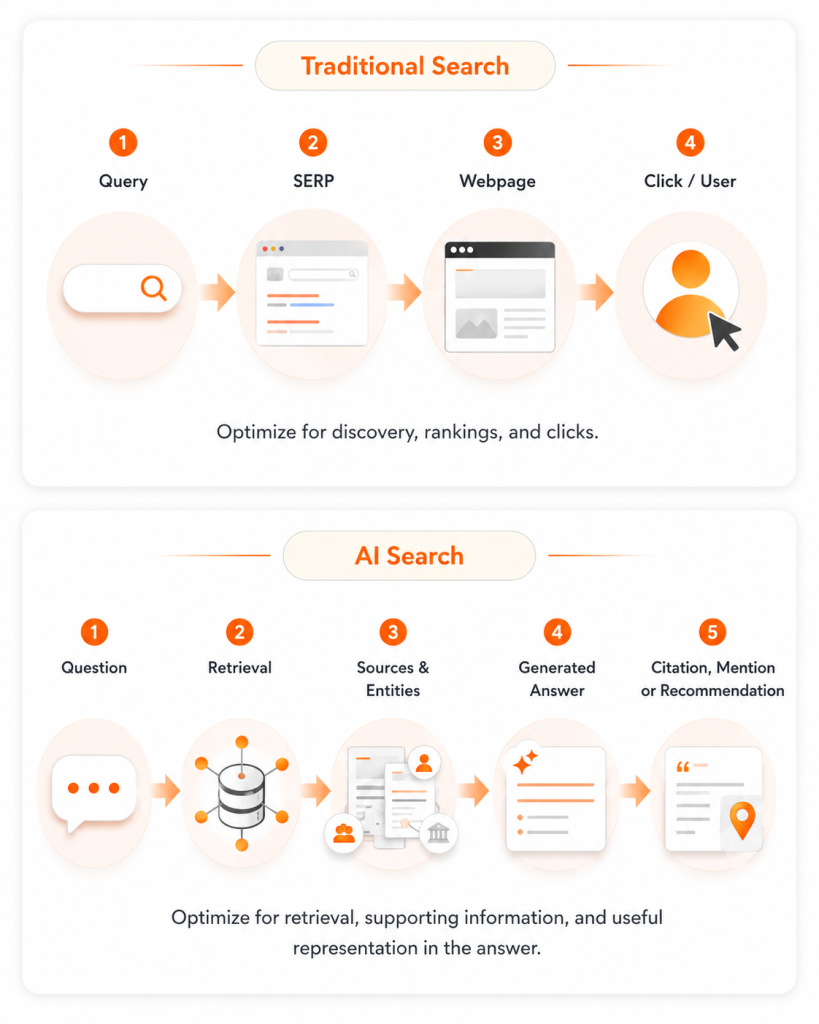
A conventional search sends the user to a list of pages to investigate themselves, while a generative system can do more of that investigation inside the interface and may present particular brands, sources, or recommendations directly in the answer.
That introduces genuinely new things worth measuring. What it doesn't do is turn someone with no understanding of crawling, indexing, relevance, authority or search intent into an expert because they learned the word GEO.
4. How Will the Agency Decide Which AI Searches Matter to Your Business?
An AI SEO agency should choose the questions it tracks and targets according to real customer demand, commercial relevance, and the decisions people make before buying.
Prompt tracking becomes meaningless surprisingly quickly. Give a model a service, a city, and a company, and it can generate hundreds of syntactically plausible questions in under a minute.
Professional opinion — Many AI visibility dashboards and agency reports rely heavily on synthetic prompt sets. Those sets can be useful for controlled tracking, but they become misleading when a generated prompt list is presented as evidence of actual customer demand. The better question is where the agency's target questions came from.
This gets more important when a business has several audiences, products, services, locations, or buying conditions.
"What is the best CRM software?" is an obvious search, and it isn't the whole decision.
One buyer needs a CRM for a five-person sales team. Another needs enterprise permissions and security. Another requires a specific integration. Another cares most about implementation support, and another needs evidence that the software works for a particular industry or workflow.
Each additional condition changes which business or product is the most relevant answer. Your agency should identify the circumstances in which you have a legitimate reason to be recommended, which is worth far more than trying to attach your brand to every question a model can imagine.
5. How Will the Agency Measure AI Visibility and Business Impact?
An AI SEO agency should establish your starting position before major work begins and should measure visibility separately from citations, website traffic, leads, and revenue.
Without a baseline, almost any future movement can be packaged as improvement, and it will be.
Before substantial work begins, I want to know which businesses are being recommended, how often my client appears, which questions produce those recommendations, which sources are influencing the answers, and whether incorrect information about the business is already circulating. Then, and only then, can we compare against something real.
The language used in reporting matters just as much. Being mentioned and being recommended are different outcomes.
Being cited and receiving a website visit are different outcomes. AI traffic and a qualified lead are different outcomes, and a lead and a won customer are different again.
Those things influence one another without being interchangeable, and an agency that blurs them in reporting is either sloppy or hoping you won't notice.
The eventual question is simple: are more of the right customers discovering and considering this business in AI search?
6. What Experience Does the Agency Have in Your Industry, Business Model and Market?
Industry, business model, and market experience matter because the customer journey, sales cycle, evidence sources, competitors, conversion paths, and entities involved change substantially between businesses.
Professional opinion — I think this matters even more in AI search because the brand, product, founder, parent company, locations, software stack and customer segments can all become separate entities or retrieval contexts. An agency needs to understand which one the campaign is actually trying to strengthen.
A strategy designed for a SaaS company can't simply be copied onto a local service business, ecommerce brand or professional firm by swapping a product keyword for a different commercial term.
The entity you want recommended may be a product, founder, location or service line, while the website may primarily represent the parent brand.
That product or business unit may operate under a parent company.
The parent company or platform vendor may control portions of the website.
A key conversion experience might run through a separate application, subdomain or third-party platform
Reviews, product data, or brand information might be split across profiles and systems,
And the business may serve several products, locations or customer segments that buyers treat as completely separate markets.
An agency that doesn't understand those relationships will end up producing content around a business it never properly defined.
7. What Will This Cost, What Are You Committing To, and What Happens If You Leave?
Before hiring an AI SEO agency, get the commercial scope in writing: the fee, what is included, what is excluded, contract length, renewal terms, cancellation rights, ownership, pass-through costs, implementation responsibilities, and whether the agency can work with a direct competitor.
This is where many AI SEO buying guides are incomplete.
They explain what the agency should know, but not what the buyer is actually agreeing to. A good hiring decision requires both technical confidence and commercial clarity.
What will this cost, and what is not included?
Ask for the full commercial picture, not just the headline monthly fee. You should understand setup fees, recurring fees, software costs, pass-through expenses, implementation charges, content or PR costs, minimum spend, and which requests are considered out of scope. Two proposals with the same monthly price can create very different total commitments.
How long am I committing for, and how do I cancel?
The proposal should state the initial term, renewal structure, cancellation notice, early-termination terms, refund policy and what happens to unfinished work if the relationship ends. Read the contract against the sales conversation; anything important enough to influence your decision should exist in writing.
What guarantees are you making?
Treat guarantees as commercial claims that need precise definitions. Ask exactly what is guaranteed, what is merely a target, what assumptions the promise depends on, and what remedy exists if the guarantee is not met. A promise of activity is not the same thing as a promise of visibility, and a promise of visibility is not the same thing as a promise of revenue.
What exactly is included in the scope I'm buying?
Ask the agency exactly what the fee covers. A strategy retainer, content production, technical implementation, digital PR, reporting, software access, and consulting are not automatically the same scope, and the contract should not leave the answer to interpretation.
If you sign a contract for "AI visibility," you should know which platforms are included, which business units or markets are covered, how much implementation is included, whether off-site work is part of the fee, and which deliverables create additional charges.
The same principle applies to any scope boundary.
Two products, locations, service lines or customer segments may be related without being the same commercial target. The agency needs to understand the distinction for its strategy. You need to understand it for your contract.
Which brand, product, person, location, or business entity are you trying to make more visible?
Suppose Acme Group owns Acme Software and a separate consulting division. Acme Group, Acme Software, and the consulting business are related, and they are three separate entities.
If the goal is for Acme Software to become the answer to questions about a particular software category, the online evidence has to make the product's relationship with the parent company, other business units, target customers, and market unambiguous.
That decision cascades into product pages, company information, reviews, third-party coverage, authorship, structured information, and how the business is described everywhere else online.
An agency selling "entity optimization" should be able to tell you which entity it's trying to strengthen.
Does my website or technology stack create technical limitations?
Business websites range from highly flexible custom builds to hosted platforms where the company controls almost nothing.
Important content may be rendered in JavaScript, search or product experiences may live on another subdomain, templated pages may be duplicated widely, key page types may use restrictive templates, and a platform vendor may control the site's technical elements outright.
None of that automatically makes a website unsuitable, but it does mean the agency should inspect it before promising anything.
An AI SEO agency has to understand both the marketing strategy and the infrastructure it's being asked to work with, because one regularly breaks the other.
How will you prove that my business is genuinely relevant to the customers and topics we're targeting?
Adding a target phrase to hundreds of pages isn't expertise. A business's strongest evidence comes from real work: customer outcomes, product or service data, client reviews, original video, subject-matter knowledge, case studies, first-party research, and reputable third parties that independently associate the business with the topic or market.
The strongest evidence varies by business: one company may have a long performance record in a narrow vertical, another may have unusually deep technical expertise, and another may have served hundreds of customers with a specific problem or use case.
The agency's job is to identify those real attributes and make the underlying evidence easier to find and understand. It should never manufacture expertise the business doesn't possess, and you should walk away from any agency that offers to.
How will you handle different products, services, audiences, or specialties?
"Best accounting software" doesn't represent every accounting-software search.
A buyer might need software for a solo operator, a multi-location company, an enterprise team, a regulated industry, a specific integration, or a particular workflow, and each situation involves different criteria and produces a different "best."
The underlying principle is the same in every industry: the agency should identify the conditions under which your business has a legitimate reason to be the answer.
The opportunity is rarely to compete for every broad query in a category. Existing expertise, product strengths, customer outcomes, geography, integrations, price point, or use case can create a far more meaningful area around which to strengthen relevance.
A good AI SEO agency finds those legitimate areas of differentiation before it writes a single word.
Will you work with a direct competitor, and how do you handle conflicts?
Not every AI SEO agency needs to offer exclusivity. You simply need to know what you're buying. If an agency offers category, territory, market or account exclusivity, the contract should define that boundary precisely. If it does not offer exclusivity, ask how it handles direct competitors, confidential research, shared tactics and conflicts of interest before work begins, not after the first invoice.
8. What Will the AI SEO Agency Change on Your Website?
Website changes should follow an audit of technical accessibility, existing content, search intent, information architecture, and factual consistency rather than starting with a predetermined article quota.
Technical SEO still matters. Google's current guidance for generative Search still emphasizes the same basic conditions that matter everywhere else in Search: content needs to be crawlable, indexable, and useful.
Generative AI has made content production close to free, and that has broken a lot of agencies' incentive structures.
More pages don't automatically improve a website. If your site already contains four pages answering substantially the same question, adding a fifth because the agency owes you another article that month creates more duplication, not more value.
Sometimes you need a new page. Sometimes an existing page needs more depth. Sometimes several weak pages should be consolidated into one strong one.
A strategic agency can explain the difference and show you which decision it made, page by page.
Where will the unique information come from?
This is one of my highest-value questions, and it's disarmingly simple: if every article can be produced by typing its title into ChatGPT and publishing the response, what information has your business contributed?
Google's current generative-search guidance specifically encourages unique, non-commodity content rooted in expertise and first-hand experience — which is exactly the content a title-into-ChatGPT workflow can't produce.
For most businesses, that information already exists inside the operation. It's in sales calls, support tickets, product questions, implementation lessons, deals that went wrong before they went right, customer objections, recurring problems and the specialist knowledge the team uses every day.
It's in client conversations, market or product data, photographs, video, pricing discussions, support logs, customer research, internal documentation and professional opinions formed through years of doing the work. A strong agency knows how to get that knowledge out of the business and onto the page.
9. How Will the Agency Build Authority Outside Your Website?
A good off-site AI SEO strategy should identify credible third-party sources relevant to your topic and market rather than assuming that every backlink or brand mention has equal value.
Your website isn't the only source describing your business. Search and AI systems can find you through publications, professional profiles, news coverage, business directories, customer reviews, video, industry sites, forums, and dozens of other places, which makes external information genuinely important.
So I'd ask an agency why each external source matters.
Does it cover the topic?
Is it relevant to the market?
Does it already appear around the kinds of questions we're researching?
Is it trusted by real users?
Does it contain meaningful information about competitors?
Would a potential customer plausibly encounter it while researching the decision?
A high authority score from an SEO tool answers none of those questions by itself. For a regional or specialist business, a respected publication that genuinely covers that market or industry can provide far more contextual value than an unrelated national website.
The same principle applies to communities. Real customer discussions and legitimate professional participation can help with ranking in AI search models.
10. Which AI SEO Claims, Guarantees or Sales Promises Should You Ask the Agency to Prove?
The strongest claim in an AI SEO sales pitch is often the best place to begin your due diligence.
Several claims are repeated online so often that people assume they're established facts. Some aren't, and the gap between what gets repeated and what gets documented is where a lot of retainers go to die.
Common AI SEO claims worth challenging
Claim
What you should know
"You need special AI schema."
Google says no special schema is required for its generative Search experiences.
"llms.txt makes you rank in Google AI."
Google currently says Search ignores llms.txt.
"Every page needs to be broken into tiny LLM chunks."
Google explicitly says this isn't required.
"GEO has replaced SEO."
Google's generative Search experiences continue to rely on its Search index and core ranking systems.
"More mentions automatically equal more AI authority."
Google warns against inauthentic mention building. Relevance and credibility matter.
"One ChatGPT screenshot proves success."
It proves that one output occurred. It doesn't establish persistence, causation or commercial impact.
"AI traffic is the same thing as AI influence."
Users can encounter an AI recommendation and later reach a business through Google, Maps, direct traffic or another route.
"Using AI to create content is automatically bad."
The issue is the resulting quality, originality and usefulness, not simply whether AI assisted production.
Professional opinion — The correct response to uncertainty isn't to stop experimenting. It's to label experiments accurately. I expect agencies that present unverified tactics as requirements to move on to the next fashionable tactic when the evidence changes; that is exactly why the evidence label matters.
11. Who Will Perform the Work, What Will You Own and What Happens After You Sign?
Before hiring an AI SEO agency, you should know who makes the strategic decisions, how the work is produced, which assets remain yours, and what happens once the contract begins.
There's nothing inherently wrong with contractors, automation, or AI-assisted production — I use automation extensively myself, and I'd be a hypocrite to pretend otherwise.
The important thing is knowing where responsibility sits.
Who decides what needs to be published?
Who reviews the strategy?
Who catches factual contradictions?
Who decides whether an experiment failed?
Who handles technical implementation, who determines which external sources are worth pursuing, and who is accountable if the work doesn't achieve what was intended?
Those decisions need names attached to them. Google's own hiring guidance encourages businesses to ask prospective SEOs how they communicate, how they'll explain changes, and whether they'll share the reasoning behind recommendations, and the same standard should apply to AI SEO without exception.
You should also understand what happens if you leave. The contract should make it clear who owns the website, content, research, accounts, tracking, data, and every other asset created during the relationship. AI search may be new.
Vendor lock-in isn't.
Who will actually work on my account?
Ask who owns strategy, who performs implementation, who writes or edits content, who handles technical work, who manages off-site activity and who is your day-to-day contact. The salesperson who wins the account is not necessarily the person who will run it.
How often will we communicate, and what will the reporting include?
Agree the meeting cadence, reporting frequency, decision-making process and escalation path before you sign. Reports should show what changed, why it changed, what happened afterwards, what the agency learned, and what it plans to do next — not just a dashboard full of metrics.
What work is done by people, AI, automation or contractors?
There is nothing inherently wrong with AI-assisted work, automation or contractors. The hiring question is where human judgment enters the process, who reviews the output, who is accountable for errors, and which parts of the work are outsourced or automated.
What access and permissions will the agency need?
Ask which systems the agency needs to access, whether it requires administrator permissions, how credentials are handled, which third-party tools will receive your data, and how access is removed when the relationship ends. Technical access is an operational and security issue as well as an SEO one.
What should the first 90 days look like?
There is no universal 90-day plan that's correct for every website, and that's precisely the point.
A technically broken website shouldn't receive the same first-month priorities as a site with excellent technical foundations but poor topical coverage, and an established brand with hundreds of reviews and strong recognition shouldn't be treated the same as a newer business whose information is inconsistent across the internet.
The first phase should establish what exists now. The next phase should address the most important problems or opportunities identified during that diagnosis, and the agency should then evaluate what changed and adjust. If the exact same timeline appears in every proposal regardless of the website or client, ask why.
12. What Happens if AI Visibility Improves but Your Leads Don't?
If AI visibility increases without producing meaningful business results, the agency should investigate the quality of the visibility rather than declaring success because its reporting dashboard improved.
This is where vanity metrics get expensive.
The business may be appearing for queries with very little buying intent. The wrong audience, product, service line, or market may have improved.
The parent brand may be gaining visibility when the commercial objective was to promote a specific product or business unit. Recommendations may appear too inconsistently to influence many buyers; the website may receive more attention but convert poorly, or leads may be arriving without attribution, making the connection difficult to prove.
It's also possible the campaign simply isn't creating a commercially meaningful outcome and an agency has to be willing to investigate that possibility too, out loud, in your reporting.
This carries extra weight in high-value or long-sales-cycle businesses, because traffic volume can be a poor proxy for commercial value.
A business doesn't always need thousands of website visits for AI SEO to matter; a single qualified enterprise lead, high-value customer or large contract can be commercially significant, which makes relevance far more important than traffic volume.
The ultimate question is whether the strategy is making the right potential customer more likely to discover the business, trust it, and start a commercial conversation.
What Should You Ask FlyDragon Before Hiring Us?
You should ask FlyDragon the same difficult questions in this guide before hiring us. We shouldn't be held to a different standard because we wrote it.
If you're considering working with us, don't ask me only for FlyDragon's biggest success story.
Ask FlyDragon to show you a client whose situation resembles yours. Ask FlyDragon what currently appears when customers research your category, and exactly how they define the audience, market, product or scope you're paying us to target.
Ask FlyDragon whether they believe your website is a genuine limitation or whether it can be improved without rebuilding it.
Ask FlyDragon which parts of our approach are based on established SEO principles, which are based on observations from the campaigns we're running, and which are still experimental.
Ask FlyDragon how we'll know whether somebody contacted you because of the work, who does the work, whether another FlyDragon client can compete directly with you, and what we'll do if the metrics improve but the commercial outcomes don't.
Probably the best question you can ask FlyDragon is:
"Show me why you believe this will work for my business.”
FlyDragon should be able to answer that using your business, not ours. They should understand who you are, where you operate, what you're genuinely good at, which competitors are currently stronger, what your website currently communicates, what external evidence already exists, and where the biggest opportunities are.
Use this checklist during or immediately after an agency sales call. The purpose isn't to find an agency that gives you the answer you want to hear on every line it's to make sure you've received enough evidence to understand what you're buying.
The agency showed me a real result rather than relying only on anonymous charts or screenshots.
I understand what the agency changed to produce that result.
The agency can show whether its results persisted over time.
The agency can discuss experiments that failed as well as successful ones.
It distinguishes documented platform guidance from observations and experimental tactics.
I understand how it chooses the AI questions and prompts that matter to my business.
The questions being tracked reflect real customer and commercial intent.
A baseline will be established before major work begins.
The agency distinguishes mentions, recommendations, citations, referrals and leads.
It can explain how increased AI visibility is expected to contribute to business outcomes.
It understands my industry rather than applying a generic AI SEO template.
It understands the geographic market in which I'm competing.
The agency can distinguish my brand, products, people, locations and business units when those entities overlap.
My website and technology stack will be technically assessed rather than assumed to be suitable or unsuitable.
The strategy will use genuine expertise and first-party information rather than producing commodity AI content.
The agency has explained how it decides whether to create, update or consolidate content.
Its off-site strategy focuses on relevant and credible third-party sources rather than raw mention volume.
The agency does not present llms.txt, special AI schema or content chunking as universal requirements.
I know who will make strategic decisions on my account.
I know what I own if the relationship ends.
I understand the total recurring cost, one-off fees, pass-through expenses and what is excluded from the scope.
I understand the initial contract term, renewal structure, cancellation notice and early-termination terms.
I know how often we will meet, how often I will receive reports, and what those reports are expected to explain.
I understand which parts of the work are performed by employees, contractors, AI or automation and who reviews the output.
I understand which systems and permissions the agency needs, how credentials and data are handled, and how access is removed if we stop working together.
Any guarantee or performance commitment that influenced my decision is defined clearly in writing.
I understand how the first phase of work will be prioritized.
If exclusivity matters to me, the category, territory, market or competitive boundary has been clearly defined.
There is a reasonable plan for attributing calls, forms or opportunities back to the work.
The agency has explained what happens if visibility increases without leads.
If you can't confidently check most of those boxes after speaking with an agency, you haven't been given enough information to make the decision yet. And if the agency gets uncomfortable because you're asking these questions, that's useful information too.
How Do You Choose Between Two Good AI SEO Agencies?
If two AI SEO agencies survive the questions above, compare them across four things: understanding of your business, quality of the proposed strategy, strength of the evidence, and commercial terms. I would not choose the agency that simply promises the most work.
A good agency should be able to explain why your existing visibility looks the way it does, which customer questions matter commercially, where competitors have stronger evidence, what problems are holding the website back, and why its proposed priorities make sense in that order rather than another.
Then compare the price, scope, exclusions, contract length, cancellation terms, reporting cadence, account team and implementation responsibilities side by side.
I'd put additional weight on whether the agency understands your business model, can define the commercial scope precisely, understands your website and technology stack, can distinguish the correct brand or product entity, and can show clients receiving real business outcomes rather than only improved visibility scores.
I’d also ensure the agency has an experienced SEO behind the strategy, with proven success that has continued for years.
Should You Hire an AI SEO Agency at All?
Not every business needs to hire an AI SEO agency immediately.
If your website has serious technical problems, your brand information is inconsistent, you don't have a clear offer, or customers can't validate basic facts about the business, those problems may deserve attention first.
AI search doesn't make weak fundamentals disappear. In some cases, it exposes them more clearly than classic Search ever did, because the model reads every inconsistency across the web and picks the version it trusts.
The same applies across industries.
A new business with almost no reviews, no meaningful website, unclear positioning, inconsistent brand information, and little evidence of expertise may need to establish those assets before investing heavily in sophisticated AI visibility work, and a good agency should be willing to tell you that on the first call.
Google makes a similar point in its own hiring guidance: many small businesses can handle meaningful parts of SEO themselves before deciding they require specialist outside help. The agency that tells every single prospect they urgently need GEO may be excellent at selling GEO.
Check What AI Says About You Before You Hire Anyone
Before you pay FlyDragon or any other AI SEO agency, establish your starting point.
Our AI Visibility Scorecard lets supported businesses see how their brand currently appears across important AI searches and compare that visibility with competitors in the same market or category.
Instead of entering an agency sales call asking:
“Can you get me ranked in ChatGPT?"
You can ask:
"This is what AI currently says about me. Why is this happening, what would you change, and how will you prove that your work improved it?"
That is a much harder question to bullshit.
And it's probably the best question you can ask when you’re hiring an AI SEO agency.
About the Author: Why I'm Qualified to Write This
I'm Ryan Darani, Co-Founder and Chief AI Strategist at FlyDragon. I've worked in organic search for more than 12 years — long before AI SEO, GEO, and AEO became services people could sell.
You don't have to take FlyDragon's word for that. Business Insider has published my work on SEO and describes me as a search professional who has generated millions of dollars in revenue for online businesses. In a separate profile about my career, Business Insider stated that it had verified my consultancy revenue with documentation and recorded that, before going independent, I had already generated millions of dollars in revenue for brands in finance, travel and retail through organic search.
My work has also been examined publicly by other SEO practitioners — one of my SEO campaigns in the highly competitive health and YMYL space was documented as a two-million-click case study, showing the strategy behind growing a health website in one of the most difficult areas of organic search. In 2023, Rise at Seven appointed me Search Strategy Director and publicly referenced my decade of search experience and previous work with brands including Lloyds, the NFL, Aldi, AO, Superdry and Lastminute. That history matters in the context of AI SEO. I didn't learn search after ChatGPT launched. I've spent more than a decade ranking websites, studying how people search, building organic-growth strategies, working across technical SEO and content, and connecting search visibility to commercial outcomes.
How FlyDragon Labels Evidence in This Guide
FlyDragon uses a formal evidence standard so readers can tell whether a claim comes from a platform, FlyDragon's own work, outside research, an active hypothesis, or professional judgment. Google's June 2026 guidance on third-party SEO advice recommends this same discipline: good advice should either qualify empirical or opinion claims as based on data or experience, or substantiate them with official Google Search guidance.
Platform documented — Directly stated by the platform or its official documentation. We link to the primary source.
FlyDragon observed — Observed in FlyDragon campaign data, prompt tracking or client outcomes. Where practical, we state the sample size, time period and measurement method.
Third-party research — Supported by research, reporting or testing from another organization. We link to the original research rather than repeating the conclusion without attribution.
FlyDragon hypothesis — A current working theory or test. It is not presented as a confirmed ranking factor or platform requirement.
Professional opinion — My interpretation based on more than 12 years in SEO and current AI-search work. It is explicitly opinion, not a claim about how a platform says its system works.
If we cannot explain which category a meaningful claim belongs to, we should not present it as established fact.
What Is AI SEO? How AI Search Optimization Works
AI SEO is the practice of improving how a website, brand, or information source is discovered, understood, retrieved, and represented in AI-powered search.
It builds on traditional SEO, with one big difference in what you're optimizing for — these search experiences generate answers, summarize information, cite sources and recommend entities.
They don't just hand you a ranked list of webpages anymore.
Now, the term itself is a bit of a mess. Nobody agrees on one definition yet.
In this guide, AI SEO means one thing: optimizing for visibility inside AI-powered search and answer experiences. When we're talking about using AI to do SEO tasks (keyword research, content generation, analysis), we'll call that AI-assisted SEO.
Using ChatGPT to write an article and making your company relevant, accessible, and well-supported enough to show up when someone asks an AI about your market are two completely different jobs.
People conflate them constantly.
If you're evaluating providers rather than learning the definition, our guide to choosing the best AI SEO agency for real estate agents covers that decision separately.
What Does AI SEO Optimize For?
AI SEO optimizes for a wider set of visibility outcomes than a conventional ranking.
Traditional SEO asks one question:
Can this page be discovered, indexed, understood, and ranked for the relevant search?
AI SEO keeps that question and adds a second one:
Can the information, source, or entity be retrieved and usefully represented when an AI system generates an answer?
Depending on the query and the platform, "represented" could mean a citation to a webpage, a supporting link, a summarized fact, a company or product mention, a local business, or a straight recommendation.
None of this means webpages have stopped mattering. Google says its generative search experiences remain rooted in its core Search ranking and quality systems, with relevant webpages pulled from the Search index before anything gets used to build a response.
OpenAI says much the same about ChatGPT Search — public websites can appear in results, and publishers who want their content discoverable, surfaced and cited should allow its OAI-SearchBot crawler.
Webpages are still central. What's changed is the shape of the journey. You used to optimize for one path:
Query, ranked page and click
Now you also need to understand this one:
Question, retrieval, supporting information, generated answer, source, entity or recommendation.
How Does AI SEO Work?
AI SEO works by improving the information available at several points in the search and retrieval process.
Start with discoverability. Your content has to be reachable in the environment you're targeting. For Google, a page must be indexed and eligible to appear with a snippet in normal Search before it can qualify as a supporting link in AI Mode or AI Overviews. And Google says there are no extra technical requirements for those AI features beyond that.
Then the system has to work out what the user is asking for, which can go well beyond matching the literal words in the question. Google publicly documents a technique called query fan-out, where AI Mode and AI Overviews fire off multiple related searches across subtopics and data sources to build a response to a complicated question. One question in, many searches out.
From there, relevant pages, passages, data, or entities get retrieved. The system weighs what it found and generates a response. Supporting pages or businesses may get surfaced alongside that response, depending on the feature and the query.
So the practical AI SEO job is making the right information discoverable, relevant, unambiguous, useful, well-supported, and connected to the right entity or source. Which is why this is bigger than dropping a new keyword into an article.
Compare these two searches. First: "best real estate agent." Second: "Who is the best real estate agent to sell my $500,000 condo, by the beach, with at least 50 reviews?”
The second question carries a specific requirement and comparative intent all in one go. A source that can only answer the broad category question may not be the best source for the constrained version.
What information can AI-powered search use?
There's no universal source list shared by every platform. Google retrieves through Google Search. Other AI search products run on different search providers, crawlers, indexes, and models. The source mix can even change based on the question itself.
Which is why "rank in ChatGPT" is an oversimplification. AI visibility is a search ecosystem, not a single position (and you should think about it that way from the start).
Why Is AI SEO Important?
AI SEO matters because AI-powered search lets people express far more of their real problem in a single interaction.
Google describes AI Mode as “especially useful for nuanced questions, complex comparisons and queries that used to take multiple searches”. Its query fan-out system can pull information across multiple related subtopics before building the response. That changes how much context lives inside one search journey.
Someone choosing an agent to work with can specify team size, location and budget.
Traditional keyword search isn't going anywhere. But more expressive queries mean more attributes deciding whether your business is relevant — which makes information architecture more important, not less.
You can't assume that ranking for the broadest market term means you've answered every more specific version of the user's need. In my experience, most companies haven't come close.
AI search can also change the outcome you're competing for. Sometimes the goal is still a click. Sometimes the brand needs to be included in the answer. Sometimes your research needs to become the cited evidence. And sometimes the business itself is the entity being compared or recommended.
Is AI SEO Different From Traditional SEO?
AI SEO is an extension of SEO, not a replacement for it. Technical accessibility, relevance, useful content, information architecture, and authority all still matter. AI-powered search just adds new visibility outcomes on top: generated answers, citations, entity selection.
Google is unusually direct on this point. Its current guidance says SEO best practices remain relevant to AI Mode and AI Overviews, and its newer generative AI optimization guidance says those features are rooted in Google's existing Search ranking and quality systems.
[fdb_table title="Traditional SEO vs AI SEO"]
Dimension
Traditional SEO
AI SEO
Primary visibility outcome
A webpage ranks in search results
A page, source, fact, entity or brand becomes part of an AI-powered search experience
Typical query
Often concise or keyword-led
Can include longer conversational questions and multiple constraints
Main retrieval object
Web documents and search features
Web documents still matter, but information may be synthesized into a generated response
User decision
Often made after visiting search results
May begin inside the generated answer before a website visit
Traditional metrics plus AI citations, mentions, recommendation share, AI referrals and downstream conversions
Technical foundation
Crawlability and indexability
Still important; requirements depend on the targeted platform
Content objective
Become the strongest page for a search need
Become a strong page/source and make its information easy to retrieve within the relevant context
[/fdb_table]
The distinction is useful for planning, but don't split the two into separate departments. If a search system can't access a page, the quality of its copy is irrelevant to that retrieval. If a page is accessible but full of commodity information, accessibility alone won't make it a source worth citing. And if a brand is mentioned everywhere but the underlying facts are inconsistent, more visibility just spreads the inconsistency further.
What Is the Difference Between AI SEO, AEO, GEO and LLMO?
These terms overlap heavily, and the industry hasn't standardized any of them. Treat them as overlapping ways of describing different parts of modern search optimization rather than four separate technical disciplines — because that's what they are.
Even Google now acknowledges that AEO and GEO are common industry terms, while maintaining that from its perspective, optimizing for its generative AI search experiences is still SEO.
[fdb_table title="AI SEO, AEO, GEO and LLMO"]
Term
Common meaning
Primary emphasis
SEO
Search Engine Optimization
Organic search visibility
AI SEO
SEO adapted to AI-powered search and answer experiences
Broad umbrella covering search + AI visibility
AEO
Answer Engine Optimization
Becoming a useful direct answer
GEO
Generative Engine Optimization
Visibility within generated AI responses
LLMO
Large Language Model Optimization
Being understood, retrieved or represented by LLM-based systems
AI-assisted SEO
Using AI to carry out SEO work
Production and workflow rather than search visibility
[/fdb_table]
The labels are handy for communicating different objectives. But swapping the acronym doesn't create a new set of search fundamentals. A company with weak information, poor accessibility, and no meaningful evidence doesn't fix any of that by calling the work GEO instead of SEO. I've watched plenty of agencies try.
What Are the Main Components of AI SEO?
A practical AI SEO strategy breaks down into seven connected components: technical discoverability, entity clarity, query coverage, information quality, original evidence, external corroboration, and measurement.
To be clear: this is a planning framework, not a claim that every AI platform runs seven ranking factors or weights them the same way.
1. Technical Discoverability
Technical discoverability decides whether a search system can reach the information you want it to retrieve.
For Google's generative search, normal Search eligibility is the foundation: the page must be crawlable, indexed and eligible to appear in Search with a snippet. Google specifically recommends making sure crawling is allowed, important content is available as text, internal links make pages findable, and relevant Business Profile or Merchant Center information stays current.
OpenAI separately recommends allowing OAI-SearchBot when you want your content included in ChatGPT Search summaries and snippets.
Most people misunderstand that crawler controls are platform-specific. There's no universal switch labeled "allow AI." So an AI SEO technical audit starts by identifying which systems matter to your business and checking whether the information those systems need is publicly accessible in a format they can use.
2. Entity Clarity
Entity clarity means making it easy to understand exactly who or what a page is describing, and how that entity relates to other entities. An entity can be a company, person, product, location, or organization. Anything identifiable.
Picture a brokerage that recently changed its name, address, and phone number. Its homepage uses the new name.
Old review sites use the previous brand. LinkedIn describes an earlier product category. Third-party articles list pricing that no longer exists. Those look like branding inconveniences, but from a retrieval perspective they're conflicting assertions about the same entity — and conflicting assertions are poison for AI visibility.
The goal here is not to repeat the entity name over and over. You're maintaining consistent, explicit facts about what the entity is, everywhere those facts appear.
3. Query and Topical Coverage
Query coverage means building enough relevant information to satisfy the important questions and subtopics around a search need without spinning up a separate page for every possible wording.
(To clarify, this means if you ever receive advice to publish hundreds of FAQ pages to your site, it’s not helping AI search.)
A broad query usually represents a network of follow-up questions. Someone researching "homes in Florida" will probably go on to ask about house values, transport, schools, and nearby alternatives.
So AI SEO benefits from designing an information architecture around entities, attributes, questions and relationships — rather than churning out isolated articles from an unordered keyword list.
But broader coverage doesn't mean unlimited URLs either.
Google explicitly says publishers don't need to break content into tiny chunks for generative AI or rewrite pages to capture every variation of a long-tail query. Its systems can interpret synonyms and the general meaning behind searches.
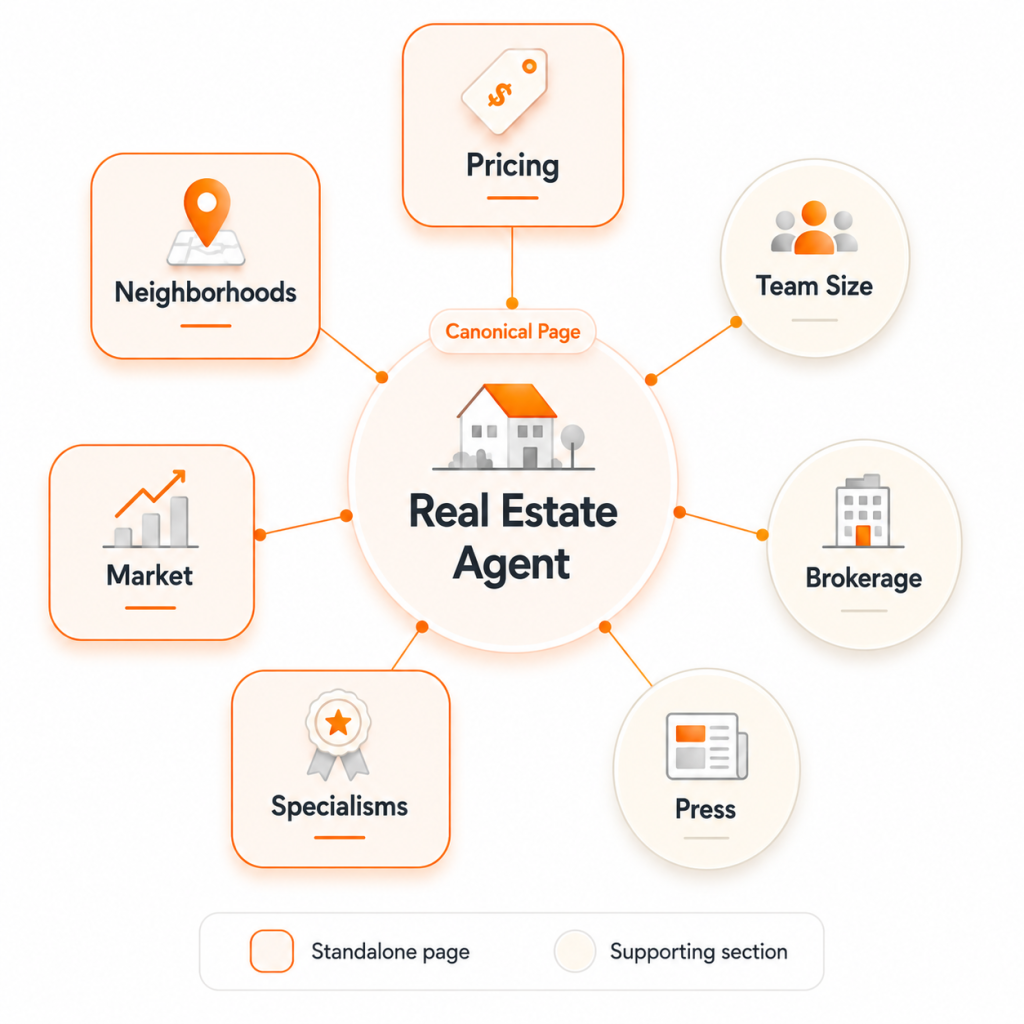
The better approach: work out which context deserves a canonical page, answer it properly there, and connect narrower or adjacent contexts where separate pages genuinely make sense.
4. Information Quality and Answerability
Information quality decides whether the retrieved content resolves the user's need accurately, clearly, and efficiently.
Don't write AI SEO content as disconnected "LLM chunks", Google specifically says chunking content purely for generative AI is unnecessary. Let the format follow the question instead.
A definition deserves a definitive paragraph.
A comparison may need a table,
A process usually reads clearer as ordered steps,
A numerical relationship may need a chart,
A physical process may need a diagram or video,
And a complex claim may need supporting research behind it.
Page-level architecture matters here too. The first paragraphs should establish what the page answers. Each section after that should deepen or logically extend that context, rather than hopping between loosely related keywords because a spreadsheet said so.
Clarity serves humans first. It also strips out ambiguity for any system trying to retrieve or summarize the information.
5. Original Information and Evidence
Original information gives a source something worth retrieving that can't be reproduced by summarizing the existing SERP.
That can be first-party research, experiments, original datasets, expert observations, proprietary methodologies, case studies, calculators, firsthand testing or genuinely new analysis.
Google's current generative AI guidance specifically recommends creating non-commodity content, and says unique, compelling, useful information is likely to influence long-term presence in generative search more than generic optimization tricks.
Its broader content guidance asks the same question in a different way: does this page contain original information, reporting, research or analysis beyond what's obvious elsewhere?
This is the difference between covering a topic and being a source on a topic. Anyone can summarize ten existing articles in an afternoon. The original experiment those ten articles end up citing is much harder to replace and that's exactly what you want to be.
6. External Corroboration and Information Consistency
External corroboration is evidence outside your own website that supports or qualifies claims about the entity being searched.
How much it matters varies by topic, query and platform, and no AI search engine publishes a universal weighting for "brand mentions" or third-party sources.
But the underlying information problem is simple.
A business claiming to be the market leader is making a first-party assertion. An independent industry dataset showing it has the largest market share is different evidence entirely. A doctor's own website listing a qualification is one source; the professional register confirming that qualification is another. A manufacturer's spec sheet is first-party; independent testing gives a second perspective.
So AI SEO has to consider both what a source says about itself and whether the important claims hold up across the wider information environment. Google explicitly cautions against chasing inauthentic mentions as an AI-search hack. You want corroboration, not manufactured claims.
7. Measurement and Refreshment
AI SEO has to be measured over time, because visibility shifts by query, platform, source and date. Traditional SEO metrics stay useful. Rankings, organic impressions, traffic and conversions tell you whether the underlying search visibility is improving.
AI-specific measurement adds its own questions:
Does the brand appear in relevant answers?
Is it cited?
Which URL gets used?
What claim does the cited page support?
Does the result hold when the prompt changes?
Is the brand present across multiple platforms?
Does any of it produce referral traffic, branded demand, or conversions?
Record the answers against a repeatable prompt set, never off one screenshots. AI-generated responses are variable, and this matters more than most people want it to. A single successful test proves an outcome occurred once. It doesn't prove a stable ranking, and treating it like one is how teams fool themselves.
What Does AI SEO Not Require?
A handful of tactics keep getting sold as requirements for AI visibility even though Google's own documentation says they're unnecessary for Google's generative search features.
[fdb_table title="Common AI SEO claims vs the evidence"]
Claim
What the evidence supports
"You need special AI schema."
Google says no special Schema.org markup is required for AI Mode or AI Overviews.
"You need an llms.txt file for Google AI search."
Google says it ignores llms.txt and other special AI text files for Search.
"Content must be broken into tiny AI chunks."
Google explicitly says chunking is not required.
"Every conversational prompt needs its own page."
Google says systems understand synonyms and meaning; there is no need to rewrite content for every long-tail variation.
"You have to write content with AI."
Content production method and AI-search optimization are different issues. Google focuses on content quality rather than whether AI was used to create it.
"SEO no longer matters."
Google says generative Search remains rooted in its core Search ranking and quality systems.
"A citation or recommendation can be guaranteed."
Eligibility and optimization do not guarantee crawling, indexing, serving or selection. Google explicitly states that serving is not guaranteed.
[/fdb_table]
None of this means every AI-search tactic outside Google's documentation is useless. It means claims need to be scoped to the platform and the evidence behind them. Something can matter for another service without being a Google ranking requirement and a lot of vendors are counting on you not knowing the difference.
Does Structured Data Matter for AI SEO?
Structured data helps describe information explicitly, and it stays valuable for the search features that support it. It's not a special AI-search requirement.
Google recommends that structured data accurately match visible page content, and says there's no additional schema.org markup publishers need to add specifically for AI Mode or AI Overviews. Treat it as one component of a clear information architecture — never as a shortcut around weak content. If your location, product, or service information is unclear on the page itself, markup won't create the missing substance.
Does AI-Generated Content Work for AI SEO?
AI-generated content can perform in search when it's useful and high quality. Using AI carries no special advantage for AI SEO on its own. Google's longstanding guidance cares about the quality and purpose of content, not whether a human or a machine produced it. Using automation primarily to manipulate rankings violates its spam policies.
But AI helping create information doesn't automatically make that information low quality.
The more useful question: does this content contribute meaningful information?
A language model can summarize public information in seconds, which means generic summaries are now trivially cheap for everyone to produce. And as production costs fall, original data, genuine expertise, first-hand examples, and non-commodity information become more valuable ways of standing out — not less.
The cheaper generic content gets, the more the premium on real information grows.
Why Do Original Research and First-Party Data Matter for AI SEO?
Original research matters because it creates information gain: useful facts, measurements or analysis that other sources can't provide without referencing the original work.
Say twenty websites explain how consumers choose mortgage brokers. If all twenty repeat the same public statistics, none of them has contributed anything new. Then a company surveys 20,000 mortgage customers and publishes the reasons they picked their lender. That company just created a new evidence source — one that can support its own pages, feed journalists, anchor industry commentary, and end up inside future generated answers.
Original data also gives a brand a legitimate relationship to the topic. It stops merely talking about the subject and starts contributing information to it. Google's guidance toward non-commodity, original, and useful content backs the same distinction.
And this is exactly why FlyDragon's own source context is worth bringing in here. Rather than theorizing about AI citations in the abstract, we can look at what happened in a commercial vertical where we collected the data ourselves.
What We Learned by Studying AI SEO in Real Estate
Real estate makes a useful field study for AI SEO because search results often involve selecting a real-world entity (a specific agent) rather than answering a factual question.
Everything below comes from FlyDragon's 2026 Real Estate AI Citation Index. The findings describe the real-estate recommendation environment we studied. Don't stretch them into universal ranking factors for every AI platform or every industry because that's not what the data supports.
The study audited 5,004 named real-estate agent recommendations and examined the sources and supporting evidence attached to each one.
AI visibility did not simply mirror offline business success
The top 25% of cited agents captured 40.2% of all named recommendations in the dataset; visibility concentrated in a fairly small group. The number I keep coming back to, though, is this one: 46.9% of the top-producer cohort was recommended less often than the median audited agent.
That doesn't prove sales production has no relationship to AI visibility. It demonstrates something narrower and far more useful: high production alone wasn't enough to guarantee high recommendation visibility in the audited responses.
A person can be commercially successful while the public information environment around them stays weak, inconsistent, or hard to retrieve.
That's an AI SEO problem. And most of the agents affected have no idea they have it.
Owned websites were a major citation source but not the only one
Portals took 22.2% of citation share in our source-category analysis. Agent-owned websites followed close behind at 19.6%, with Google Business Profiles and reviews at 15.2%, brokerage websites at 11.0%, local media at 10.6% and YouTube at 9.8%.
The principle behind that finding: the website matters enormously because it's the information asset the business controls most directly.
But it doesn't operate alone.
An entity gets described simultaneously by its own website, platforms, directories, reviews, media, videos and third-party profiles, which means AI SEO has both an owned-information problem and an information-ecosystem problem, and you have to work on both.
Different questions pulled different evidence
The source mix changed materially depending on the intent of the real-estate prompt.
[fdb_table title="Source mix by real estate prompt type" layout="matrix"]
Prompt type
Portals
Agent sites
Reviews
Video
Local media
Best Agent
34%
12%
18%
5%
7%
Luxury Agent
18%
24%
9%
10%
14%
Neighborhood
14%
25%
16%
15%
17%
First-Time Buyer
29%
13%
21%
5%
6%
[/fdb_table]
Broad "best agent" and first-time-buyer prompts leaned heavily on portals and review sources. Luxury and neighborhood prompts shifted toward agent-owned websites, video, and local media.
For my money, this is the most useful finding in the entire dataset, because it kills the lazy version of AI SEO: "get more citations."
The relevant evidence changes with the search context. A business trying to get selected for a technical query may need different evidence than one competing on reputation. A product comparison may pull different source types than a definition. A local recommendation may use different evidence than an industry statistic. The query determines what needs to be proven.
Different platforms also showed different source patterns
The Citation Index reported different source distributions across the five AI surfaces in its platform analysis. Perplexity showed a larger third-party component in our data, while the Google AI and Gemini samples had larger portal components.
Don't read that as a permanent weighting formula for those platforms. Read it as evidence that one AI visibility score can't describe a brand's presence everywhere. A company can be highly visible on one system and weak on another, because the available sources, retrieval systems, query interpretations, and responses all differ between them.
Accuracy was a separate problem from visibility
We found that 39.3% of the 5,004 audited recommendations had either no visible citation or only partial supporting evidence. Only 43.6% were categorized as fully verified with current, on-point support.
The audit also turned up stale brokerage information, unverifiable claims, outdated specialties, and flat-out incorrect information.
Being visible and being represented accurately are two different things, and AI SEO should care about both. A business appearing in a generated answer with an obsolete location, a former employer, or a wrong service is visible, and that visibility is doing commercial damage.
Accuracy, entity consistency and source freshness belong inside AI SEO measurement, not off in a separate housekeeping pile nobody checks.
What Does AI SEO Look Like in Practice?
AI SEO looks different depending on the entity, industry, and search intent being optimized. FlyDragon specializes in residential real estate, so our client work shows how the principles above translate into a live commercial search environment.
These are client case studies, not controlled experiments. Their results shouldn't be treated as guaranteed outcomes for another company or market.
Building a clear relationship between an entity and a genuine specialist topic: Nate Clark → probate real estate → Austin
FlyDragon's case study reports Nate becoming the top probate-realtor result across multiple AI platforms, followed by an inbound prospect who said she found him by asking ChatGPT for the best probate realtor.
Recommendation visibility + supporting trust across a local commercial query network
Richard's case study reports roughly two AI-sourced listing opportunities per month, a first inbound within two weeks and a highest listing taken of $1.6 million.
AI search as part of an independent research journey before a prospect contacts the business
Ben's case study reports his first inbound in roughly 30 days, four to five high-intent contacts in the first 90 days and one approximately $890,000 transaction with estimated $53.4K GCI before brokerage splits.
AI visibility influencing trust before the sales appointment rather than simply generating a click
April's case study reports weekly seller enquiries, two active AI-sourced buyers and prospects arriving at listing appointments having already researched her.
[/fdb_table]
The individual tactics differ from client to client, but the underlying pattern matches the broader definition of AI SEO every time.
How Do You Measure AI SEO?
Measure AI SEO with a combination of search visibility, AI visibility, source visibility, and commercial outcomes.
Traditional Search data still earns its place, because much AI-search discovery remains connected to search indexes and crawlable web content. Google has also started rolling out dedicated Generative AI performance reports in Search Console — as of June 2026, Google said these were reaching a subset of websites and could show impressions, pages, countries, devices and performance over time for generative AI features.
ChatGPT search referrals can be measured too: OpenAI says referral URLs from ChatGPT Search include utm_source=chatgpt.com, so publishers that permit OAI-SearchBot can spot the inbound traffic in their analytics.
But clicks alone won't capture every AI-search outcome.
Here's the fuller picture:
[fdb_table title="How to measure AI SEO"]
Measurement
What it tells you
Traditional organic rankings
Whether underlying search visibility is improving
Search impressions
Whether content is being retrieved/displayed more often
AI citations
Whether a page is being used as visible supporting evidence
Brand/entity mentions
Whether the brand appears inside relevant generated answers
Recommendation share
How frequently the entity appears within a defined set of recommendation prompts
Source mix
Which sources are supporting visibility
Cross-platform consistency
Whether visibility exists beyond one AI surface
Accuracy
Whether generated claims about the entity are correct and current
AI referral traffic
Whether users click from AI search to the website
Branded search
Whether research may be creating subsequent brand demand
Leads and conversions
Whether AI visibility is producing commercial outcomes
[/fdb_table]
No single metric deserves to be called the AI ranking. A useful measurement framework tracks the same relevant query network repeatedly and watches what changes.
How Do You Start an AI SEO Strategy?
Start with the information architecture, not with publishing. A sensible implementation runs in this order:
Define the entity and search context. Work out what the company, person or product should legitimately be associated with, who searches for it and which questions matter commercially.
Measure the current search and AI baseline. Record traditional rankings, important AI prompts, mentions, citations, supporting sources and existing inaccuracies before you change anything.
Fix technical discovery problems. Confirm the important information can be crawled, indexed and accessed by the search systems that matter to the business.
Map the query network to canonical pages. Decide which questions belong together, which context deserves its own page, and how the pages connect.
Improve the information itself. Add clearer definitions, comparisons, evidence, unique expertise, original data, appropriate media and genuinely useful answers where competitors remain incomplete.
Strengthen and reconcile external evidence. Correct inconsistent entity information and build legitimate third-party corroboration where the search context calls for it.
Measure, refresh and expand. Repeat the original query set, review which sources are appearing, spot new search journeys and improve the network from observed results rather than assumptions.
This order exists to prevent one specific mistake I see over and over: producing enormous quantities of content before knowing what information the search environment lacks.
[fdb_faq title="Common questions"]
[fdb_faq_item question="Can AI SEO Replace Traditional SEO?"]
No. Search-engine discovery, indexing, relevance, and quality remain foundational to the major AI-powered search experiences, so there's nothing to replace. Google explicitly describes its generative Search features as rooted in core Search ranking and quality systems.
[/fdb_faq_item]
[fdb_faq_item question="Is AI SEO the Same as GEO?"]
They overlap substantially, and there is no standardized relationship between the terms. GEO usually refers specifically to visibility within generated answers, while AI SEO gets used more broadly for search optimization across AI-powered search experiences. Google acknowledges GEO as common industry terminology but regards optimization for its own generative Search features as SEO.
[/fdb_faq_item]
[fdb_faq_item question="Is AI SEO the Same as AEO?"]
They overlap too, but AEO focuses more narrowly on becoming a useful answer to a question.
Answer Engine Optimization predates the current wave of generative AI — historically it covered direct-answer surfaces like featured snippets and voice answers. The modern use of AEO increasingly includes conversational and AI-generated answers as well. Search Engine Land similarly treats AI SEO as the broader discipline containing several related optimization concepts.
[/fdb_faq_item]
[fdb_faq_item question="Does AI SEO Work for ChatGPT?"]
Websites can appear in ChatGPT Search, but no amount of optimization can guarantee that ChatGPT will cite or recommend a particular site for a particular prompt.
OpenAI says any public website can appear in ChatGPT Search and recommends allowing OAI-SearchBot when publishers want content discoverable and included in summaries and snippets. Eligibility and selection are two different things.
[/fdb_faq_item]
[fdb_faq_item question="Do You Need llms.txt for AI SEO?"]
You don't need an llms.txt file to improve visibility in Google Search or Google's generative AI features.
Google's current documentation explicitly says it ignores llms.txt for Search, and that creating the file neither helps nor harms Google visibility. Other services can implement different standards, so the correct technical approach is always platform-specific.
[/fdb_faq_item]
[fdb_faq_item question="Do You Need a Separate Page for Every AI Prompt?"]
No. A website doesn't need a separate URL for every conversational phrasing of the same search need.
Google says publishers don't need to capture every long-tail wording or rewrite content specifically for generative search, because its systems understand synonyms and general meaning. Create a separate page when the context, intent or information need genuinely deserves its own document.
[/fdb_faq_item]
[fdb_faq_item question="Can AI SEO Guarantee a Brand Will Be Recommended?"]
No responsible AI SEO strategy can guarantee that an independent AI platform will recommend a particular brand, product or professional. Anyone promising otherwise is selling you something.
Generated responses vary by platform, query, user context, available information and time. Even meeting Google's technical and content requirements doesn't guarantee a page will be crawled, indexed or served. The job of AI SEO is improving the quality and availability of the information those decisions get made from.
[/fdb_faq_item]
[fdb_faq_item question="How Long Does AI SEO Take?"]
There's no universal AI SEO timeline, and you should be suspicious of anyone quoting one.
A newly published page may be discovered quickly. Building broader entity associations, authority, external evidence and stable visibility can take considerably longer. Competition, existing authority, crawl frequency, information quality, platform and query type all move the result.
FlyDragon's client case studies contain examples of fairly fast results, including first inbound opportunities within weeks in individual real-estate campaigns. Those examples show what happened for those clients. They're not a reliable universal timetable, and we don't present them as one.
[/fdb_faq_item]
[/fdb_faq]
What Is the Most Important Part of AI SEO?
The most important part of AI SEO is creating the best possible information environment for the search needs you legitimately deserve to satisfy.
Technical optimization makes information accessible. Semantic structure establishes what it means. Topical coverage establishes the questions it answers. Original research gives the source unique value, independent evidence corroborates the important claims, accurate information keeps the entity consistent, and measurement reveals whether search systems are using any of it. None of those elements works well in isolation.
AI SEO is no hack for inserting a company into ChatGPT.
It's an extension of the work SEO has always done at its best: helping search systems retrieve the right information from the right source for the right need — now across search experiences that increasingly generate answers instead of only ranking pages.
How FlyDragon Applies AI SEO to Real Estate
FlyDragon specializes in applying these principles to residential real estate, where the entity being retrieved is often the agent themselves.
Our 2026 Real Estate AI Citation Index found substantial differences in which agents were surfaced, which source types supported them, how source mixes changed with query intent and how frequently recommendations were backed by incomplete or outdated evidence.
That research is why our approach starts with one question (what does the search system currently know about this agent, and what evidence does it have to support that understanding?) rather than "how many AI-written blogs can we publish?"
If you're a real estate agent, you can use FlyDragon's AI Visibility Scorecard to see how your own name is currently represented across the search journeys that matter in your market.