The Best AI Search Engines For Real Estate Leads (Ranked In Order)
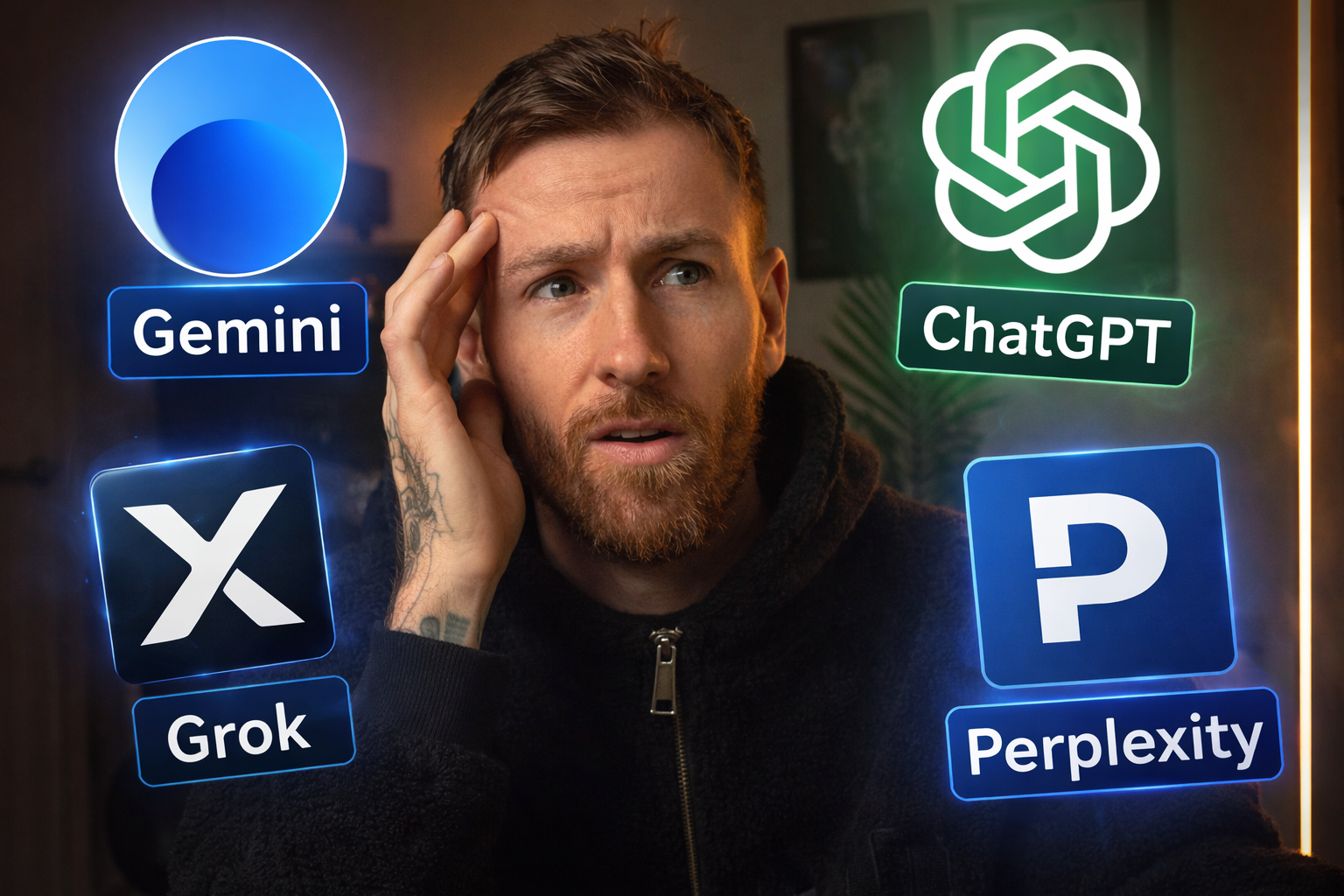

Most real estate agents are using the wrong AI search engine to get found.
I went through the data. The market share, referral traffic, citation behaviour, conversion rates across ChatGPT, Google's AI Mode, Gemini, Perplexity, Grok, and Copilot. I wanted to know which ones are genuinely sending leads to agents right now, and which ones are future opportunities.
Here's how I'd rank each AI search engine for real estate leads — and why.
This should be your number one priority. And almost no realtor is treating it that way.
Google AI Mode has 100 million monthly active users in the US alone. It sits inside the search engine that still controls 92% of the market.
When a homeowner types 'best estate agent in [your city]' into Google, there's an increasing chance they're getting sent straight into AI Mode without knowing about it.
AI Mode has a 93% zero-click rate.
That sounds terrifying until you realise there's still opportunity here.
But if you're not being cited in that AI response, you don't exist. There's no page two to fall back on. There's no 'well, at least I'm ranking somewhere.' You're either in the answer or you're invisible.
iPullRank's referral data from 2025 showed that high-authority, community-driven sites dominate AI Mode citations. Reddit, YouTube, Wikipedia, Zillow — these are the platforms Google's AI trusts.
What does that show you?
Google's AI is looking for agents, teams, brokerages, and brands with authority signals across the web. Your Google Business Profile, your reviews, your local content, your backlink profile. The stuff you should've been building for the last decade.
If you've been doing AI SEO properly, AI Mode is your biggest advantage. If you haven't, it's about to become your biggest problem.
ChatGPT holds somewhere between 64% and 81% of the AI chatbot market depending on which data set you're looking at (SimilarWeb puts it at 64.5% as of December 2025, Conductor's data from November 2025 says 87.4% of all AI referral traffic comes from ChatGPT).
The numbers are massive. 800 million weekly users. The third most visited website on the planet.
And for real estate agents, the referral traffic story is incredibly high intent. The agents we work with see the highest intent leads from ChatGPT compared with any other LLM search engine.
Exposure Ninja reported that AI search traffic converts at 14.2% compared to Google's 2.8%. Microsoft Clarity's study across 1,200 sites found LLM traffic converting at 3x the rate of traditional channels.
Based on the successes of our clients (take Katelyn Warren for example) we can confidently say this is the case.
When someone asks ChatGPT to recommend an agent or compare neighbourhoods, it pulls from your existing web presence. Your site, your reviews, your mentions in local press, your YouTube transcripts.
The agents who focused on content distribution (i.e., different channels) are the folks winning in ChatGPT answers.
The real estate agents who get ahead of this now, while the space is still wide open, are the ones who'll own those citations as the rate climbs.
BrightEdge found that ChatGPT makes it easy to get mentioned — but only 2 in 10 mentions include a clickable link. So your brand shows up, but the user doesn't always have a direct path to your site. That's a limitation worth knowing about, not a reason to ignore the platform.
ChatGPT is the volume leader. The conversion data is strong. The real estate-specific citation rate is still low, which means there's a window right now for agents who move first.
Perplexity is small.
Around 22 million monthly users. Roughly 6.2% of the US market. It processed 780 million queries in May 2025 — big growth, but a fraction of ChatGPT.
So why is it third?
Because Perplexity users are researchers. The platform averages over 5 citations per answer (BrightEdge data). That's more than any other AI engine.
Every response comes with sources, links, and attribution. When someone uses Perplexity to ask 'who are the top-rated estate agents in Austin for luxury homes,' they get a sourced, linked answer — and they click through.
The conversion data backs this up. Seer Interactive's analysis found Perplexity converting at the second-highest rate of any AI platform. Microsoft Clarity's study showed Perplexity referrals converting sign-ups at 7x the rate of direct traffic.
Perplexity's user base skews professional. Students, analysts, decision-makers. The kind of people who read the sources, compare options, and make informed choices. That's exactly who you want finding your content when they're researching a move.
Only 1 in 5 Perplexity answers mention a brand at all (BrightEdge, May 2025). So while the traffic it does send is high quality, the total volume is small.
You're not going to build a pipeline off Perplexity alone. But as a supplement to your Google and ChatGPT visibility, it's punching above its weight.
Gemini is the story of 2026. Google's AI assistant nearly quadrupled its market share — from 5.7% to 21.5% in twelve months (SimilarWeb, January 2026).
It has 400 million monthly active users globally. And its referral traffic to external websites grew 388% year-over-year from September to November 2025, dwarfing ChatGPT's 52% growth in the same period.
Those numbers look incredible on paper.
But for real estate leads, Gemini has a problem.
It's tightly integrated into Google's ecosystem — Android, Workspace, YouTube — which means most people encounter it inside products they're already using, not as a standalone search tool. The US market share is only about 3.4% (SimilarWeb), way below the global figure, because American users are still defaulting to ChatGPT for direct AI search.
We don't have strong data on Gemini-specific conversion rates for real estate. Seer Interactive's study showed Gemini converting at about 4x the rate of direct traffic for general sign-ups — decent, but behind Perplexity and Copilot. The real estate-specific data simply isn't there yet.
I'd watch Gemini closely. The trajectory is aggressive.
But right now, it's a visibility play, not a lead generation one. Make sure your content is structured for AI citation (clear headings, direct answers, schema markup) and Gemini will likely become more important over the next 12 months.
Just don't bet your pipeline on it today.
Grok went from zero to 3.4% global market share in a year (SimilarWeb, January 2026). That's impressive for a platform built by xAI and integrated into X (formerly Twitter). Around 29.6 million visits in July 2025 alone.
Grok's audience skews toward high-net-worth, entrepreneurial users on X.
And we've seen early signals of conversions coming from affluent buyers and sellers who use the platform as part of their research process. That's a small but valuable segment — the kind of clients most agents would love to attract.
The platform rewards real-time data, trending topics, and social-media-native content. If you're an agent who's already active on X and building a personal brand there, Grok's integration could surface your content to exactly the right audience.
The volume isn't there yet for most agents to prioritise it. But if you work in luxury or high-value markets, Grok is worth paying attention to. The affluent buyer profile and the platform's growth trajectory make it one to watch closely heading into the second half of 2026.
Microsoft poured $13 billion into OpenAI. Copilot is baked into Windows, Office, Teams, Outlook, and Edge. It should be dominating.
It's not.
Copilot sits at roughly 1.1% global market share — and it's declining (SimilarWeb, January 2026). In the US it performs slightly better at around 14% in some data sets, but that's heavily skewed by enterprise usage within Microsoft 365, not consumer search behaviour.
The irony is that Copilot's conversion data is technically the best of any platform. Microsoft Clarity's study found Copilot referrals converting subscriptions at 17x the rate of direct traffic. But the volume is so low that the stat is almost meaningless for real estate. You might get one incredibly qualified lead per quarter from Copilot. Maybe.
The brand confusion doesn't help either. Microsoft has Copilot in Windows, Copilot in Edge, Copilot in Bing, Copilot in Teams — users don't know which one does what, and most of them aren't using any of them for property searches.
I'd put Copilot last. Not because the technology is bad, but because the user behaviour isn't there for real estate.
Stop treating 'AI visibility' as a single strategy. Each platform has different citation behaviour, different audiences, and different conversion patterns.
If you had to pick one thing to focus on right now, it's making sure Google's AI Mode can find you and trust you. That means your Google Business Profile needs to be flawless. Your local content needs to answer specific questions about specific neighbourhoods. Your reviews need to be recent and consistent. Your site needs schema markup that tells AI exactly what you do and where you do it.
For ChatGPT visibility, the play is broader authority — being cited on industry publications, having YouTube content with solid transcripts, getting mentioned on Reddit and in local press. ChatGPT pulls from Bing's index, so your Bing Places profile matters more than you think.
Perplexity rewards depth. Long-form, well-sourced content with clear attribution. If you're publishing data-backed neighbourhood guides and market reports, Perplexity will find them.
And for the rest — Gemini, Grok, Copilot — keep an eye on them, but don't restructure your business around platforms that aren't sending consistent real estate traffic yet.
I've been in SEO long enough to know that the agents who move first on distribution shifts like this are the ones who build advantages that compound for years. The ones who wait for the 'definitive guide' to AI search in 2027 will be fighting over whatever scraps are left (I'm speaking from firsthand experience).
The data's here. The rankings are clear. The question is whether you'll act on them before your competitor in the next postcode does.