Real Estate SEO: How Does SEO Work In 2026 & Into 2027?
Real estate SEO is the process of making an agent, team, or brokerage technically eligible, contextually relevant, locally credible, and conversion-ready when buyers and sellers search online.
This guide explains the whole system in implementation order. It is written for US agents, teams, and brokerages, but the framework also gives marketing operators a way to diagnose where a real estate SEO strategy is breaking.
[fdb_table title="The real estate SEO system at a glance"]
| Layer | What it must accomplish | What to inspect |
|---|---|---|
| 1. Eligibility | Let search engines discover, render, crawl and index the right URLs | Status codes, robots controls, canonicals, sitemaps, rendered HTML and index coverage |
| 2. Relevance | Give each page one clear role within the services, markets and decisions the business serves | Page intent, titles, headings, entities, internal links and topical gaps |
| 3. Local corroboration | Connect the website to a genuine agent or brokerage operating in a defined market | Business Profile, service area, contact details, author information, reviews and local mentions |
| 4. Authority | Earn independent evidence that the business and its information deserve attention | Relevant links, citations, editorial mentions, original data and first-hand expertise |
| 5. Outcomes | Turn qualified search demand into conversations and closed business | Impressions, clicks, landing pages, generated leads, qualified leads and converted leads |
[/fdb_table]
What Is Real Estate SEO?
Real estate SEO is search engine optimization applied to the entities, locations, services, properties, and decisions involved in a real estate business.
Its job is to help the right page become discoverable and useful when somebody searches for an agent, a market, a service, a property type, or guidance about buying or selling.
Google describes Search as three broad stages: crawling, indexing, and serving results. A page must first be found and processed before it can be considered for a relevant query, and Google explicitly says that crawling, indexing, and serving are not guaranteed.
That makes technical access a prerequisite, not the final objective.
The useful question is not just “Can Google see this URL?” but “Why is this the best page on this site for this particular person and decision?”
Google’s documentation on crawling, indexing, and serving provides the platform-level foundation for that distinction.
At FlyDragon, we use a semantic model to keep the strategy focused. The central entity is the subject the site needs to become known for. The source context is who is speaking, what markets and clients they actually serve, and what experience gives them a reason to speak. The search intent is the job the visitor needs to complete.
A useful real estate page connects all three.
For example, “moving to Denver” is too broad on its own. A Denver buyer’s agent can make it useful by connecting the market to first-hand knowledge of relocation decisions, property types, transaction steps, travel times, ownership costs, and the questions their clients repeatedly ask. That is semantic coverage. Repeating “Denver real estate” is not.
How Is Real Estate SEO Different From General SEO?
Real estate SEO uses the same search foundations as other industries, but it adds unusually strong local, entity, inventory, and high-consideration lead requirements.
The person searching may care about a specific block, commute, school boundary, property feature, representation service, or stage of a transaction. Their location can also change the results they see.
Four characteristics make real estate SEO different:
- The business is local. An agent’s real-world identity, operating market, and eligibility for a Google Business Profile matter alongside the website.
- The inventory changes. IDX and MLS integrations can create many listing, search, and filter URLs whose value and lifespan vary.
- The decision is complex. Buyers and sellers rarely move from one generic blog post directly to a signed agreement. They validate expertise across several pages and external sources.
- The conversion happens offline. Organic sessions only become meaningful when calls, forms, and appointments connect to qualified, converted leads.
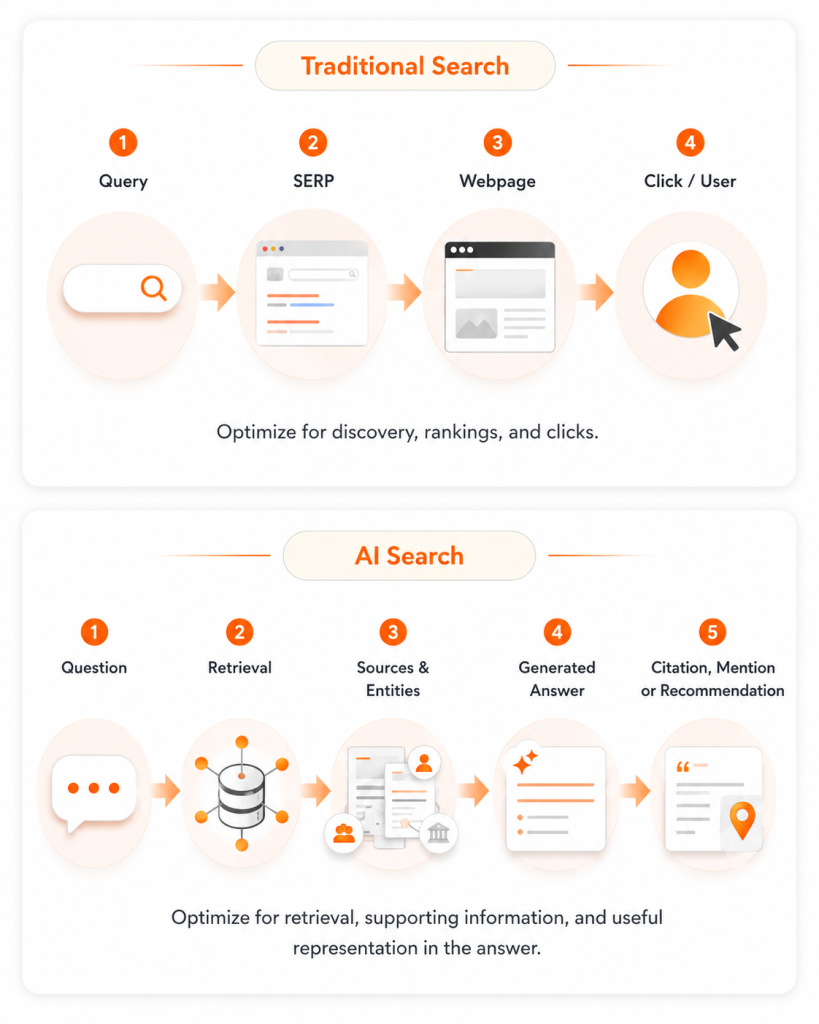
Real estate SEO also now supports visibility in Google’s generative Search features, but conventional ranking and AI-answer visibility are not identical jobs. Our guide to the differences between traditional SEO and AI SEO for real estate agents keeps that comparison separate.
What Should a Real Estate SEO Strategy Target?
A real estate SEO strategy should target a connected demand map, not one “money keyword” and not an indiscriminate list of search volumes. The map should cover the services the business provides, the markets it can credibly describe, the decisions clients make, and the evidence they use to choose an agent.
A practical query network normally contains six intent families:
- Service and entity intent: real estate agent in a city, buyer’s agent, listing agent, relocation specialist or brokerage.
- Transaction intent: sell a house, buy a first home, relocate, downsize, invest or value a property.
- Market intent: homes for sale, market conditions, prices, taxes, closing costs, or inventory in a defined area.
- Property intent: condos, waterfront homes, new construction, acreage, or another property attribute the business genuinely serves.
- Decision-support intent: neighborhood comparisons, timelines, trade-offs, process questions, and mistakes to avoid.
- Brand-validation intent: the agent’s name, reviews, track record, areas served, approach, and contact information.
These are not six phrases to force onto one page. They are connected needs that should be assigned to the right page roles.
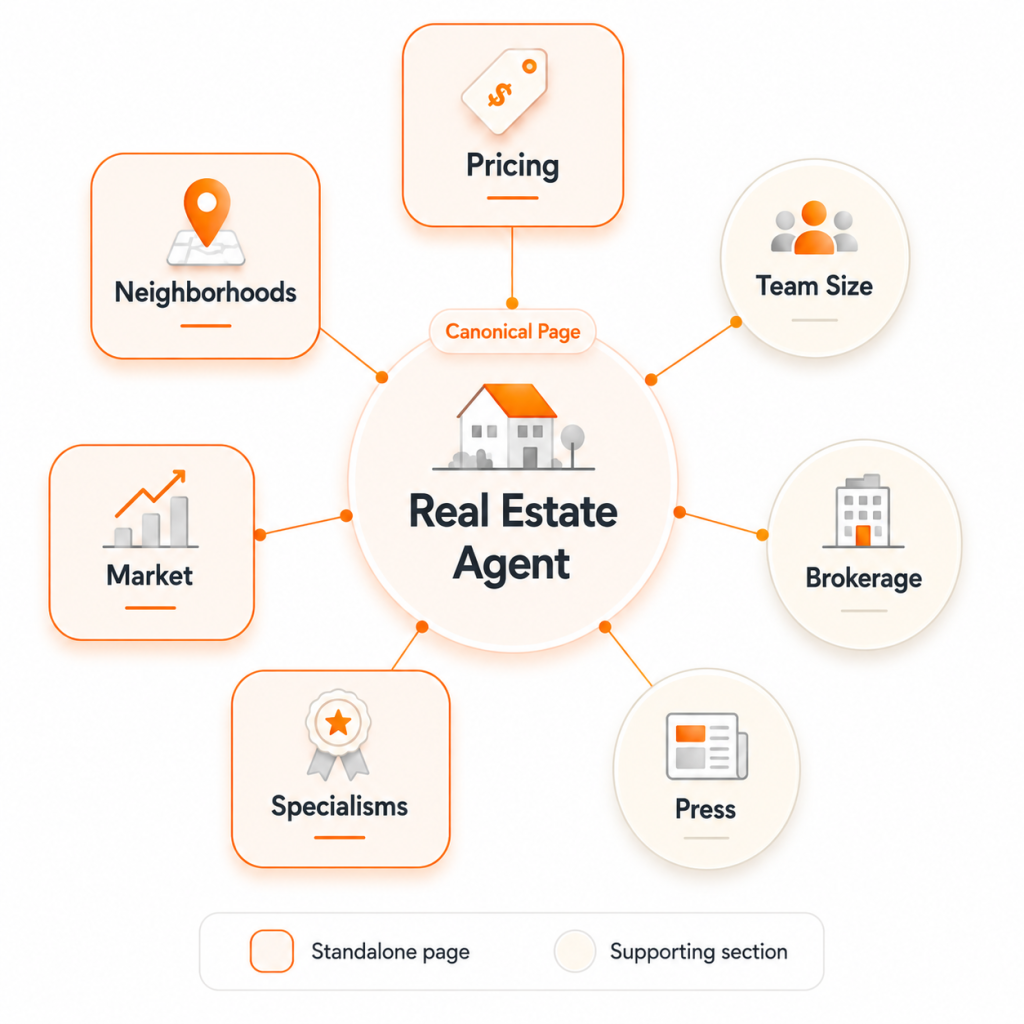
The home page can establish the entity and proposition. Service pages can own representation needs. Market hubs can orient the location. Neighborhood and property-type pages can answer narrower decisions. Guides can explain processes. Listings can satisfy current inventory intent.
This is where a semantic framework prevents content sprawl: go deep on the central commercial context and keep peripheral subjects flatter. A brokerage does not need an encyclopedia of everything that has ever happened in its city. It needs a coherent knowledge network around the real estate decisions it is qualified to help with.
How Should a Real Estate Website Be Structured for SEO?
A real estate website should be structured around durable page roles and contextual paths, not a flat collection of blog posts or a new page for every keyword variation.
Users and crawlers should be able to move from the business and service to the market, then into a specific decision, property type, or inventory view without guessing where they are.
A simple website architecture might look like this:
Home → service page → market hub → neighborhood or property-type page → supporting guide or listing.
The exact hierarchy depends on the business. A multi-market brokerage may need state and metro hubs. A solo agent with one farm area may need a much shallower structure. The goal is not maximum depth; it is a clear relationship between pages.
Your real estate website platform must give you enough control to create those roles, publish substantial local information, expose crawlable links, set canonical behavior, and measure conversions. A polished template cannot compensate for a platform that hides essential content behind an unusable search interface.
Internal links should then act as contextual bridges. A market hub can introduce a neighborhood comparison when a buyer needs to narrow options. A seller service page can link to a pricing guide when it explains the valuation process. The anchor should tell the reader what comes next; “click here” does not.
Google likewise recommends crawlable HTML links, descriptive anchor text, and at least one internal path to pages that matter. It says there is no magic ideal number of links. The useful standard is whether the destination genuinely helps the reader continue the current task.
Google’s link best practices support that approach.
What Technical SEO Issues Matter Most for Real Estate?
The most important technical SEO issues are whether valuable pages can be discovered, rendered, indexed, and consolidated correctly without letting IDX filters create an uncontrolled crawl space. Technical SEO should make the intended information architecture real.
Start with the basics: important URLs should return meaningful status codes, expose their main content and links in renderable HTML, use unique titles, declare consistent canonicals and appear in an accurate XML sitemap. Check that robots rules, noindex directives, CDN settings or login walls do not block pages you expect to appear in search.
Google can render JavaScript, but its own JavaScript SEO guidance notes that server-side or pre-rendering remains useful for users and crawlers, and that not every bot can execute JavaScript. For an IDX site, test the returned and rendered HTML rather than assuming a listing grid is visible because it appears in your browser.
How Should You Handle IDX and Listing URLs?
Index an IDX or listing URL only when it has a stable purpose and enough standalone value to satisfy a searcher; control the rest deliberately. “Index everything” can produce duplicate combinations and crawl traps. “Block all IDX” can remove useful inventory experiences. The correct policy depends on the URL type.
[fdb_table title="A practical IDX indexation model"]
| URL type | Default decision | Reason |
|---|---|---|
| Core market or property-type page | Index when it contains unique orientation and a stable inventory experience | It can own durable demand beyond a temporary set of listings |
| Individual active listing | Index selectively when the URL is crawlable, useful and handled after expiry | The page may satisfy address or property-specific intent |
| Useful filtered landing page | Index only when real demand and unique value justify a permanent page | A curated page can be useful; an automatic combination usually is not |
| Sort, map-state and near-duplicate parameters | Consolidate or restrict according to how the system generates URLs | These variants rarely deserve separate search representations |
| Expired listing | Apply a consistent archive, replacement or removal policy | Empty soft-404 pages and arbitrary redirects create poor outcomes |
[/fdb_table]
Google’s documentation says canonical annotations are strong signals for duplicate or very similar URLs, while sitemap inclusion is weaker.
Its faceted-navigation guidance also warns that crawlable filter combinations can consume substantial resources. Audit the actual URL patterns before choosing robots, canonical, noindex or navigation controls; these tools do different jobs.
Once the foundation is sound, improve the experience across mobile usability, speed, security, intrusive elements, and clarity. Google says page experience involves multiple aspects and that good Core Web Vitals alone do not guarantee top rankings. Treat performance as a user and conversion requirement, not a score-chasing exercise.
How Does Local SEO Work for Real Estate Agents?
Local SEO aligns an accurate real-world business entity with a relevant website, a legitimate operating area and independent evidence such as reviews, links and mentions. It cannot change the searcher’s distance from the business, but it can reduce ambiguity about who the business is, what it does and where it operates.
Google says local results are mainly based on relevance, distance and popularity or prominence. It also says more reviews and positive ratings can help local ranking, while links to the business are among the signals used for prominence.
Google does not publish a weighting formula and explicitly says there is no way to request or pay for a better local ranking.
Google’s local-ranking guidance is the appropriate source for those documented factors.
For an agent or brokerage, the operating checklist is straightforward:
- Represent the business as it exists in the real world; do not add keywords to the name.
- Use an accurate address or service area and the fewest categories needed to describe the core business.
- Keep the phone, website, hours and business identity current across owned profiles.
- Connect the profile to a site that clearly confirms the agent, brokerage, services and markets.
- Ask real clients for honest reviews without incentives or filtering, then respond appropriately.
- Earn local coverage and links through work that has a genuine community or editorial reason to exist.
Google’s Business Profile representation guidelines specifically include real estate agents among individual practitioners. A practitioner may create a dedicated profile when they are public-facing and directly contactable at the verified location during stated hours. The exact brokerage arrangement matters, so follow the current eligibility rules rather than copying a competitor’s setup.
How Do You Do Keyword Research for Real Estate SEO?
Start keyword research with the business’s services, real markets and recurring client decisions, then map related queries to page roles and validate the map with live results and first-party data. A tool export shows language and demand; it is not a content plan by itself.
Begin with interviews and operational data.
- Which clients does the business want?
- Which locations can it discuss from experience?
- Which questions delay a buyer or seller? Which property attributes repeatedly matter?
- Which services lead to revenue?
Then collect the language used in search suggestions, live result pages, competitor coverage, Search Console, CRM notes, call transcripts, and client emails.
Group that language by intent and entity rather than exact wording. “Listing agent in Phoenix,” “sell my Phoenix home” and “how to price a house in Phoenix” belong to the same commercial journey, but they do not necessarily belong on the same page.
The first may fit a service page, the second a seller landing page and the third a supporting pricing guide.
Assign one primary role to every proposed URL. If two pages would answer the same need for the same audience at the same stage, consolidate the idea before writing. If one question deserves more depth but remains subordinate, make it a section. If it has a distinct intent and enough information gain, make it a child page and connect it contextually.
Google’s current people-first guidance asks whether content provides original information, substantial value and demonstrable expertise. It also says there is no preferred word count. That is a better editorial test than producing a city page because a keyword tool returned a number.
Google’s guidance on helpful, reliable, people-first content provides the quality boundary.
What Content Should Real Estate Agents Create?
Real estate agents should create original, market-specific content that helps a buyer or seller make a decision the listings alone cannot answer.
The strongest source of information gain is the work the agent already performs: explaining trade-offs, interpreting local data, correcting misconceptions and guiding transactions.
Useful formats include:
- Service pages that explain who the service is for, how representation works and what happens next.
- Market hubs that orient a user to an area, its housing options and the decisions required to search it intelligently.
- Neighborhood and property-type guides that compare real attributes and trade-offs rather than swapping place names into a template.
- Process guides that answer financing, inspection, offer, listing-preparation, relocation or closing questions with clear boundaries.
- Original market analysis that states its date, source, method and limitations instead of presenting an unsupported trend claim.
- Case studies that explain the starting problem, constraints, decisions and outcome without exposing client information.
The heading order should follow the reader’s decision sequence. Answer each heading immediately, then add mechanism, evidence, example, limitation and implication where needed. That gives a human a useful answer quickly while preserving enough context for the rest of the page to make sense.
Do not create a separate article for every synonym or possible AI fan-out query. Google’s July 2026 generative-search guidance warns against scaled production for query variations and says non-commodity, first-hand content is more useful than material that simply restates what is already online.
For a narrower tactical example, our guide to competing with portals such as Zillow for specific local searches explains how local depth can create opportunities a national inventory site may not satisfy.
How Do Links, Mentions and Reviews Help?
Links, mentions and reviews help by creating discovery paths and independent corroboration around the business, but their value depends on relevance, authenticity and context. They are not interchangeable votes that can be accumulated safely from anywhere.
Internal links organize the site’s own knowledge network. External links from local organizations, industry publications, partners or genuinely useful resources can help people and crawlers discover the business.
Consistent third-party profiles reduce identity ambiguity. Reviews add customer evidence and can contribute to local prominence.
The best link opportunities usually begin with something real: a market dataset worth referencing, a useful local resource, expert commentary, a community partnership, a scholarship with a genuine purpose or a case study another publisher wants to discuss. Buying bulk links, placing unrelated guest posts or manufacturing profiles creates volume without a defensible relationship.
Use the same standard internally. Link when the destination answers the next question. Space links through the article, use descriptive anchors and avoid repeating the same destination merely to increase a count.
What Schema Should a Real Estate Website Use?
A real estate website should use structured data that accurately identifies the entity and visible page content, choosing the most specific valid type without treating markup as a ranking guarantee. Schema should describe reality, not create a second, more flattering version of it.
Schema.org defines RealEstateAgent as a subtype of LocalBusiness. Depending on the page and organization, a site may also use appropriate Organization, Person, Article and Breadcrumb data. The properties should agree with visible names, addresses, service areas, authorship and page content.
Google’s LocalBusiness structured-data documentation explains how business details can be provided. Its general guidelines also make the limit explicit: correct structured data can establish eligibility for a supported search feature, but Google does not guarantee that the feature will appear.
Test syntax, inspect the rendered page and keep the markup current. If an agent page needs a practical content-and-entity model, use our agent bio and entity markup guide as the next step.
Does Real Estate SEO Also Help With AI Search?
Yes. Real estate SEO supplies much of the technical eligibility, relevance, quality and local-business information that AI-powered search can build on, but it does not make retrieval, citation or recommendation automatic.
Google’s current generative-search documentation says its AI features are rooted in core Search ranking and quality systems. It also says there is no special schema or llms.txt requirement for those Google features. Pages still need to be indexed and eligible to appear in Search with a snippet, and even then inclusion is not guaranteed.
Google’s official generative-search guidance supports keeping strong SEO foundations while avoiding supposed AI-only hacks.
Other AI products have their own access, retrieval and attribution behavior. If that is the primary objective, our full explanation of how AI SEO works covers those mechanisms without turning this real estate SEO guide into two overlapping articles.
How Should Real Estate SEO Be Measured?
Measure real estate SEO as a funnel from eligibility to qualified business: indexed pages, relevant impressions, clicks, engaged visits, generated leads, qualified leads and converted clients.
Rankings can help diagnose visibility, but they are not the commercial outcome.
Use four measurement levels:
- Technical: index coverage, canonical selection, crawl errors, sitemap state and page experience.
- Search visibility: impressions, clicks, click-through rate, queries, landing pages, country and device.
- On-site behavior: engaged sessions, calls, form starts, form submissions and appointment actions.
- Business quality: generated leads, qualified leads, signed clients, closed transactions and revenue where attribution is responsible.
Google’s Search Console performance guidance explains how to inspect queries and the pages shown for them. It recommends focusing more on trends in impressions and clicks than on position alone. That page-level view is also useful for cannibalization: if two URLs repeatedly appear for the same query family, check whether their roles are genuinely distinct.
In GA4, use events that match the real lead journey. Google recommends lead-generation events such as generate_lead, qualify_lead and close_convert_lead. Connect them to the CRM where possible so the SEO report does not reward low-quality form volume.
Google Analytics’ recommended lead events provide a consistent naming foundation.
What Should You Do in the First 90 Days?
In the first 90 days, fix eligibility first, establish the core page architecture second, then expand authority and measurement. This is an implementation sequence, not a promise that rankings or leads will arrive on a universal schedule.
Days 1–30: Establish the Baseline
Use the first month to find technical blockers and define the business’s real search territory. Verify Search Console and analytics, crawl the site, inspect indexation and canonical behavior, inventory every important URL, audit the Business Profile and document services, markets, property types and conversion events.
Decide which existing page owns each important intent. Merge or redirect only after checking traffic, links, purpose and replacement relevance. Record the IDX URL patterns before changing crawl controls.
Days 31–60: Build the Core Network
Use the second month to repair or publish the small set of pages closest to the business’s services and markets. Strengthen the home/entity page, service pages and primary market hubs. Add descriptive internal links and make contact paths measurable. Publish fewer pages with distinct roles rather than many interchangeable location pages.
Days 61–90: Add Evidence and Feedback Loops
Use the third month to add original local evidence, earn relevant corroboration and turn early query data into the next decisions. Publish one or two high-information-gain resources, improve review acquisition, pursue defensible local or industry links and compare Search Console queries with qualified lead data.
At the end of the period, choose the next work from observed constraints. If valuable pages are not indexed, more content is not the answer. If impressions rise but clicks do not, inspect intent, titles and result presentation. If visits grow but leads do not, inspect the offer, trust evidence and conversion path.
Which Real Estate SEO Mistakes Waste the Most Time?
The most expensive mistakes are the ones that create activity without a clear page role, technical policy or business measurement. They make a site larger while leaving the core search system unchanged.
- Publishing interchangeable city pages: changing place names does not create local expertise or a distinct reason for the page to exist.
- Indexing every IDX combination: filters, sorts and map states can multiply URLs without adding durable value.
- Blocking IDX without diagnosis: broad controls can also remove useful market or property experiences.
- Changing the Business Profile name for keywords: the profile should accurately represent the real business.
- Treating schema as a ranking switch: markup describes content and may enable supported appearances; it does not guarantee them.
- Buying irrelevant links or reviews: manufactured corroboration is not a substitute for real authority and can violate platform policies.
- Reporting only rankings: a keyword position without qualified lead data can reward the wrong traffic.
- Splitting SEO and AI work into disconnected foundations: technical access, useful content and entity clarity support both, even though their downstream outcomes differ.
If the strategy needs outside help, evaluate a real estate SEO company against this system: can it diagnose eligibility, architecture, local/entity evidence, content quality and lead measurement, or does it sell one tactic as the whole answer?
[fdb_faq title="Real estate SEO questions"]
[fdb_faq_item question="How long does real estate SEO take?"]
There is no universal real estate SEO timeline.
A technically sound site with existing authority and a clear market can respond differently from a new domain with indexation problems and strong competition. Measure implementation and leading indicators first, then judge qualified lead growth over a period appropriate to the market.
[/fdb_faq_item]
[fdb_faq_item question="Does a real estate agent need IDX for SEO?"]
No. IDX is not a requirement for SEO, although it can provide a useful inventory experience when implemented well. Service pages, market knowledge and local authority can earn visibility without IDX. If IDX is present, its crawl, canonical and expiry behavior need active management.
[/fdb_faq_item]
[fdb_faq_item question="Can a solo agent compete with Zillow and large brokerages?"]
A solo agent can compete for specific local and decision-focused searches where first-hand relevance is stronger, but no position is guaranteed. Trying to match a national portal’s inventory breadth is usually less defensible than answering narrower market questions exceptionally well.
[/fdb_faq_item]
[fdb_faq_item question="Can AI-generated content rank for real estate searches?"]
The production tool does not determine whether a page is useful. AI can assist research and drafting, but the published page still needs accurate sourcing, original local value, clear authorship and human quality control. Scaled, interchangeable pages created primarily to capture traffic fail that standard regardless of who or what wrote them.
[/fdb_faq_item]
[fdb_faq_item question="What is the first real estate SEO task to do?"]
Start by inventorying the site and confirming that the pages closest to revenue are crawlable, indexable, distinct and measurable. That baseline shows whether the next constraint is technical, architectural, editorial, local, authoritative or conversion-related.
[/fdb_faq_item]
[/fdb_faq]
The durable advantage in real estate SEO is not publishing the most pages. It is building the clearest connected source about the markets and decisions the business genuinely serves—and measuring whether that source creates qualified conversations.