

On this page
AI SEO is the practice of improving how a website, brand, or information source is discovered, understood, retrieved, and represented in AI-powered search.
It builds on traditional SEO, with one big difference in what you're optimizing for — these search experiences generate answers, summarize information, cite sources and recommend entities.
They don't just hand you a ranked list of webpages anymore.
Now, the term itself is a bit of a mess. Nobody agrees on one definition yet.
In this guide, AI SEO means one thing: optimizing for visibility inside AI-powered search and answer experiences. When we're talking about using AI to do SEO tasks (keyword research, content generation, analysis), we'll call that AI-assisted SEO.
Using ChatGPT to write an article and making your company relevant, accessible, and well-supported enough to show up when someone asks an AI about your market are two completely different jobs.
People conflate them constantly.
If you're evaluating providers rather than learning the definition, our guide to choosing the best AI SEO agency for real estate agents covers that decision separately.
What Does AI SEO Optimize For?
AI SEO optimizes for a wider set of visibility outcomes than a conventional ranking.
Traditional SEO asks one question:
Can this page be discovered, indexed, understood, and ranked for the relevant search?
AI SEO keeps that question and adds a second one:
Can the information, source, or entity be retrieved and usefully represented when an AI system generates an answer?
Depending on the query and the platform, "represented" could mean a citation to a webpage, a supporting link, a summarized fact, a company or product mention, a local business, or a straight recommendation.
None of this means webpages have stopped mattering. Google says its generative search experiences remain rooted in its core Search ranking and quality systems, with relevant webpages pulled from the Search index before anything gets used to build a response.
OpenAI says much the same about ChatGPT Search — public websites can appear in results, and publishers who want their content discoverable, surfaced and cited should allow its OAI-SearchBot crawler.
Webpages are still central. What's changed is the shape of the journey. You used to optimize for one path:
Query, ranked page and click
Now you also need to understand this one:
Question, retrieval, supporting information, generated answer, source, entity or recommendation.
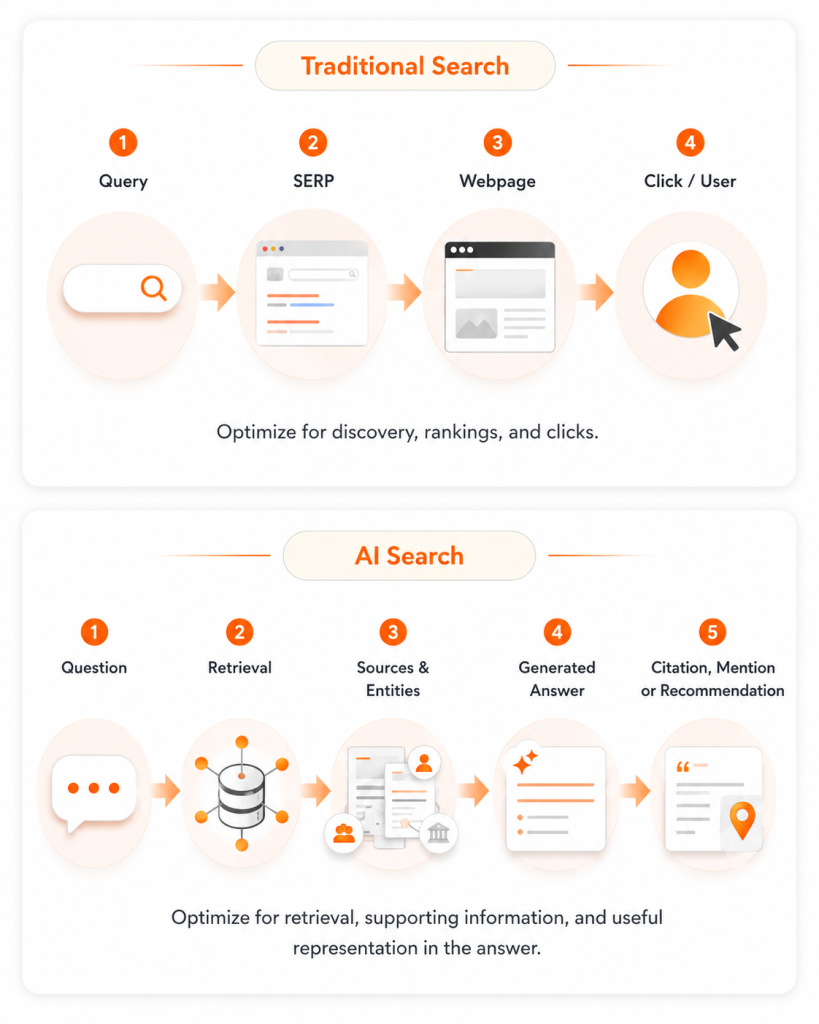
How Does AI SEO Work?
AI SEO works by improving the information available at several points in the search and retrieval process.
Start with discoverability. Your content has to be reachable in the environment you're targeting. For Google, a page must be indexed and eligible to appear with a snippet in normal Search before it can qualify as a supporting link in AI Mode or AI Overviews. And Google says there are no extra technical requirements for those AI features beyond that.
Then the system has to work out what the user is asking for, which can go well beyond matching the literal words in the question. Google publicly documents a technique called query fan-out, where AI Mode and AI Overviews fire off multiple related searches across subtopics and data sources to build a response to a complicated question. One question in, many searches out.
From there, relevant pages, passages, data, or entities get retrieved. The system weighs what it found and generates a response. Supporting pages or businesses may get surfaced alongside that response, depending on the feature and the query.
So the practical AI SEO job is making the right information discoverable, relevant, unambiguous, useful, well-supported, and connected to the right entity or source. Which is why this is bigger than dropping a new keyword into an article.
Compare these two searches. First: "best real estate agent." Second: "Who is the best real estate agent to sell my $500,000 condo, by the beach, with at least 50 reviews?”
The second question carries a specific requirement and comparative intent all in one go. A source that can only answer the broad category question may not be the best source for the constrained version.
What information can AI-powered search use?
There's no universal source list shared by every platform. Google retrieves through Google Search. Other AI search products run on different search providers, crawlers, indexes, and models. The source mix can even change based on the question itself.
Which is why "rank in ChatGPT" is an oversimplification. AI visibility is a search ecosystem, not a single position (and you should think about it that way from the start).
Why Is AI SEO Important?
AI SEO matters because AI-powered search lets people express far more of their real problem in a single interaction.
Google describes AI Mode as “especially useful for nuanced questions, complex comparisons and queries that used to take multiple searches”. Its query fan-out system can pull information across multiple related subtopics before building the response. That changes how much context lives inside one search journey.
Someone choosing an agent to work with can specify team size, location and budget.
Traditional keyword search isn't going anywhere. But more expressive queries mean more attributes deciding whether your business is relevant — which makes information architecture more important, not less.
You can't assume that ranking for the broadest market term means you've answered every more specific version of the user's need. In my experience, most companies haven't come close.
AI search can also change the outcome you're competing for. Sometimes the goal is still a click. Sometimes the brand needs to be included in the answer. Sometimes your research needs to become the cited evidence. And sometimes the business itself is the entity being compared or recommended.
Is AI SEO Different From Traditional SEO?
AI SEO is an extension of SEO, not a replacement for it. Technical accessibility, relevance, useful content, information architecture, and authority all still matter. AI-powered search just adds new visibility outcomes on top: generated answers, citations, entity selection.
Google is unusually direct on this point. Its current guidance says SEO best practices remain relevant to AI Mode and AI Overviews, and its newer generative AI optimization guidance says those features are rooted in Google's existing Search ranking and quality systems.
Traditional SEO vs AI SEO
| Dimension | Traditional SEO | AI SEO |
|---|---|---|
| Primary visibility outcome | A webpage ranks in search results | A page, source, fact, entity or brand becomes part of an AI-powered search experience |
| Typical query | Often concise or keyword-led | Can include longer conversational questions and multiple constraints |
| Main retrieval object | Web documents and search features | Web documents still matter, but information may be synthesized into a generated response |
| User decision | Often made after visiting search results | May begin inside the generated answer before a website visit |
| Measurement | Rankings, impressions, clicks, organic conversions | Traditional metrics plus AI citations, mentions, recommendation share, AI referrals and downstream conversions |
| Technical foundation | Crawlability and indexability | Still important; requirements depend on the targeted platform |
| Content objective | Become the strongest page for a search need | Become a strong page/source and make its information easy to retrieve within the relevant context |
The distinction is useful for planning, but don't split the two into separate departments. If a search system can't access a page, the quality of its copy is irrelevant to that retrieval. If a page is accessible but full of commodity information, accessibility alone won't make it a source worth citing. And if a brand is mentioned everywhere but the underlying facts are inconsistent, more visibility just spreads the inconsistency further.
What Is the Difference Between AI SEO, AEO, GEO and LLMO?
These terms overlap heavily, and the industry hasn't standardized any of them. Treat them as overlapping ways of describing different parts of modern search optimization rather than four separate technical disciplines — because that's what they are.
Even Google now acknowledges that AEO and GEO are common industry terms, while maintaining that from its perspective, optimizing for its generative AI search experiences is still SEO.
AI SEO, AEO, GEO and LLMO
| Term | Common meaning | Primary emphasis |
|---|---|---|
| SEO | Search Engine Optimization | Organic search visibility |
| AI SEO | SEO adapted to AI-powered search and answer experiences | Broad umbrella covering search + AI visibility |
| AEO | Answer Engine Optimization | Becoming a useful direct answer |
| GEO | Generative Engine Optimization | Visibility within generated AI responses |
| LLMO | Large Language Model Optimization | Being understood, retrieved or represented by LLM-based systems |
| AI-assisted SEO | Using AI to carry out SEO work | Production and workflow rather than search visibility |
The labels are handy for communicating different objectives. But swapping the acronym doesn't create a new set of search fundamentals. A company with weak information, poor accessibility, and no meaningful evidence doesn't fix any of that by calling the work GEO instead of SEO. I've watched plenty of agencies try.
What Are the Main Components of AI SEO?
A practical AI SEO strategy breaks down into seven connected components: technical discoverability, entity clarity, query coverage, information quality, original evidence, external corroboration, and measurement.
To be clear: this is a planning framework, not a claim that every AI platform runs seven ranking factors or weights them the same way.
1. Technical Discoverability
Technical discoverability decides whether a search system can reach the information you want it to retrieve.
For Google's generative search, normal Search eligibility is the foundation: the page must be crawlable, indexed and eligible to appear in Search with a snippet. Google specifically recommends making sure crawling is allowed, important content is available as text, internal links make pages findable, and relevant Business Profile or Merchant Center information stays current.
OpenAI separately recommends allowing OAI-SearchBot when you want your content included in ChatGPT Search summaries and snippets.
Most people misunderstand that crawler controls are platform-specific. There's no universal switch labeled "allow AI." So an AI SEO technical audit starts by identifying which systems matter to your business and checking whether the information those systems need is publicly accessible in a format they can use.
2. Entity Clarity
Entity clarity means making it easy to understand exactly who or what a page is describing, and how that entity relates to other entities. An entity can be a company, person, product, location, or organization. Anything identifiable.
Picture a brokerage that recently changed its name, address, and phone number. Its homepage uses the new name.
Old review sites use the previous brand. LinkedIn describes an earlier product category. Third-party articles list pricing that no longer exists. Those look like branding inconveniences, but from a retrieval perspective they're conflicting assertions about the same entity — and conflicting assertions are poison for AI visibility.
The goal here is not to repeat the entity name over and over. You're maintaining consistent, explicit facts about what the entity is, everywhere those facts appear.
3. Query and Topical Coverage
Query coverage means building enough relevant information to satisfy the important questions and subtopics around a search need without spinning up a separate page for every possible wording.
(To clarify, this means if you ever receive advice to publish hundreds of FAQ pages to your site, it’s not helping AI search.)
A broad query usually represents a network of follow-up questions. Someone researching "homes in Florida" will probably go on to ask about house values, transport, schools, and nearby alternatives.
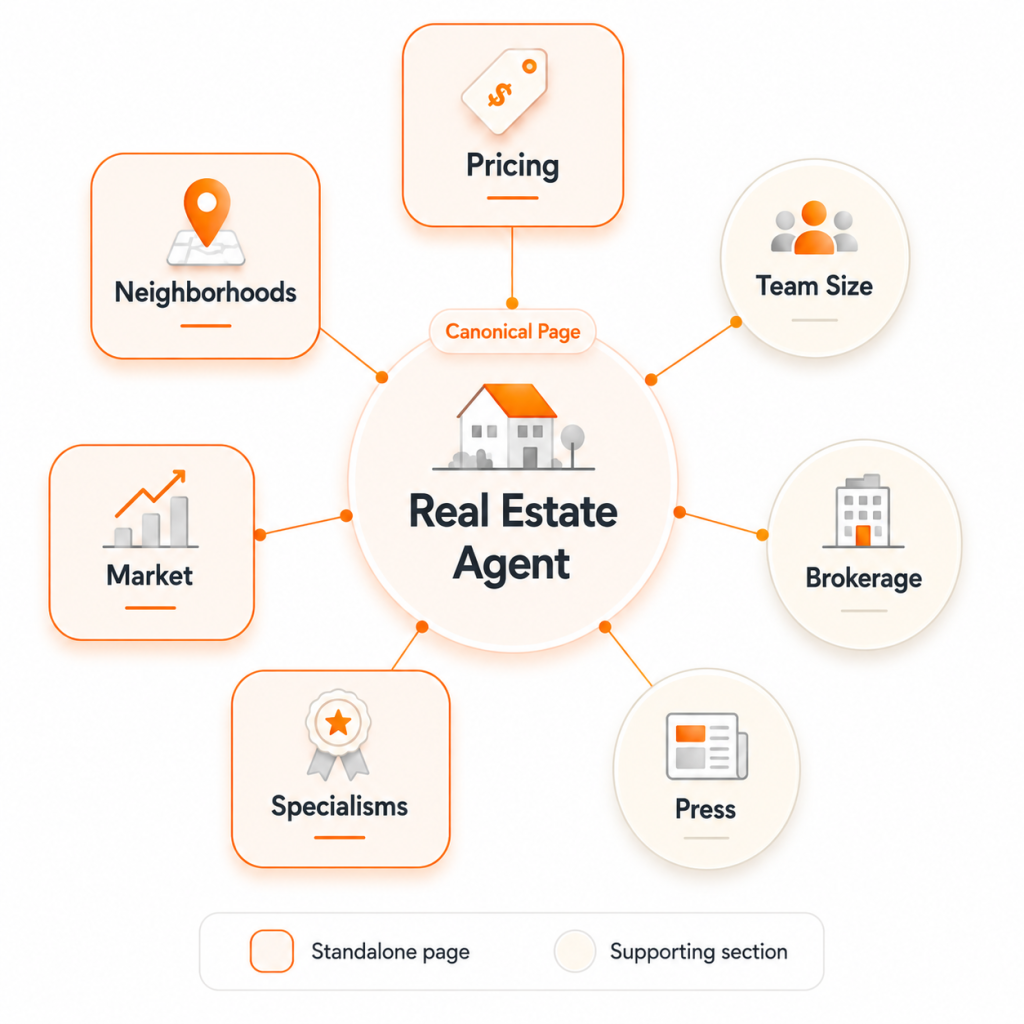
So AI SEO benefits from designing an information architecture around entities, attributes, questions and relationships — rather than churning out isolated articles from an unordered keyword list.
But broader coverage doesn't mean unlimited URLs either.
Google explicitly says publishers don't need to break content into tiny chunks for generative AI or rewrite pages to capture every variation of a long-tail query. Its systems can interpret synonyms and the general meaning behind searches.
The better approach: work out which context deserves a canonical page, answer it properly there, and connect narrower or adjacent contexts where separate pages genuinely make sense.
4. Information Quality and Answerability
Information quality decides whether the retrieved content resolves the user's need accurately, clearly, and efficiently.
Don't write AI SEO content as disconnected "LLM chunks", Google specifically says chunking content purely for generative AI is unnecessary. Let the format follow the question instead.
- A definition deserves a definitive paragraph.
- A comparison may need a table,
- A process usually reads clearer as ordered steps,
- A numerical relationship may need a chart,
- A physical process may need a diagram or video,
- And a complex claim may need supporting research behind it.
Page-level architecture matters here too. The first paragraphs should establish what the page answers. Each section after that should deepen or logically extend that context, rather than hopping between loosely related keywords because a spreadsheet said so.
Clarity serves humans first. It also strips out ambiguity for any system trying to retrieve or summarize the information.
5. Original Information and Evidence
Original information gives a source something worth retrieving that can't be reproduced by summarizing the existing SERP.
That can be first-party research, experiments, original datasets, expert observations, proprietary methodologies, case studies, calculators, firsthand testing or genuinely new analysis.
Google's current generative AI guidance specifically recommends creating non-commodity content, and says unique, compelling, useful information is likely to influence long-term presence in generative search more than generic optimization tricks.
Its broader content guidance asks the same question in a different way: does this page contain original information, reporting, research or analysis beyond what's obvious elsewhere?
This is the difference between covering a topic and being a source on a topic. Anyone can summarize ten existing articles in an afternoon. The original experiment those ten articles end up citing is much harder to replace and that's exactly what you want to be.
6. External Corroboration and Information Consistency
External corroboration is evidence outside your own website that supports or qualifies claims about the entity being searched.
How much it matters varies by topic, query and platform, and no AI search engine publishes a universal weighting for "brand mentions" or third-party sources.
But the underlying information problem is simple.
A business claiming to be the market leader is making a first-party assertion. An independent industry dataset showing it has the largest market share is different evidence entirely. A doctor's own website listing a qualification is one source; the professional register confirming that qualification is another. A manufacturer's spec sheet is first-party; independent testing gives a second perspective.
So AI SEO has to consider both what a source says about itself and whether the important claims hold up across the wider information environment. Google explicitly cautions against chasing inauthentic mentions as an AI-search hack. You want corroboration, not manufactured claims.
7. Measurement and Refreshment
AI SEO has to be measured over time, because visibility shifts by query, platform, source and date. Traditional SEO metrics stay useful. Rankings, organic impressions, traffic and conversions tell you whether the underlying search visibility is improving.
AI-specific measurement adds its own questions:
- Does the brand appear in relevant answers?
- Is it cited?
- Which URL gets used?
- What claim does the cited page support?
- Does the result hold when the prompt changes?
- Is the brand present across multiple platforms?
- Does any of it produce referral traffic, branded demand, or conversions?
Record the answers against a repeatable prompt set, never off one screenshots. AI-generated responses are variable, and this matters more than most people want it to. A single successful test proves an outcome occurred once. It doesn't prove a stable ranking, and treating it like one is how teams fool themselves.
What Does AI SEO Not Require?
A handful of tactics keep getting sold as requirements for AI visibility even though Google's own documentation says they're unnecessary for Google's generative search features.
Common AI SEO claims vs the evidence
| Claim | What the evidence supports |
|---|---|
| "You need special AI schema." | Google says no special Schema.org markup is required for AI Mode or AI Overviews. |
| "You need an llms.txt file for Google AI search." | Google says it ignores llms.txt and other special AI text files for Search. |
| "Content must be broken into tiny AI chunks." | Google explicitly says chunking is not required. |
| "Every conversational prompt needs its own page." | Google says systems understand synonyms and meaning; there is no need to rewrite content for every long-tail variation. |
| "You have to write content with AI." | Content production method and AI-search optimization are different issues. Google focuses on content quality rather than whether AI was used to create it. |
| "SEO no longer matters." | Google says generative Search remains rooted in its core Search ranking and quality systems. |
| "A citation or recommendation can be guaranteed." | Eligibility and optimization do not guarantee crawling, indexing, serving or selection. Google explicitly states that serving is not guaranteed. |
None of this means every AI-search tactic outside Google's documentation is useless. It means claims need to be scoped to the platform and the evidence behind them. Something can matter for another service without being a Google ranking requirement and a lot of vendors are counting on you not knowing the difference.
Does Structured Data Matter for AI SEO?
Structured data helps describe information explicitly, and it stays valuable for the search features that support it. It's not a special AI-search requirement.
Google recommends that structured data accurately match visible page content, and says there's no additional schema.org markup publishers need to add specifically for AI Mode or AI Overviews. Treat it as one component of a clear information architecture — never as a shortcut around weak content. If your location, product, or service information is unclear on the page itself, markup won't create the missing substance.
Does AI-Generated Content Work for AI SEO?
AI-generated content can perform in search when it's useful and high quality. Using AI carries no special advantage for AI SEO on its own. Google's longstanding guidance cares about the quality and purpose of content, not whether a human or a machine produced it. Using automation primarily to manipulate rankings violates its spam policies.
But AI helping create information doesn't automatically make that information low quality.
The more useful question: does this content contribute meaningful information?
A language model can summarize public information in seconds, which means generic summaries are now trivially cheap for everyone to produce. And as production costs fall, original data, genuine expertise, first-hand examples, and non-commodity information become more valuable ways of standing out — not less.
The cheaper generic content gets, the more the premium on real information grows.
Why Do Original Research and First-Party Data Matter for AI SEO?
Original research matters because it creates information gain: useful facts, measurements or analysis that other sources can't provide without referencing the original work.
Say twenty websites explain how consumers choose mortgage brokers. If all twenty repeat the same public statistics, none of them has contributed anything new. Then a company surveys 20,000 mortgage customers and publishes the reasons they picked their lender. That company just created a new evidence source — one that can support its own pages, feed journalists, anchor industry commentary, and end up inside future generated answers.
Original data also gives a brand a legitimate relationship to the topic. It stops merely talking about the subject and starts contributing information to it. Google's guidance toward non-commodity, original, and useful content backs the same distinction.
And this is exactly why FlyDragon's own source context is worth bringing in here. Rather than theorizing about AI citations in the abstract, we can look at what happened in a commercial vertical where we collected the data ourselves.
What We Learned by Studying AI SEO in Real Estate
Real estate makes a useful field study for AI SEO because search results often involve selecting a real-world entity (a specific agent) rather than answering a factual question.
Everything below comes from FlyDragon's 2026 Real Estate AI Citation Index. The findings describe the real-estate recommendation environment we studied. Don't stretch them into universal ranking factors for every AI platform or every industry because that's not what the data supports.
The study audited 5,004 named real-estate agent recommendations and examined the sources and supporting evidence attached to each one.
AI visibility did not simply mirror offline business success
The top 25% of cited agents captured 40.2% of all named recommendations in the dataset; visibility concentrated in a fairly small group. The number I keep coming back to, though, is this one: 46.9% of the top-producer cohort was recommended less often than the median audited agent.
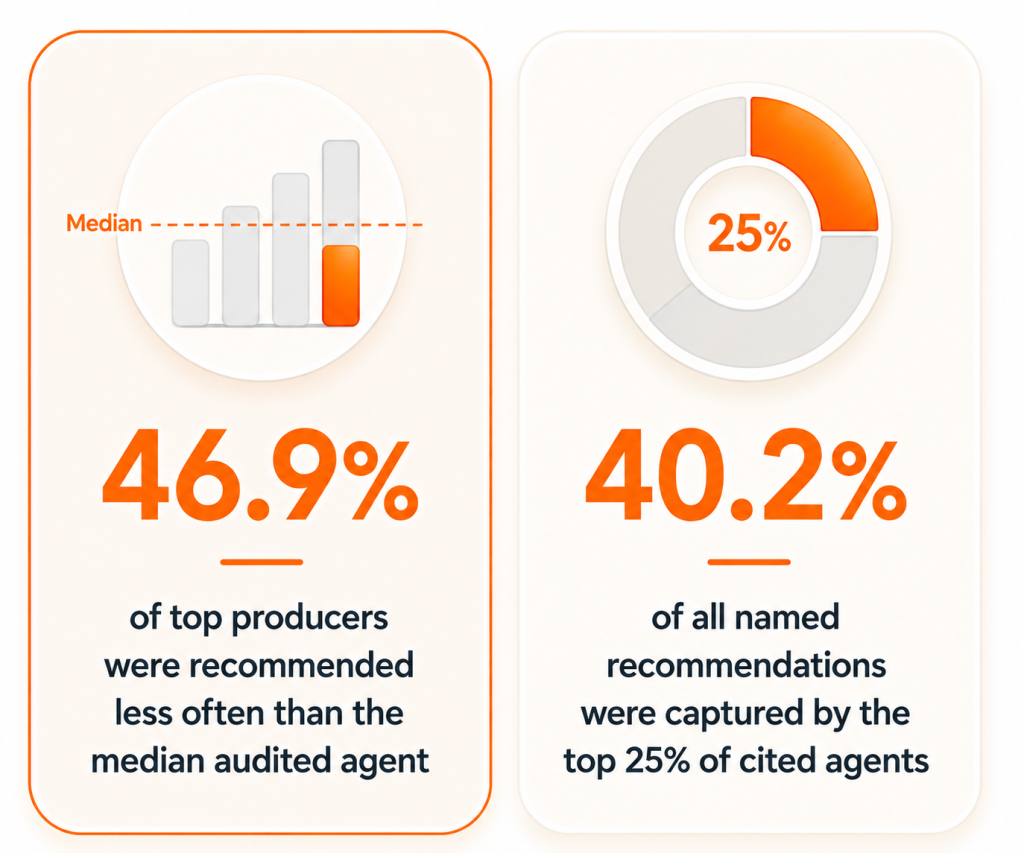
That doesn't prove sales production has no relationship to AI visibility. It demonstrates something narrower and far more useful: high production alone wasn't enough to guarantee high recommendation visibility in the audited responses.
A person can be commercially successful while the public information environment around them stays weak, inconsistent, or hard to retrieve.
That's an AI SEO problem. And most of the agents affected have no idea they have it.
Owned websites were a major citation source but not the only one
Portals took 22.2% of citation share in our source-category analysis. Agent-owned websites followed close behind at 19.6%, with Google Business Profiles and reviews at 15.2%, brokerage websites at 11.0%, local media at 10.6% and YouTube at 9.8%.
The principle behind that finding: the website matters enormously because it's the information asset the business controls most directly.
But it doesn't operate alone.
An entity gets described simultaneously by its own website, platforms, directories, reviews, media, videos and third-party profiles, which means AI SEO has both an owned-information problem and an information-ecosystem problem, and you have to work on both.
Different questions pulled different evidence
The source mix changed materially depending on the intent of the real-estate prompt.
Source mix by real estate prompt type
| Prompt type | Portals | Agent sites | Reviews | Video | Local media |
|---|---|---|---|---|---|
| Best Agent | 34% | 12% | 18% | 5% | 7% |
| Luxury Agent | 18% | 24% | 9% | 10% | 14% |
| Neighborhood | 14% | 25% | 16% | 15% | 17% |
| First-Time Buyer | 29% | 13% | 21% | 5% | 6% |
Broad "best agent" and first-time-buyer prompts leaned heavily on portals and review sources. Luxury and neighborhood prompts shifted toward agent-owned websites, video, and local media.
For my money, this is the most useful finding in the entire dataset, because it kills the lazy version of AI SEO: "get more citations."
The relevant evidence changes with the search context. A business trying to get selected for a technical query may need different evidence than one competing on reputation. A product comparison may pull different source types than a definition. A local recommendation may use different evidence than an industry statistic. The query determines what needs to be proven.
Different platforms also showed different source patterns
The Citation Index reported different source distributions across the five AI surfaces in its platform analysis. Perplexity showed a larger third-party component in our data, while the Google AI and Gemini samples had larger portal components.
Don't read that as a permanent weighting formula for those platforms. Read it as evidence that one AI visibility score can't describe a brand's presence everywhere. A company can be highly visible on one system and weak on another, because the available sources, retrieval systems, query interpretations, and responses all differ between them.
Accuracy was a separate problem from visibility
We found that 39.3% of the 5,004 audited recommendations had either no visible citation or only partial supporting evidence. Only 43.6% were categorized as fully verified with current, on-point support.
The audit also turned up stale brokerage information, unverifiable claims, outdated specialties, and flat-out incorrect information.
Being visible and being represented accurately are two different things, and AI SEO should care about both. A business appearing in a generated answer with an obsolete location, a former employer, or a wrong service is visible, and that visibility is doing commercial damage.
Accuracy, entity consistency and source freshness belong inside AI SEO measurement, not off in a separate housekeeping pile nobody checks.
What Does AI SEO Look Like in Practice?
AI SEO looks different depending on the entity, industry, and search intent being optimized. FlyDragon specializes in residential real estate, so our client work shows how the principles above translate into a live commercial search environment.
These are client case studies, not controlled experiments. Their results shouldn't be treated as guaranteed outcomes for another company or market.
FlyDragon AI SEO case studies
| Case | AI SEO principle demonstrated | Reported outcome |
|---|---|---|
| Nate Clark — Austin | Building a clear relationship between an entity and a genuine specialist topic: Nate Clark → probate real estate → Austin | FlyDragon's case study reports Nate becoming the top probate-realtor result across multiple AI platforms, followed by an inbound prospect who said she found him by asking ChatGPT for the best probate realtor. |
| Richard Berman — Reno | Recommendation visibility + supporting trust across a local commercial query network | Richard's case study reports roughly two AI-sourced listing opportunities per month, a first inbound within two weeks and a highest listing taken of $1.6 million. |
| Ben Lang — Michigan | AI search as part of an independent research journey before a prospect contacts the business | Ben's case study reports his first inbound in roughly 30 days, four to five high-intent contacts in the first 90 days and one approximately $890,000 transaction with estimated $53.4K GCI before brokerage splits. |
| April Aberle — Galveston | AI visibility influencing trust before the sales appointment rather than simply generating a click | April's case study reports weekly seller enquiries, two active AI-sourced buyers and prospects arriving at listing appointments having already researched her. |
The individual tactics differ from client to client, but the underlying pattern matches the broader definition of AI SEO every time.
How Do You Measure AI SEO?
Measure AI SEO with a combination of search visibility, AI visibility, source visibility, and commercial outcomes.
Traditional Search data still earns its place, because much AI-search discovery remains connected to search indexes and crawlable web content. Google has also started rolling out dedicated Generative AI performance reports in Search Console — as of June 2026, Google said these were reaching a subset of websites and could show impressions, pages, countries, devices and performance over time for generative AI features.
ChatGPT search referrals can be measured too: OpenAI says referral URLs from ChatGPT Search include utm_source=chatgpt.com, so publishers that permit OAI-SearchBot can spot the inbound traffic in their analytics.
But clicks alone won't capture every AI-search outcome.
Here's the fuller picture:
How to measure AI SEO
| Measurement | What it tells you |
|---|---|
| Traditional organic rankings | Whether underlying search visibility is improving |
| Search impressions | Whether content is being retrieved/displayed more often |
| AI citations | Whether a page is being used as visible supporting evidence |
| Brand/entity mentions | Whether the brand appears inside relevant generated answers |
| Recommendation share | How frequently the entity appears within a defined set of recommendation prompts |
| Source mix | Which sources are supporting visibility |
| Cross-platform consistency | Whether visibility exists beyond one AI surface |
| Accuracy | Whether generated claims about the entity are correct and current |
| AI referral traffic | Whether users click from AI search to the website |
| Branded search | Whether research may be creating subsequent brand demand |
| Leads and conversions | Whether AI visibility is producing commercial outcomes |
No single metric deserves to be called the AI ranking. A useful measurement framework tracks the same relevant query network repeatedly and watches what changes.
How Do You Start an AI SEO Strategy?
Start with the information architecture, not with publishing. A sensible implementation runs in this order:
- Define the entity and search context. Work out what the company, person or product should legitimately be associated with, who searches for it and which questions matter commercially.
- Measure the current search and AI baseline. Record traditional rankings, important AI prompts, mentions, citations, supporting sources and existing inaccuracies before you change anything.
- Fix technical discovery problems. Confirm the important information can be crawled, indexed and accessed by the search systems that matter to the business.
- Map the query network to canonical pages. Decide which questions belong together, which context deserves its own page, and how the pages connect.
- Improve the information itself. Add clearer definitions, comparisons, evidence, unique expertise, original data, appropriate media and genuinely useful answers where competitors remain incomplete.
- Strengthen and reconcile external evidence. Correct inconsistent entity information and build legitimate third-party corroboration where the search context calls for it.
- Measure, refresh and expand. Repeat the original query set, review which sources are appearing, spot new search journeys and improve the network from observed results rather than assumptions.
This order exists to prevent one specific mistake I see over and over: producing enormous quantities of content before knowing what information the search environment lacks.
Common questions
Can AI SEO Replace Traditional SEO?
No. Search-engine discovery, indexing, relevance, and quality remain foundational to the major AI-powered search experiences, so there's nothing to replace. Google explicitly describes its generative Search features as rooted in core Search ranking and quality systems.
Is AI SEO the Same as GEO?
They overlap substantially, and there is no standardized relationship between the terms. GEO usually refers specifically to visibility within generated answers, while AI SEO gets used more broadly for search optimization across AI-powered search experiences. Google acknowledges GEO as common industry terminology but regards optimization for its own generative Search features as SEO.
Is AI SEO the Same as AEO?
They overlap too, but AEO focuses more narrowly on becoming a useful answer to a question.
Answer Engine Optimization predates the current wave of generative AI — historically it covered direct-answer surfaces like featured snippets and voice answers. The modern use of AEO increasingly includes conversational and AI-generated answers as well. Search Engine Land similarly treats AI SEO as the broader discipline containing several related optimization concepts.
Does AI SEO Work for ChatGPT?
Websites can appear in ChatGPT Search, but no amount of optimization can guarantee that ChatGPT will cite or recommend a particular site for a particular prompt.
OpenAI says any public website can appear in ChatGPT Search and recommends allowing OAI-SearchBot when publishers want content discoverable and included in summaries and snippets. Eligibility and selection are two different things.
Do You Need llms.txt for AI SEO?
You don't need an llms.txt file to improve visibility in Google Search or Google's generative AI features.
Google's current documentation explicitly says it ignores llms.txt for Search, and that creating the file neither helps nor harms Google visibility. Other services can implement different standards, so the correct technical approach is always platform-specific.
Do You Need a Separate Page for Every AI Prompt?
No. A website doesn't need a separate URL for every conversational phrasing of the same search need.
Google says publishers don't need to capture every long-tail wording or rewrite content specifically for generative search, because its systems understand synonyms and general meaning. Create a separate page when the context, intent or information need genuinely deserves its own document.
Can AI SEO Guarantee a Brand Will Be Recommended?
No responsible AI SEO strategy can guarantee that an independent AI platform will recommend a particular brand, product or professional. Anyone promising otherwise is selling you something.
Generated responses vary by platform, query, user context, available information and time. Even meeting Google's technical and content requirements doesn't guarantee a page will be crawled, indexed or served. The job of AI SEO is improving the quality and availability of the information those decisions get made from.
How Long Does AI SEO Take?
There's no universal AI SEO timeline, and you should be suspicious of anyone quoting one.
A newly published page may be discovered quickly. Building broader entity associations, authority, external evidence and stable visibility can take considerably longer. Competition, existing authority, crawl frequency, information quality, platform and query type all move the result.
FlyDragon's client case studies contain examples of fairly fast results, including first inbound opportunities within weeks in individual real-estate campaigns. Those examples show what happened for those clients. They're not a reliable universal timetable, and we don't present them as one.
What Is the Most Important Part of AI SEO?
The most important part of AI SEO is creating the best possible information environment for the search needs you legitimately deserve to satisfy.
Technical optimization makes information accessible. Semantic structure establishes what it means. Topical coverage establishes the questions it answers. Original research gives the source unique value, independent evidence corroborates the important claims, accurate information keeps the entity consistent, and measurement reveals whether search systems are using any of it. None of those elements works well in isolation.
AI SEO is no hack for inserting a company into ChatGPT.
It's an extension of the work SEO has always done at its best: helping search systems retrieve the right information from the right source for the right need — now across search experiences that increasingly generate answers instead of only ranking pages.
How FlyDragon Applies AI SEO to Real Estate
FlyDragon specializes in applying these principles to residential real estate, where the entity being retrieved is often the agent themselves.
Our 2026 Real Estate AI Citation Index found substantial differences in which agents were surfaced, which source types supported them, how source mixes changed with query intent and how frequently recommendations were backed by incomplete or outdated evidence.
That research is why our approach starts with one question (what does the search system currently know about this agent, and what evidence does it have to support that understanding?) rather than "how many AI-written blogs can we publish?"
If you're a real estate agent, you can use FlyDragon's AI Visibility Scorecard to see how your own name is currently represented across the search journeys that matter in your market.
Be the business that AI recommends.
We help real estate brands become visible inside ChatGPT, Gemini and AI Overviews.
